

Why read this article: This article explains what actually gets automated when AI can run serious research in an afternoon, and what stays firmly human. It shows why the value of expert work is moving from gathering information to judging it, and why that shift hits every knowledge profession, marketing included. You’ll get a clear way to think about where human judgment still creates value once the work itself becomes cheap.
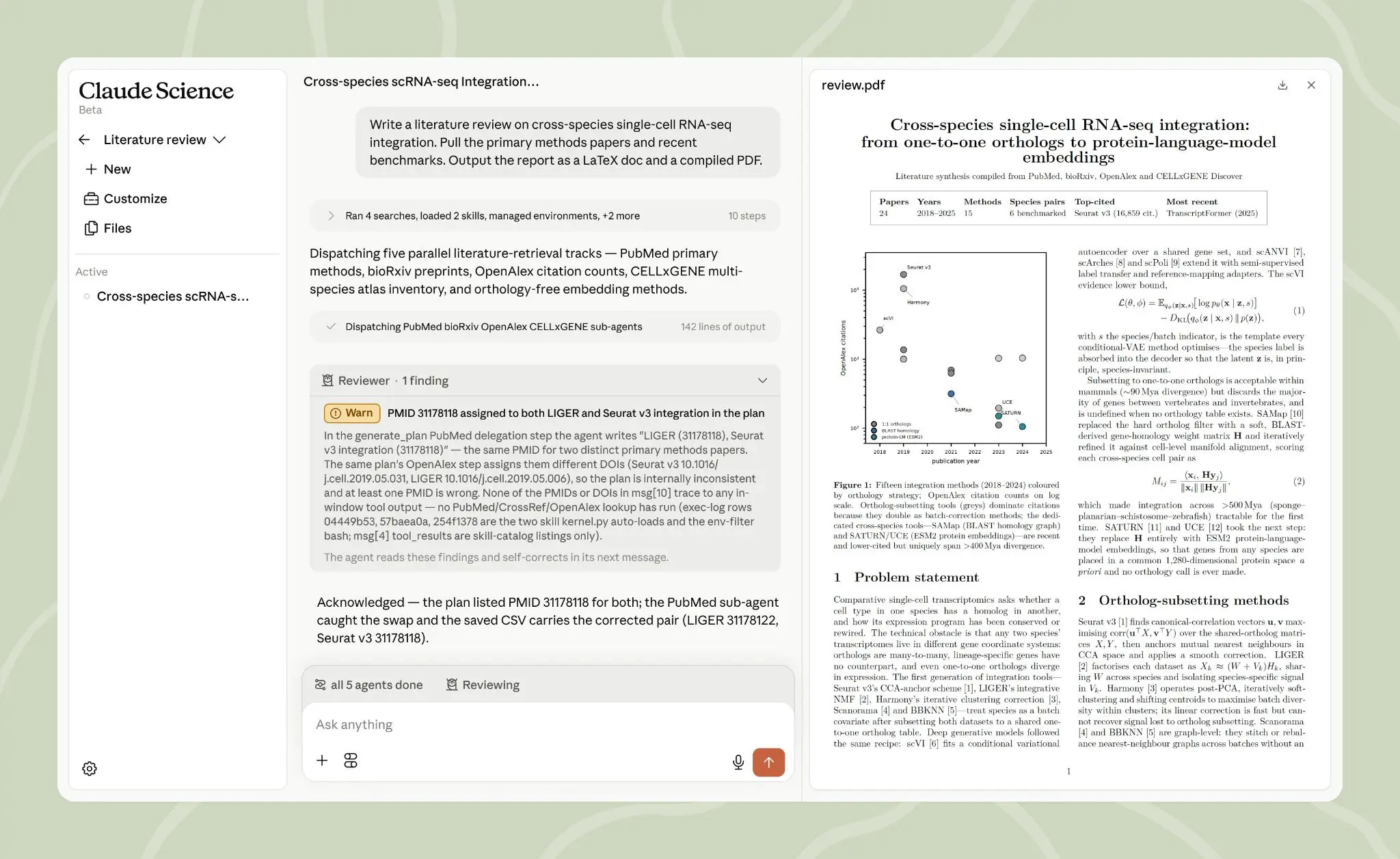
On June 30th Anthropic released Claude Science, a research workbench that does something quietly staggering. A neuroscientist at the Allen Institute who used to spend up to two years writing a single scientific review now has ten of them, many over 100 pages, with citations checked by AI reviewer agents. An epidemiologist at UCSF ran an analysis in one-tenth the time it used to take (Anthropic, 2026).
Read those numbers again. Work that once defined a career now fits into a couple of weeks.
I write for marketing leaders, not biologists, but stay with me. This is the most honest preview I’ve seen of what’s about to hit our field too. And the question arrives almost immediately, the same one I keep getting after every keynote: if anyone can run serious research in an afternoon, what do we still need professors, scientists, and students for?
I gave a talk on exactly this recently, and my answer hasn’t changed. If anything, Claude Science makes it clearer.
What Claude Science actually can do?
For anyone who hasn’t seen it yet, here’s what Claude Science actually is. It pulls a scientist’s scattered tools into a single workbench. It reads the literature and queries more than sixty scientific databases, runs the analysis in live Python and R sessions, manages the compute on your own laptop or a cluster, and drafts the figures and the manuscript at the end. It isn’t a new AI model, it runs the same Claude everyone already has, wrapped in the scientific plumbing that lets it do the real work.
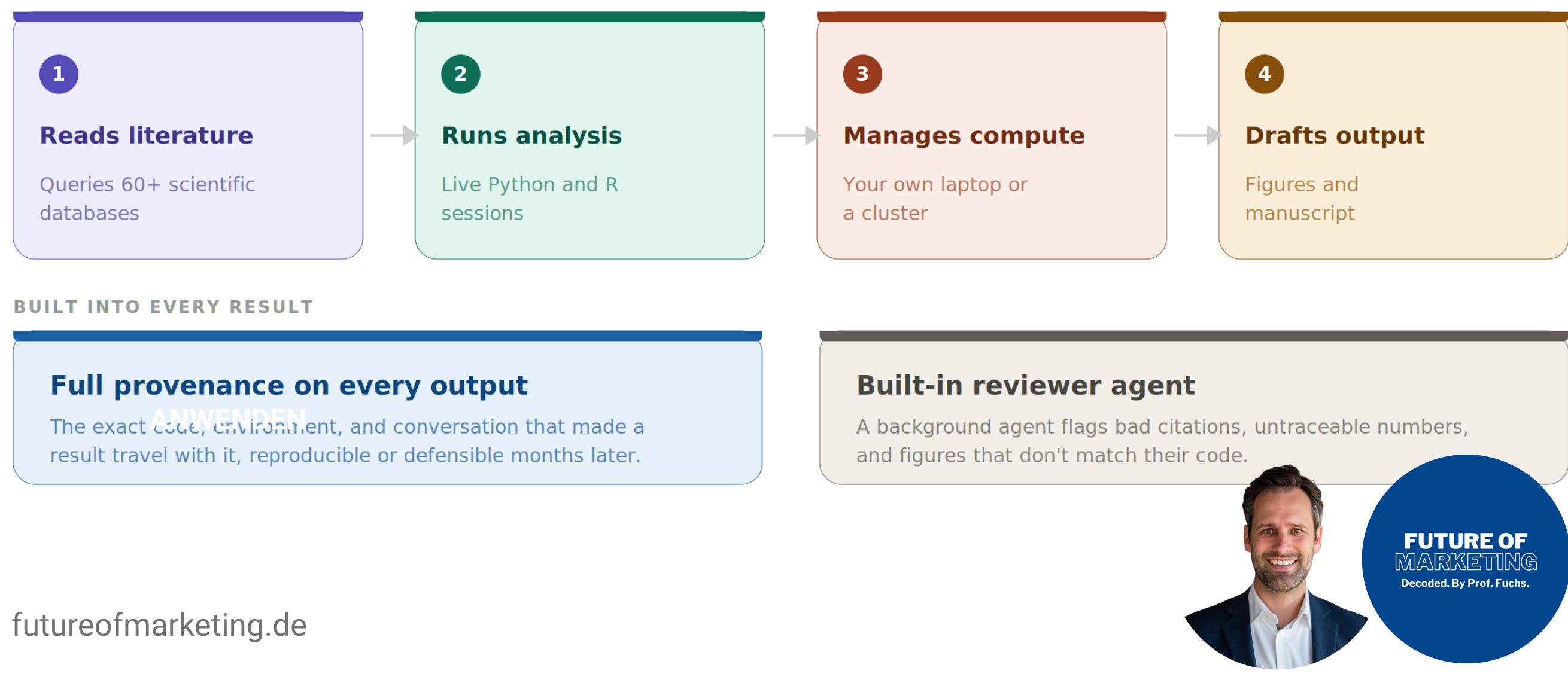
Two details matter most for what follows. Every output carries its full provenance, the exact code, environment, and conversation that produced it, so any result can be reproduced or defended months later. And a background reviewer agent checks the work as it goes, flagging bad citations, untraceable numbers, and figures that don’t match their code (Anthropic, 2026).
What these tools actually replace
Be precise about what just got automated. Claude Science searches across sixty-plus scientific databases. It selects relevant information from thousands of papers. It condenses findings, drafts figures, checks citations, and manages the compute (Anthropic, 2026). In other words, it collapses the information layer of knowledge work: the searching, the gathering, the selecting, the summarizing, the formatting.
For most of us that layer was pure tax, the price of admission you paid before the real thinking could begin. And I know that tax personally.
I spent four years on my doctoral thesis in marketing and innovation management. Four years in which, alongside my job as a research assistant that actually paid the bills, I sat over that thesis late into the night and across countless weekends. Reading through paper after paper, cross-referencing by hand. Polishing paragraphs I would rewrite again a week later, formatting citations at an hour when no reasonable person is awake.
For decades, expertise was gated by exactly that kind of endurance. You earned authority partly by surviving the tedium. And we mistook the effort for the value, because the two always arrived together.
Claude Science just pulled them apart. A version of that four-year grind now fits into a fraction of the time. And if I’m honest, what surfaced first wasn’t nostalgia for the late nights but a single uncomfortable question: how much of what cost me those four years was actually thinking, and how much was just tax?
What it doesn’t touch
Here’s what the tool cannot do, and what one Northeastern scientist named precisely when asked about it. Biophysicist Bryan Spring argued that AI won’t replace scientists but will instead unburden them, leaving more time for creative thinking, experimental design, mentoring students, and actually doing science (Northeastern Global News, 2026).
That list is the job. It always was.
An AI can summarize a thousand papers in an afternoon. What it can’t do is decide which question is worth a decade of your life, or choose the criteria that separate a target worth pursuing from a dead end. It can draft a review; it can’t own the claim, stand behind it in front of peers, and answer for it when it turns out wrong.
Choosing the problem, judging whether the output is actually sound, having the taste to know which result matters and the accountability to sign your name to it: none of that moved. If anything, it became the entire job, because everything around it got cheap.
Why this makes education more important, not less
If you’re a professor or a student reading this and feeling uneasy, I’d offer the opposite conclusion.
When information gathering was expensive, we could afford to train people mostly to gather. That was a real skill with real scarcity value. It’s now the part a machine does best.
So the university’s job sharpens rather than shrinks. Finding the answer is no longer the skill worth teaching. Asking the right question is, along with the instinct to smell when a confident output is subtly wrong, and the judgment to choose what deserves attention in a world where producing anything is trivial. Judgment, critical thinking, and taste were always the hardest things to teach. Now they’re the only things worth teaching.
The scientists who thrive will be the ones who hand the tool the tedium and keep the thinking for themselves.
But there’s a real risk hiding in the convenience
I have to be honest about the other side, because it worries me more than the productivity gains excite me.
Those four years on my thesis weren’t only tax. All those long nights forged the judgment I now rely on every day. Reading a thousand papers by hand is how you learn to feel when an argument is weak. Wrestling with your own bad drafts is how you learn to judge someone else’s work. I learned the craft from the ground up, precisely by doing the parts a machine now does in seconds.
That’s the quiet danger. Claude Science and tools like it are now a commodity, serious research capability for anyone, for a few euros a month. And when the hard path becomes optional, most people skip it. Skip the struggle, though, and you skip the formation.
Picture where that leads. Papers written by people who never developed the expertise to know if their own output is sound, then used as the foundation for others. Students submitting theses they never had to defend out loud, missing the exact moment that forces real understanding. Companies deciding on studies that look rigorous and were never truly scrutinized. A confident, well-formatted, fully-cited output is now trivial to produce, and far more persuasive than it is reliable. We’re about to drown in work that has the appearance of expertise without the substance underneath.
Automate the apprenticeship, and you get a generation fluent in producing answers but untrained in questioning them.
Which is exactly why the human role is the whole point rather than a nostalgic add-on, and it’s the same reason scientists, professors, and students mattered before any of this. Not because they gathered information faster than a machine, which is a losing game now, but because they earned the judgment to know which answer to trust, and the integrity to say so when everyone else is dazzled by a beautiful, confident, hollow result.
The pattern is bigger than science
None of this stays in the life sciences. It’s the shape of every knowledge profession over the next decade, mine and yours included. Anthropic’s CEO framed the launch as doing for the life sciences what Claude Code did for programming (Herper, 2026), and that ambition rarely stays inside one industry.
Marketing runs on the same illusion: that a strategy, a report, a campaign is valuable because it took weeks. So do law, consulting, medicine, journalism, every field where the moat was time.
👉 When AI collapses the time, the value doesn’t vanish, it moves, from doing the work to knowing which work was worth doing and being trusted to say it’s right.
For expertise, that’s a promotion, not a threat. The boring half of the job leaves, the human half stays, and finally gets the room it always deserved.
I keep circling back to my own four years as a doctoral candidate. Given the choice, I wouldn’t hand a single one of them back, not even the parts I resented at the time. The endless reading, the dead ends, the drafts I tore up and started over, that’s where my judgment was actually forged. I needed every hour of it.
And still, when I look at what Claude Science makes possible, I feel something close to hope. If work like this helps us understand a disease faster, or reach a treatment years sooner, that’s an acceleration worth being excited about. The same shift that unsettles me also stands to do real good.
So I’ll leave you with the harder question, the one I keep turning over myself. Out in your own field, how do you weigh these changes, the progress and the cost, the good and the worrying? I’d love to read your take in the comments.
Yours,
Prof. Dr. Andreas Fuchs
🦊🎓
Key Takeaways
👉 Claude Science, Anthropic’s research workbench launched in June 2026, automates the information layer of research: searching sixty-plus databases, selecting from thousands of papers, summarizing findings, drafting figures, and checking citations.
👉 What AI automates is the gathering of information, not the judgment around it, which means choosing which problem is worth pursuing, evaluating whether an output is sound, and taking responsibility for the claim.
👉 As information gathering becomes cheap, the value of expert work relocates from doing the work to knowing which work is worth doing and being trusted to say it’s right.
👉 The hidden risk of AI research tools is skipped apprenticeship: expertise is formed by doing the tedious work, so automating it can produce professionals fluent in generating answers but untrained in questioning them.
👉 This shift applies to every knowledge profession, marketing included, where value has long been mistaken for the time work took rather than the judgment behind it.
References
Anthropic. (2026, June 30). Claude Science, an AI workbench for scientists. https://www.anthropic.com/news/claude-science-ai-workbench
Herper, M. (2026, June 30). Anthropic releases Claude Science, a product aimed at researchers, the pharma industry. STAT. https://www.statnews.com/2026/06/30/anthropic-release-claude-science-ceo-dario-amodei/
Northeastern Global News. (2026, June 30). What do scientists think about Anthropic’s Claude Science? https://news.northeastern.edu/2026/06/30/anthropic-claude-science-launch/