

For the last decade, marketing has transformed the supply side: Stacks expanded. Data pipelines matured. AI entered many workflows. Companies built CDPs, orchestrated journeys, automated funnels, sequenced emails, enriched profiles, and optimized attribution.
Yet customers still behaved as if nothing had changed.
The next transformation will not come from marketers. It will come from customers:
From how they decide.
From how they search.
From how they delegate.
AI enters the journey not as a tool, but as a proxy mind. Agents of Customers will filter reality on behalf of humans, deciding what is visible, what is credible, and what is worth considering.
With this paradigm change, the foundations of brand building and customer acquisition are not merely evolving. They are dissolving into a new logic.
Today’s Customer Journey: Heavy. Manual. Outdated.
Marketing has evolved at an extraordinary pace. Customer behavior has not. Despite a decade of technological progress, a person searching for a product still must:
gather information
compare alternatives
filter noise
assess credibility
match choices to personal preferences.
It is a cognitive marathon disguised as shopping.
Meanwhile, the systems around this process have grown endlessly more complex. Yet the burden of making sense of this complexity still rests entirely on the human.
Even advanced marketing organizations continue to struggle with fragmented data, inconsistent channels, and disconnected systems that impose unnecessary cognitive load on customers.
Source: McKinsey (2025).
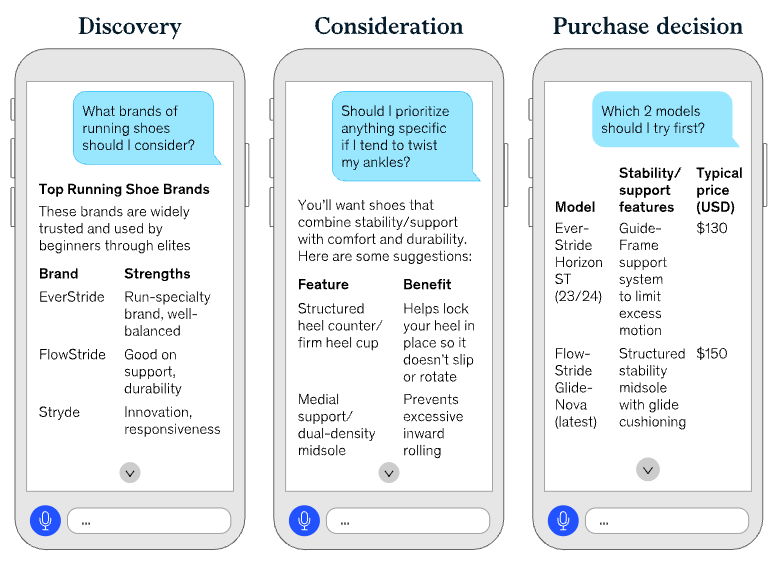
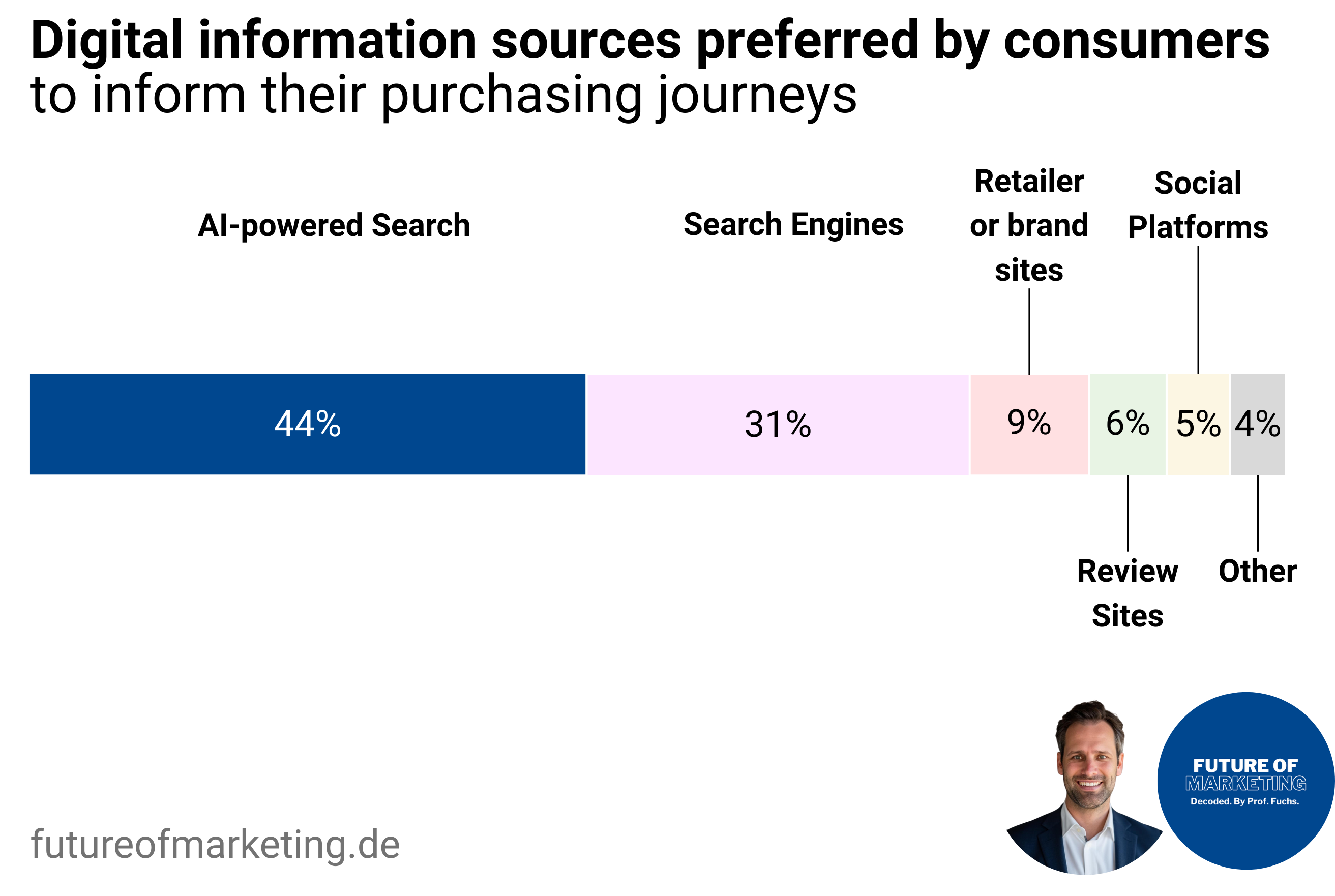
Half of all consumers already use AI-powered search, across all age groups. And AI-powered search is now the most preferred digital information source, surpassing traditional search engines (44 percent vs. 31 percent), as shown below:
Source: Own visualization based on McKinsey (2025).
The Bruce Wayne Way of Buying
Imagine you had 30 million euros in your bank account.
How would you shop?
You would not!
You would not compare washing machines. You would not decode airline pricing. You would not analyze car benchmarks at night.
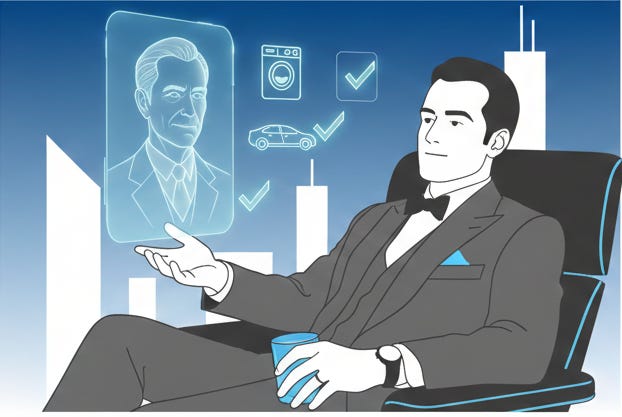
Someone else would do it for you. In the world of billionaire Bruce Wayne’s, that someone is Alfred … not just a butler, but a trusted cognitive proxy. He
absorbs complexity,
evaluates options,
and presents only refined conclusions.
This is the shift AI brings to everyone. It does not merely automate tasks. It automates Bruce Wayne’s butler Alfred.
AI-powered search already performs this work: synthesizing reviews, comparing features, extracting insights, and shaping recommendations before the user sees a single page.
What was once a privilege becomes a default:
In the future, every consumer becomes Bruce Wayne.
Not economically. Cognitively.
Because the real privilege is not money. It is the ability to delegate thought.
The Future Customer: Assisted. Delegated. Augmented.
Consider the customer journey in the near future. Customers will no longer evaluate options manually. They will no longer crawl the internet for comparison tables. They will no longer carry the cognitive burden of decision-making themselves.
Instead, that burden shifts to an intelligent agent acting entirely in their best interest. A shopping assistant. A travel planner. A personal operating system.
Not the brand’s agent … The customer’s personal agent
A system that understands constraints, preferences, budgets, values, and behavioral patterns.
A system that analyzes thousands of SKUs, reviews, specifications, and price histories in milliseconds.
A system that negotiates trade-offs and surfaces only what truly fits the individual.
And this is not a distant scenario. It is already happening:
Across major consumer categories, 40 to 55 % of buyers now rely heavily … or even exclusively … on AI-powered search as they make purchasing decisions.
In other words, the shift has already begun: Agents start curating.
At the moment this delegation becomes the norm, customers stop searching. Brinker & Riemersma (2025) describe these emerging systems as Agents of Customers, autonomous intermediaries reshaping the buyer’s journey outside the visibility of marketers.
From User Journey to Agent Journey
Today the customer journey still looks like:
trigger → search → evaluation → purchase → loyalty.
A linear model built around human effort, human cognition, and human comparison. But this sequence is already starting to dissolve. In an agent-mediated world, the journey no longer begins with a search. It begins with intent.
Soon it becomes:
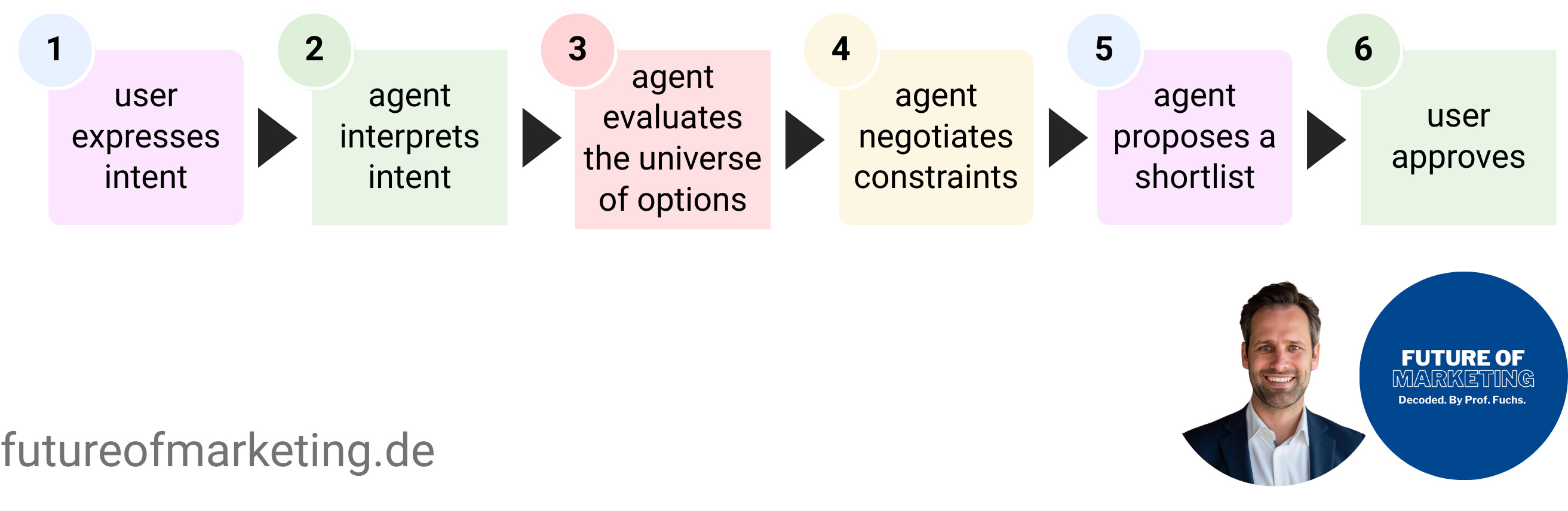
The journey becomes machine-first, not human-first.
The human no longer navigates the landscape of information. The agent does.
These agents increasingly operate upstream, outside brand-controlled systems, remixing information and preparing decisions long before customers ever see a webpage.
This raises a new question: Who are these agents now acting on behalf of the customer?
Customer AI Agents in Marketing
The rise of Agents of Customers does not create one assistant.
It creates an ecosystem of AI agents, each shaping a different dimension of the decision-making process. These agents do not merely support the customer. They increasingly replace the customer in the upstream work of evaluation.
Here are the major categories redefining the journey:
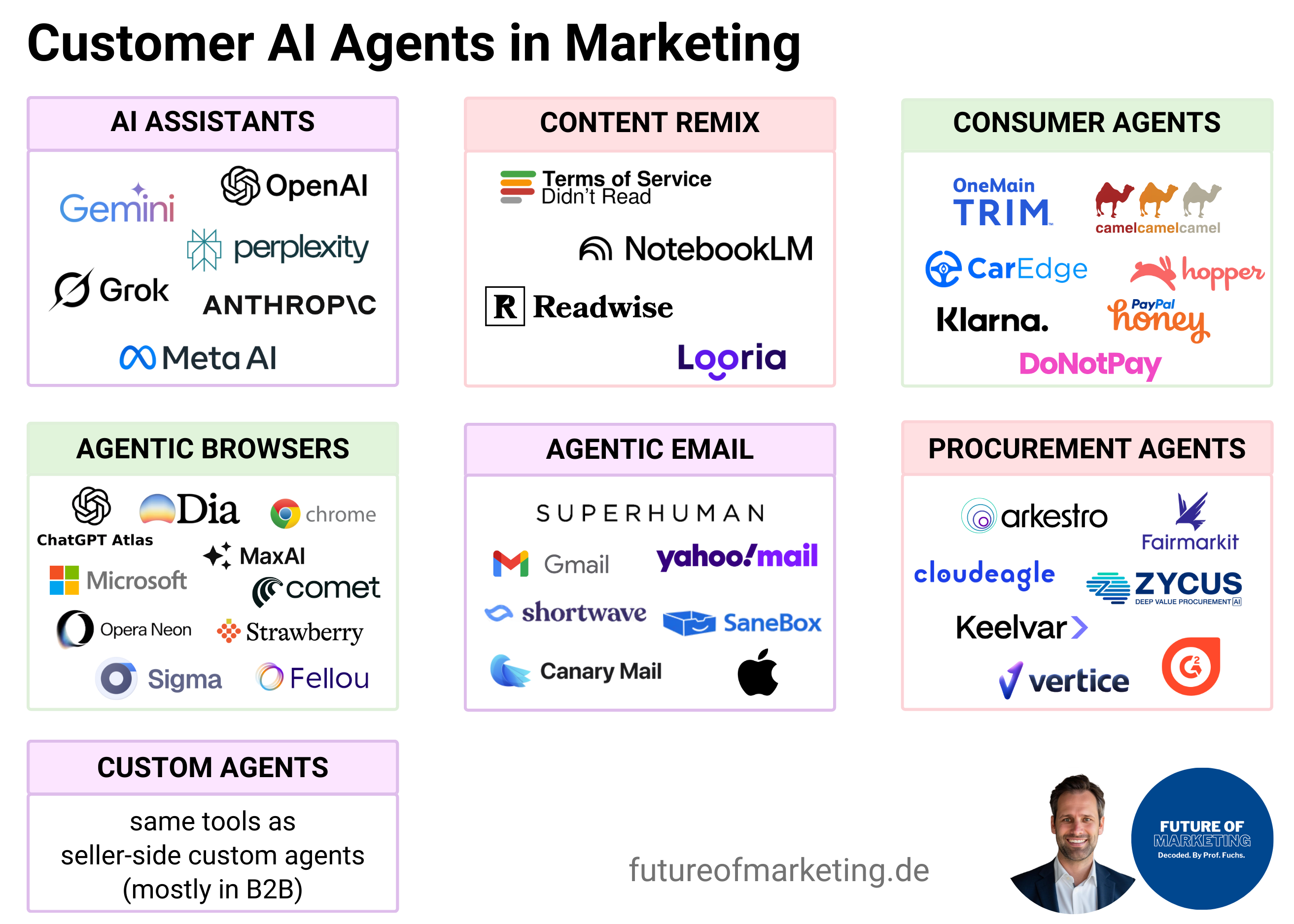
Source: Own visualization based on Brinker & Riemersma (2025).
AI Assistants (The Generalists): Systems like ChatGPT, Gemini, Perplexity, and Claude function as broad cognitive scaffolds. They interpret intent, refine queries, generate comparisons, extract meaning, and frame decisions. These assistants represent the first moment of delegation … the point where customers stop searching and start asking.
Content Remix Agents (The Synthesizers): Tools such as NotebookLM, Reafwise, or Looria process the world as streams of unstructured information. They condense articles, videos, product specs, reviews, manuals, and tutorials into coherent guidance. They do the one thing no human can do effectively at scale: they metabolize the entire informational universe.
Consumer Agents (The Decision-makers): Services like TRIM, Klarna, Hopper or Donotpay focus on specific domains of everyday life. They optimize decisions end-to-end. These agents are not informational. They are operational. They turn consumer intent into action.
Agentic Browsers (The Autonomous Explorers): Browsers like GPT Atlas, Opera Neon, Sigma or Dia explore the web without the user present. They audit sites, scrape data, verify claims, compare prices, and return only what survives their evaluation. They do not show the internet to the customer. They show a filtered internet to the agent.
Agentic Email (The Filters and Negotiators): Agents embedded in tools like Superhuman, Shortwave, Gmail or Canary interpret offers, prioritize messages, summarize threads, and manage outreach. They act as the gatekeepers of commercial communication. Every pitch, promotion, and brand message now passes through an agentic filter.
Procurement Agents (the B2B forerunners): Platforms like Keelvar, Vertice, Zycus or Arkestro automate negotiation, supplier selection, and contract optimization. Historically B2B, these logics are now migrating into consumer markets.
Across these categories, a single pattern becomes clear: The customer is no longer the primary evaluator of information. Their agents are.
McKinsey quantifies the shift: 20 to 50 % of traditional organic traffic is now at risk, because decisions increasingly occur inside AI interfaces rather than on websites. The funnel collapses into the agent.
Branding in the Age of AI-Mediated Customers
Brands evolve into systems of validated data, trusted signals, consistent patterns, and reliable performance … and AI agents evaluate these signals long before a human ever encounters the brand.
Branding will not disappear. It will become structural.
A brand’s meaning shifts from the consumer’s mind to the computational layer that filters reality for them. Brand equity becomes machine-interpreted equity. Perception becomes pattern recognition.
The consequences are clear: even leading brands lose visibility when their data models misalign with AI retrieval. One major sportswear brand falls to an AI visibility index of –0.6 compared to market share (McKinsey)
Storytelling still matters for humans. But schemas matter more for machines. And increasingly, the schema determines what the human will ever see.
What Marketers Must Do Today
Customer agents change the rules of marketing. The question is no longer how to persuade customers, but how to make your brand legible and recommendable to their agents.
Three priorities define this shift:
Design for agents and humans simultaneously: AI systems reward clarity, structure, precision, and semantic richness. If your content cannot be parsed, it cannot be recommended.
Build trust signals into everything: Agents privilege facts over storytelling …
verified attributes, transparent pricing, consistent product data, validated claims. Ambiguity is a filter-out, not a friction.
Shift from funnels to systems: The journey is now delegated, compressed, agent-driven. Relevance emerges from the ecosystem that surrounds the customer … their assistants, browsers, email agents, and procurement logic. Yet only 16 percent of brands track their AI visibility, giving early adopters a structural advantage.
Conclusion
Customer agents change everything. They filter reality, evaluate options, and shape decisions long before a human enters the journey.
This does not adjust the old marketing model … it replaces it with a machine-first architecture of choice. Brands no longer compete for attention first, but for legibility, trust signals, and inclusion in an algorithmic shortlist.
Most organisations will keep optimising for yesterday’s customer journey. A few will build for the agent-driven one … and they will define the next decade.
And for a while, we must serve both worlds: the human journey we know, and the agentic journey emerging around it. Begin building for the agents that will soon shape every customer journey.
Long before the customer chooses you, their systems will.
Prepare for that world now.
Yours,
Prof. Dr. Andreas Fuchs 🦊
The problem I still have with the AI agent ecosystem is that it’s so fragmented.
What I really want is one single input field (like in ChatGPT or Lovable) where I can describe a goal, and then my agents handle an entire marketing campaign from start to finish. For example, they should take care of attribution, setting up dashboards, defining the bidding strategy, selecting audiences and keywords, and even creating the visuals and copy 😃
At the same time, I want to stay in the loop so I can manually review and improve things. That way, I’d truly have a team of agents doing the grunt work, while I focus on refining and optimizing the results.
Maybe something like this is out there but it’s too complex to build this amount of workflows between so many tools.