

The Beginning: Every Startup Is a Promise
Every startup begins not with a product, but with a promise — a promise that something could be done differently, maybe even better. Between a brilliant idea and true customer love lies the hardest part of all: the early stage. It is the desert between inspiration and traction. No brand. No trust. No money. Just a handful of people, an unfinished product, and a vision that feels both exciting and impossible.
And yet, this is where real marketing begins. Not the marketing of campaigns, but the marketing of understanding.
Because marketing, at its core, is not about shouting louder — it is about listening better. It is not about creating desire — it is about revealing truth.
If you are a founder in this phase, this guide is for you. Below are the ideas, tools, and examples I share in my talks — five principles that turn early chaos into clarity and help you go from zero to genuine customer love.
What Makes a Startup a Startup?
A useful reset before we talk tactics. A startup is not a small version of a big company. It’s a temporary organization searching for a repeatable, scalable business model. That search defines everything: you have limited resources, extreme uncertainty, and a market that doesn’t yet know (or trust) you.
Typical starting conditions:
Little or no brand equity
No market trust (yet)
Tiny team, tiny budget
Innovative idea + scalable model (in theory)
Often reliant on external capital (angels, seed, VC)
This reality matters because it changes what good marketing looks like. Early on, you’re not optimizing funnels at scale; you’re collecting truth. Later, you’ll scale what’s true.
Startup Phases and the PMF Threshold
Think of two worlds separated by one milestone:
Early Stage (Pre Product/Market-Fit): You are searching for Problem/Solution Fit and then Product/Market Fit. The job: Learn & Validate.
Late Stage (Post Product/Market-Fit): You have traction and retention signals. The job: Systemize & Scale.
A rough benchmark many teams use for PMF is when usage and retention stabilize and revenue shows repeatability (often cited around ~1.5M ARR for SaaS; your mileage may vary).
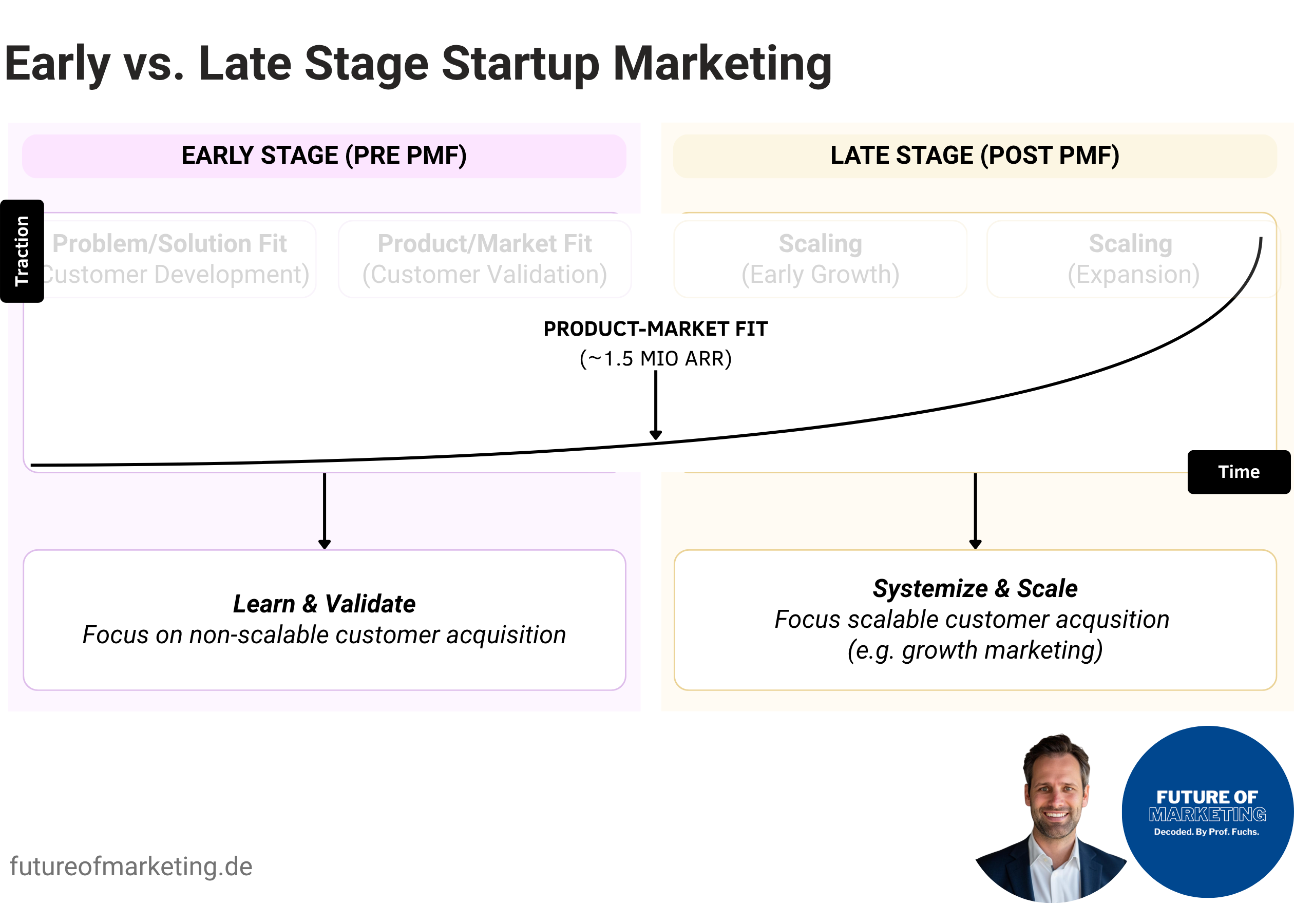
Why the distinction matters: Because activities and KPIs differ:
Pre-PMF KPIs: validated interviews, early access signups, activation, retention, NPS, usage frequency, qualitative insights.
Post-PMF KPIs: CAC, LTV, CAC/LTV ratio, ROAS, conversion funnel health, ROMI, market share, brand awareness, country-level expansion KPIs.
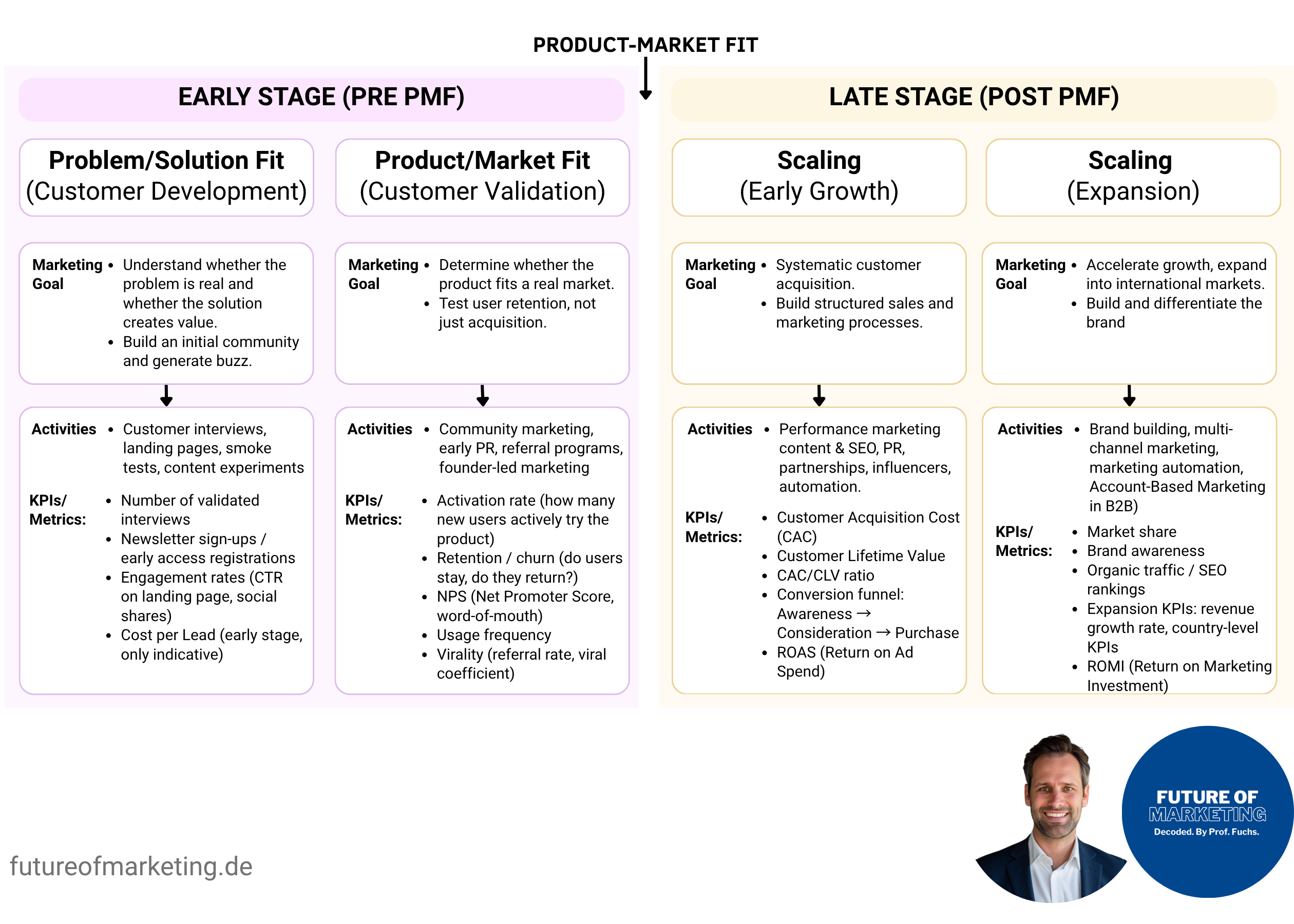
Early stage is about evidence. Late stage is about effective growth.
Practical Guide to Earn Customer Love (5 Principles)
Here’s your playbook: just 5 principles - not more:
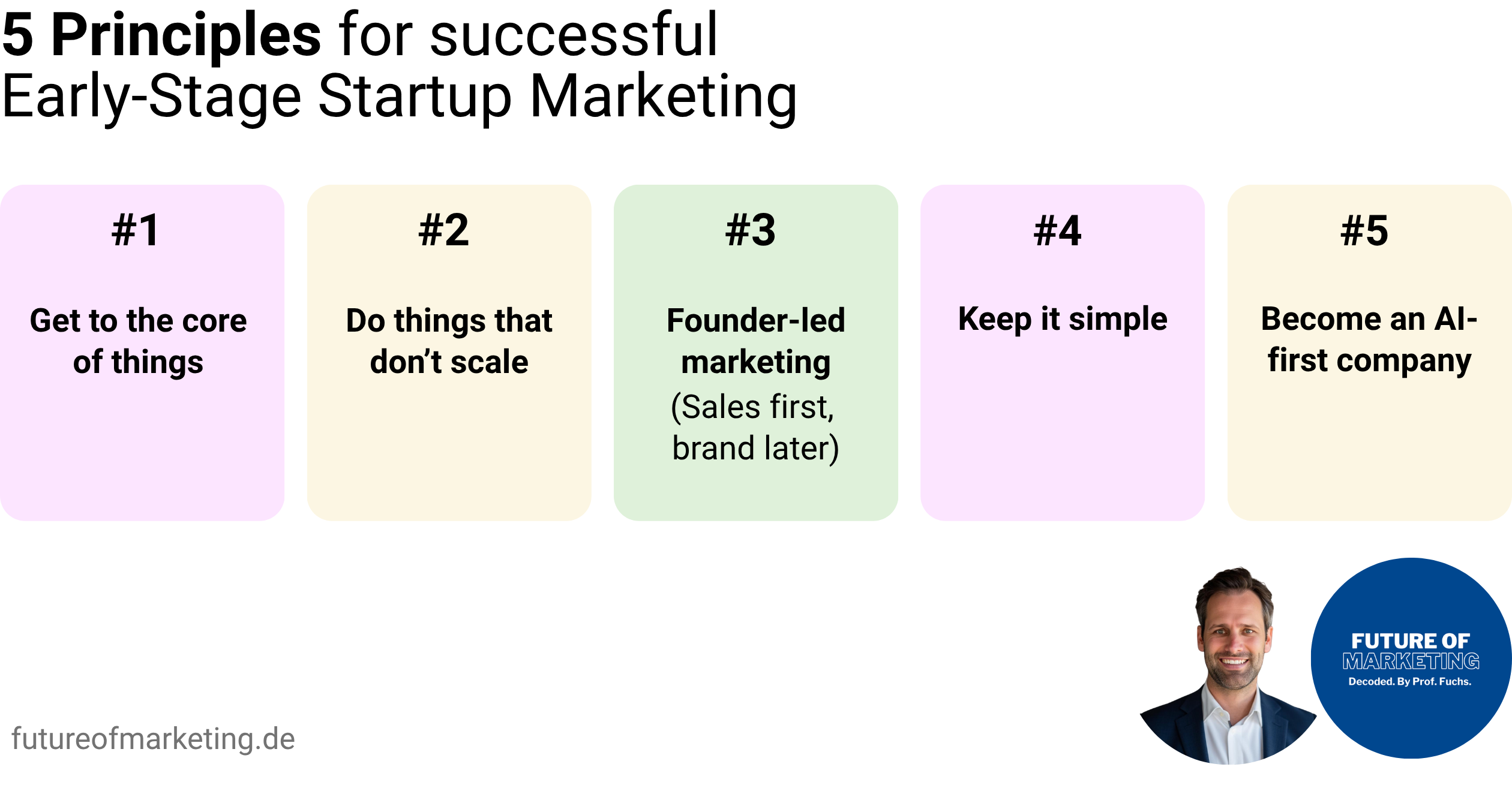
#1 Get to the Core: Validate Before You Scale
Don’t scale what you can’t validate. The startup graveyard is full of teams that “marketed” too early, too broadly, too expensively — without ever confirming that the problem mattered enough or the solution created real value.
How to work:
Know the problem: State a specific hypothesis you can test.
Know your customer: Talk to them, observe them, co-create with them.
Build a community: Start small, gather early fans, keep a tight loop.
Example ZeroLabs - From Idea to Validation:
ZeroLabs, a German non-alcoholic beer startup, began with one clear hypothesis:
“Many people want to drink less or no alcohol — without giving up the taste, authenticity, or social experience of beer.”
The founders, Moritz Keller and Max Wittrock, saw a growing demand for healthier lifestyles paired with frustration over traditional non-alcoholic beers. Wittrock, a serial founder known for mymuesli and Yokolade, brought deep expertise in brand building and consumer insight — knowing exactly how to translate cultural shifts into successful products.
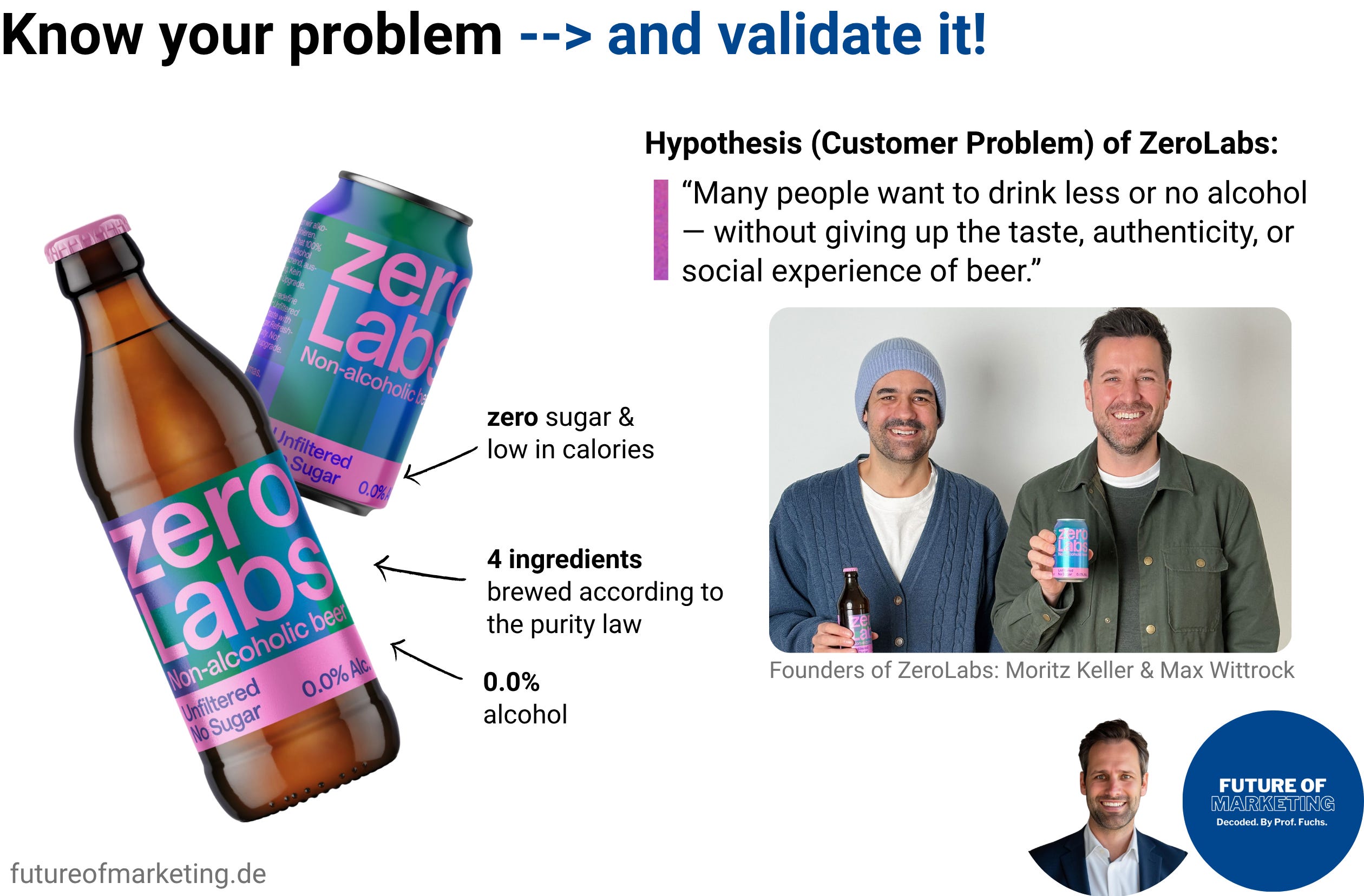
They validated their idea through interviews, community engagement, and early prototypes. The feedback was clear: people didn’t want a compromise, they wanted a modern, authentic alternative.
The product became the proof of that insight:
Best ingredients + best brewing = a taste even better than regular beer
0.0% alcohol and zero sugar
A fresh, modern brand design appealing to a new generation of mindful drinkers.
By sharing their journey openly, ZeroLabs turned early followers into loyal advocates.
The takeaway: great marketing in the early stage isn’t about noise — it’s about empathy, validation, and building real trust and a community from day one.
Skills that matter: empathy, research, analytical thinking, community leadership.
#2 Do Things That Don’t Scale (Before You Try to Scale)
In the beginning, the fastest way to learn is not automation — it’s proximity. You can’t understand your customers from dashboards alone. You have to talk to them, watch them, and sometimes even sell to them directly.
Paul Graham’s (founder of Y Combinator) famous startup mantra captures it perfectly: “Do things that don’t scale.” In the early stage, success is built on unscalable work — the manual, personal, time-intensive actions that reveal what truly matters to your users.
What to do:
Onboard your first users yourself.
Reply to every email and feedback message personally.
Host small events, meetups, or live demos.
Run 1:1 interviews or “concierge tests”.
build solutions by hand before automating them.

Example: Tinder’s early growth:
Before Tinder became a global app, its founders went door-to-door at college sororities, hosting in-person “Tinder parties.” The app only worked if you showed it at the entrance. It was raw, personal, and brilliantly targeted — a small, specific market before mass scale. I highly recommend reading this brilliant article by the amazing Scott D. Clary.
What you gain: You collect truth, not assumptions. You build early trust, understand friction points, and discover what makes people care. That’s the data that later powers real growth.
Skills that matter: creativity, adaptability, persistence.
#3 Sales First, Brand Later via Founder-Led Marketing
Early on, willingness to pay > vanity reach. Your brand will matter deeply over time, but pre-PMF the fastest path to traction is often your personal credibility as a founder. People follow people.
A mini-playbook:
Pick your topic and become the visible authority.
Create visibility: podcasts, panels, interviews, niche media, guest essays.
Use your story as the trust vehicle.
Post consistently on the one platform where your buyers live (e.g., LinkedIn).
Be active in relevant communities and associations.
Personality + expertise + consistent visibility → relevance and inbound interest, without big budgets.
Outcome: authentic presence, proximity to buyers, early revenue proof.
Skills that matter: personal branding, thought leadership, community building.
#4 Keep It Simple — Focus as a Survival Strategy
The early stage will tempt you with a thousand tactics. Resist. Choose one or two channels where your audience already spends time and master them before adding more. Depth always beats breadth.
Why this works:
You learn faster (tight feedback loops).
You save capital and time.
You can clearly attribute results and optimize.
In the beginning, prioritize pull channels — the ones that attract already-interested users (search intent, niche newsletters, communities, partner distribution) — instead of push tactics like cold outreach or broad ads. But the mix is key.
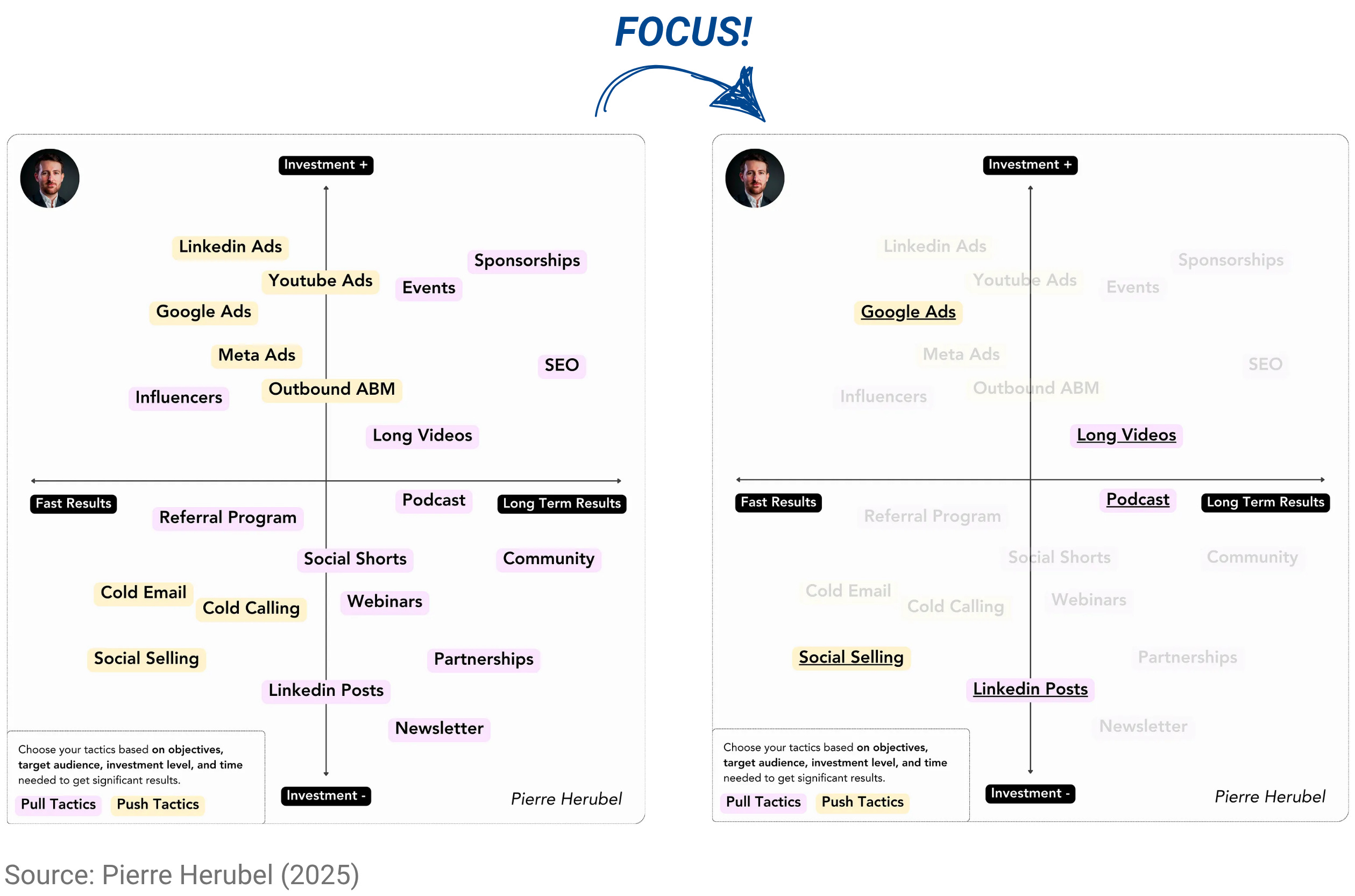
The illustrations above come from Pierre Herubel, one of the sharpest marketing thinkers out there. No one visualizes complex marketing ideas more clearly than Pierre. You should absolutely check out his work & content guides … it’s a masterclass in clarity and focus.
In short: focus is your unfair advantage: it keeps your startup alive long enough to win.
Skills that matter: prioritization, discipline, analytical thinking.
#5 Become an AI-First Company
Most startups use maybe 1% of the current AI potential. That’s good news: the efficiency gap is a competitive advantage waiting to be claimed.
Think of three layers:
AI Agents: small, specialized assistants that write, analyze, enrich, route, and decide inside your workflows. “Our marketing team is just me and ~40 AI agents” (Jacob Bank) is no longer a joke; it’s a strategy. Tools like n8n, make, Workato, or Zapier connect your stack; agents add the brains. Here’s Jacob’s 40 AI agents armada:
Video source.
👉 Check out my step-by-step guide on how to automate your marketing & sales.
Prompt Libraries: a shared, evolving repository of great prompts (and examples) in Notion or similar. Benefits: consistent quality, faster output, scalable know-how. The great Tom Orbach has created a fantastic how-to on building prompt libraries.
No-Code + AI Builders: create assets (landing pages, microsites, simple apps) in hours, not months, using tools like Lovable alongside your automation platform.
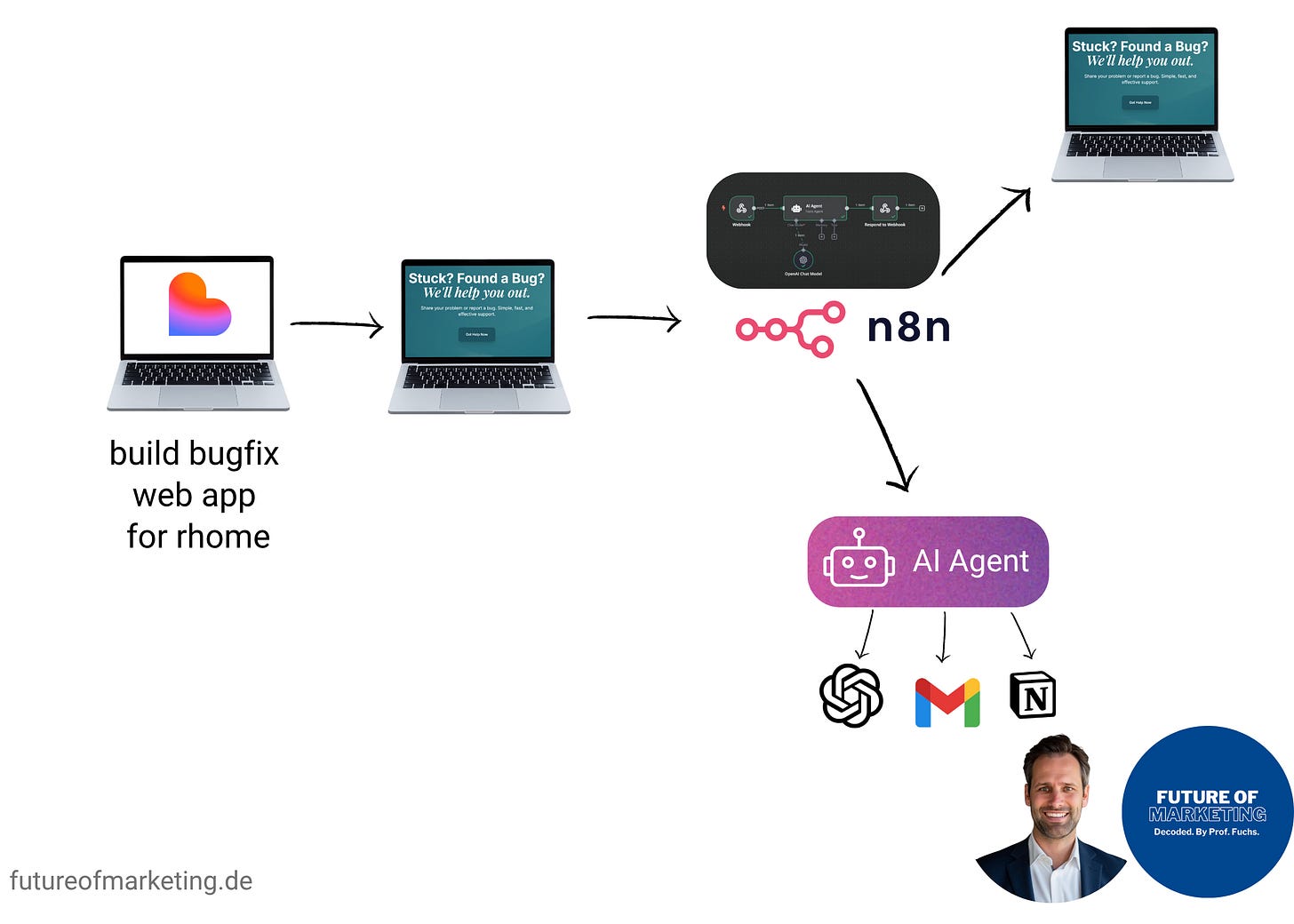
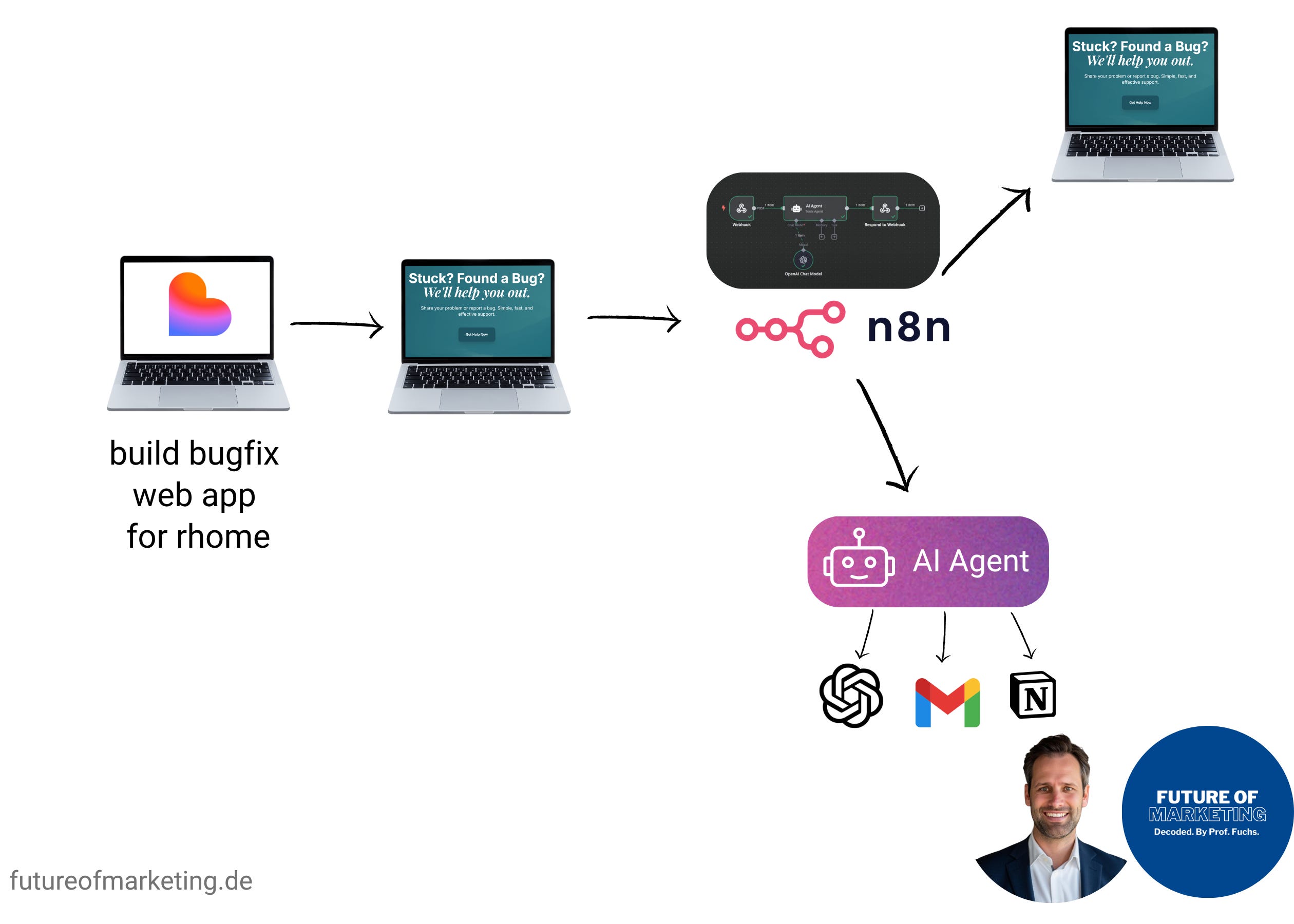
Here’s an example of how I built a bug report web app with Lovable for the global mobility HR tech startup rhome — literally in five minutes:
The exciting part is that with tools like n8n, we can now make this web app intelligent within just a few hours by connecting an AI agent and a Notion database that together handle customer interactions and data seamlessly.
Here’s a quick blueprint of how that could look like:
Skills that matter: process thinking, prompt design, no-code automation, testing mindset, learning agility.
Review these questions weekly:
Evidence: What did we validate this week?
Users: How many conversations/concierge onboardings did we run?
Activation/Retention: Are early users using the product again? Why/why not?
Focus: Which one or two channels are working? What’s the next test?
Leverage: Which manual task did we replace with an AI agent or automation?
Key Takeaways (based on the 5 principles)
#1 Get to the core of things … for true customer love 🍏: Validate before you scale. State a crisp problem hypothesis, then prove it or disprove it with real users.
#2 Do things that don’t scale ⏱️: Earn truth the hard way. Manual, unscalable work yields the insights you’ll later encode into systems.
#3 Sales first, brand later … with founder-led marketing 💬: Lead with sales signals, not vanity reach. Founder-led marketing builds trust fast and cheaply.
#4 Keep it simple 🧩: Win by focus. Master one or two channels; expand only when they truly work.
#5 Become an AI-first company 🤖: Use agents, prompt libraries, and no-code tooling to multiply the power of a tiny team.
Early-stage marketing is a craft.
Early-stage marketing is not a campaign. It’s a craft. You are not buying reach; you are earning reality. You are building a shared language with a small group of people who feel the same problem you do — and trust you enough to try your solution. If you do that well, scale is not the next miracle; it’s the next step.
👉 Want a bonus audio deep dive on this topic? Subscribe and comment audio deep dive below — I’ll send it straight to your inbox. #DoThingsThatDontScale
👉 And if this resonated, restack or share it with a founder who’s walking through the desert right now. They might just need a map.
Yes, I relate to this a lot. I can see that I’m personally struggling with some of these challenges.
Especially the trust-building part in the early stage. I agree that real trust takes time and genuine interaction. It’s not something you can shortcut with ads or surface-level visibility. It requires conversations, presence, and consistent follow-up.
Do you have any book or resource recommendations on how to build these kinds of early relationships effectively? Something practical on earning trust and forming meaningful connections in the early stage would be helpful.
I’m also thinking about the time trade-off. Time is limited, and in the beginning you need to invest heavily both in talking to users and in building the product. Balancing user conversations with execution is demanding, especially when both require deep focus and energy. I’m still trying to figure out how to manage that tension in a sustainable way.
This is great information! I’ve been running my own consulting portfolio business for a year and a half - after is was my side gig for about a decade. I’d love your eyes on my stack and website.