Generative Engine Optimization (GEO)
The 5-Step GEO Playbook for the Age of AI Search
The Great Shift: From Search to Synthesis
For two decades, digital marketing followed one rule: rank high, get the click.
Users typed queries, Google listed ten blue links, and the goal was clear: be among the top three results. That world is disappearing.
The rise of Large Language Models (LLMs) such as ChatGPT, Perplexity, Google’s Search Generative Experience (SGE) or Gemini, and Microsoft Copilot is fundamentally changing how information is retrieved and presented.
Instead of showing ranked results, these systems now generate complete answers. They do not just point to information; they synthesize it, cite it, and deliver it instantly inside the interface.
This creates what marketers now call the Zero-Click Reality. When AI summaries appear, users often never leave the page. Even the #1 Google result might never be seen. Your content is no longer the destination; it is just one of the sources behind the machine’s answer.
That is why a new discipline is emerging:
Generative Engine Optimization (GEO, LLM SEO or GAIO): It is defined as the process of optimizing web content to maximize its visibility, citability, and prominence in the synthesized answers generated by AI search engines.
Or in short: the art and science of getting your content cited inside AI-generated answers.
👉 we are no longer optimizing for a machine that ranks links, but for one that synthesizes knowledge.
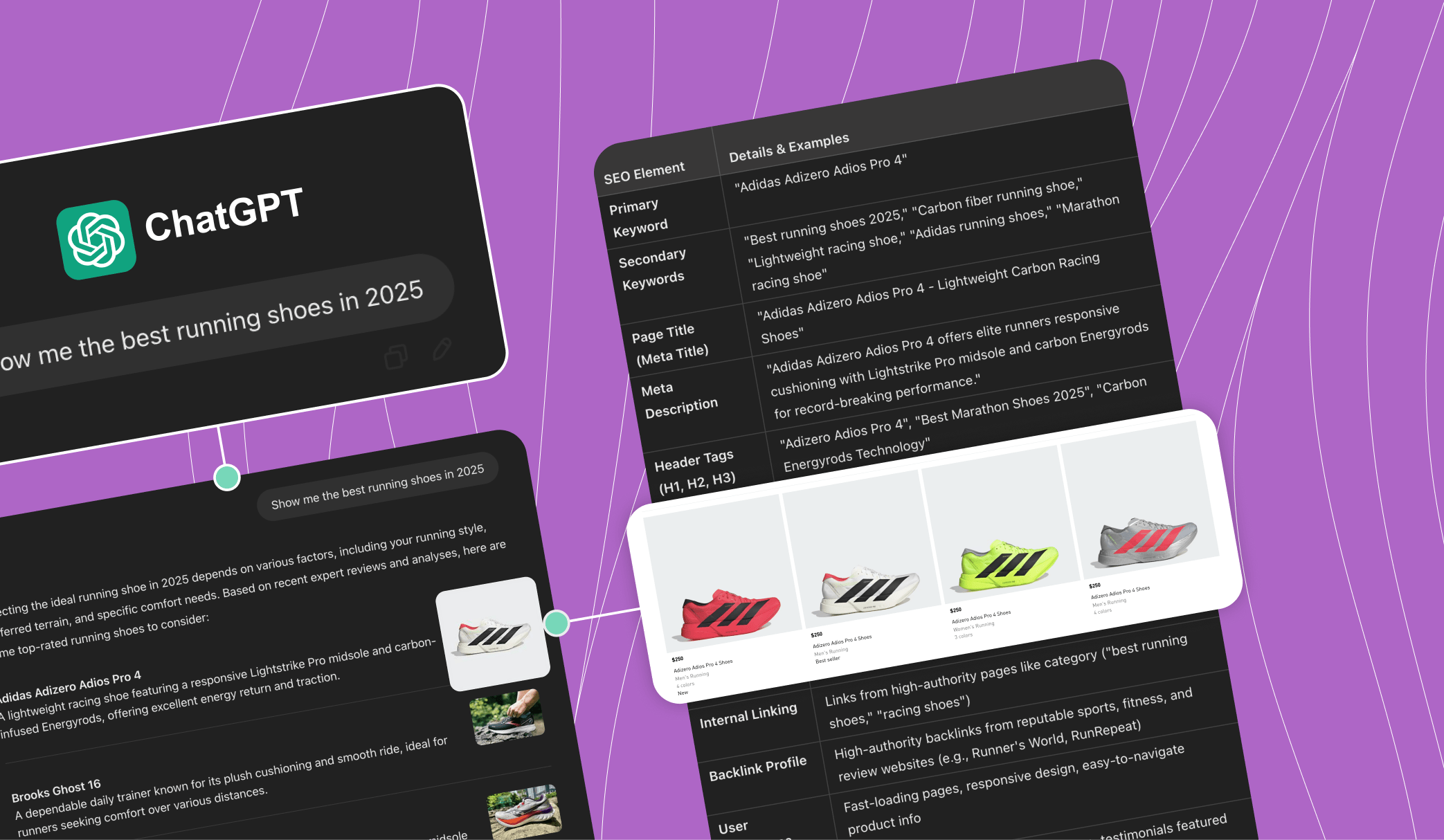
Figure: Product search in a generative engine (source: Go Fish)
Why GEO matters: The collapse of the click economy
Traffic is migrating. AI-powered assistants and AI-infused search results are steadily absorbing search intent once owned by Google.
Perplexity alone surpassed 700 million monthly queries in 2025.
34% of U.S. adults report using ChatGPT regularly (Chen et al., 2025).
Google’s AI Overviews push organic results down the screen by over 1500 pixels on mobile, reducing clicks by up to 70% in some categories (OMR).
The result is simple but brutal: even the best-ranked content can become invisible. We have entered an era where the AI, not the user, decides what to show and what to ignore.
👉 Read more in my essay: “How the New Google Search Transforms Marketing”
From SEO to GEO: The new logic of visibility
Traditional SEO and GEO share the same goal: visibility, but in completely different ecosystems.
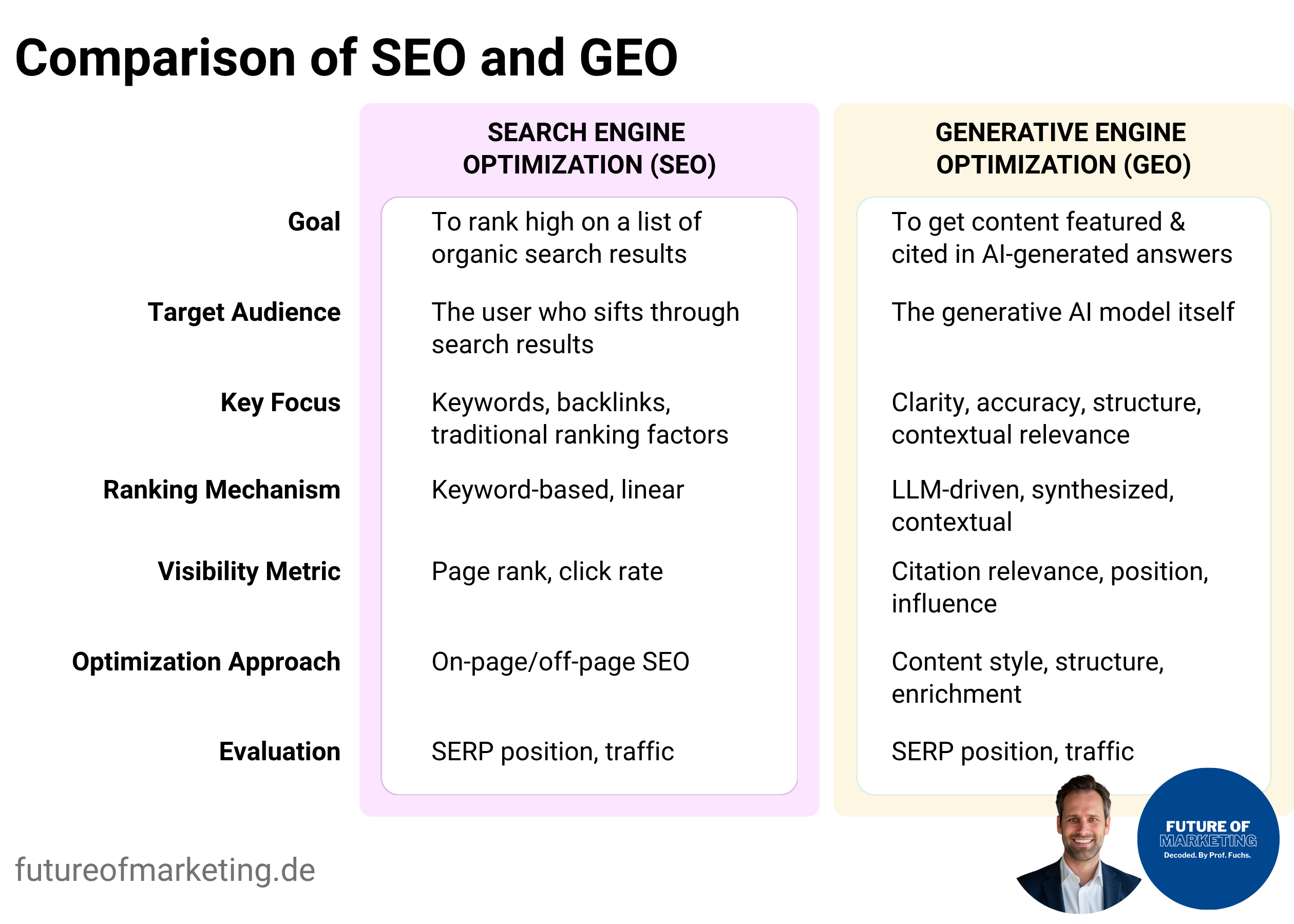
SEO optimizes for the human click.
GEO optimizes for the machine citation.
The new metric is no longer “Who clicked?” but “Who got cited?”. In practical terms, you do not need to win the click to win the influence. Because in a generative engine, the AI’s answer is the new homepage.
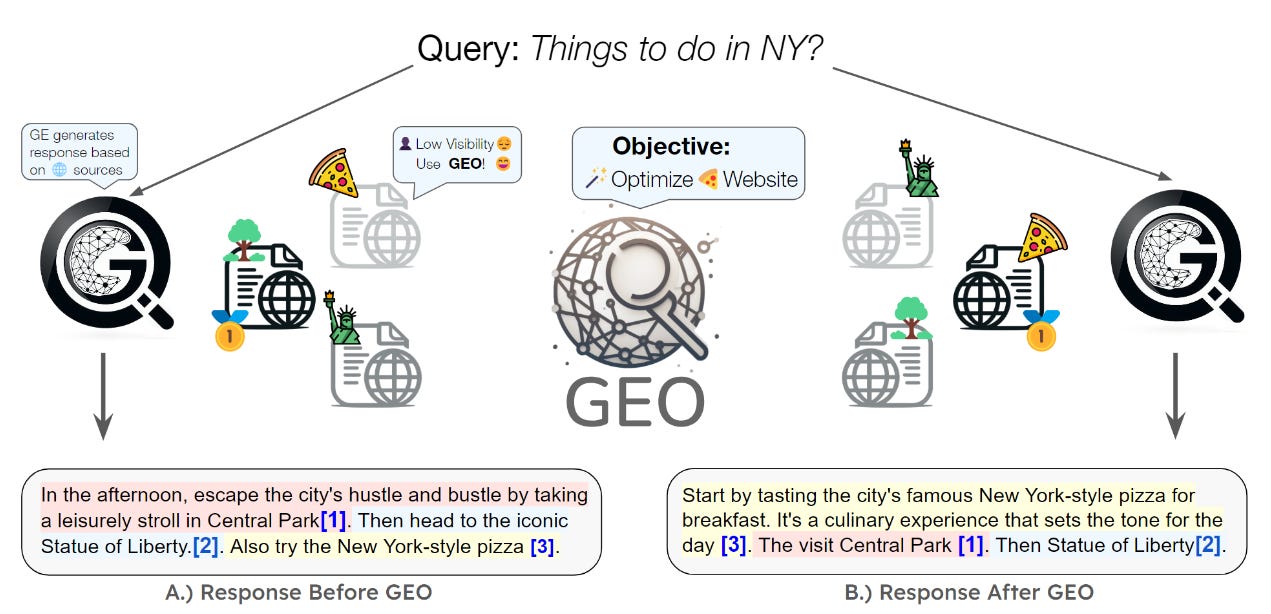
Figure: Before and after GEO optimization (source: Aggarwal et al.)
In the example above, a simple New York–style pizza website gains visibility in AI-generated answers after applying GEO principles. Instead of being ignored, it becomes part of the AI’s curated recommendation. A tangible example of how optimizing for clarity, structure, and credibility affects whether you appear in generative results.
How generative engines think
Generative Engines combine two processes: search and synthesis.
When a user asks a question, the system …
Reformulates the query into smaller, related sub-questions: Instead of running a single keyword search, the AI expands the user query into multiple related sub-queries (Query Fan-Out). These reflect different intents (informational, transactional, comparative) and use varied phrasings or entities.
Retrieves and filters: The sub-queries are sent simultaneously to external sources (web, product data, knowledge graphs). The AI then filters results, keeping only the most trustworthy and relevant ones.
Extracts and synthesis: Relevant text segments (“chunks”) are extracted from these documents. The most relevant chunks form the LLM’s knowledge base for generating the final narrative answer with inline citations.
👉 Your goal is to be one of those cited sources.
The machine decides based on three key signals:
Verifiable Authority (E-E-A-T):
Experience, Expertise, Authoritativeness, and Trustworthiness are now direct inputs for AI ranking. Trust is the new currency, as only credible and verifiable brands appear in high-value recommendations. Authority is built through third-party validation such as mentions, reviews, and features in reputable media.
Machine Scannability (Chunkability):
AI favors content that is factual, structured, and easy to parse. Clarity and relevance matter more than style. Using concise language, clear headings, lists, and tables increases extractability, while fact density through quotes, data, and citations further boosts visibility.Structured Grounding and Justification:
AI relies on clean and explicit data. Treat your website as an API by implementing consistent schema markup for product details, reviews, and pricing. Structured and trustworthy data are rewarded with higher visibility and inclusion in AI-generated recommendations.
👉 That is why content structure now beats style. The cleaner and more factual your writing, the easier it is for LLMs to use it. Think of your website as an API for AI systems. If your facts, schema, and structure are consistent, you become a reliable “data supplier”, and the AI rewards that with visibility.
The 5-Step Playbook: How to build AI visibility
In traditional SEO, you optimize for keywords.
In GEO, you optimize for clarity, credibility, and connectivity.
The shift is not about tactics, but about thinking differently … from chasing clicks to earning citations. Here’s in 5 steps how to operationalize that mindset as an integrated visibility system:
Step 1: Build authority where AI looks
AI models heavily favor earned media: credible, third-party sources like reviews, publishers, and institutional sites.
While Google still mixes brand, social, and earned content, generative engines display an 81% bias toward earned sources (vs. 45% for Google).
So the strategy shifts: Do not just polish your own blog. Be where AI looks for facts.
Do this:
Getting featured in high-authority media and reviews
Collaborating with trusted experts and communities
Treating PR, partnerships, and citations as core marketing channels, not side projects
👉 AI does not care who you say you are; it cares who others say you are.
Step 2: Make your brand “API-able”
Generative engines extract facts, not feelings.
That means your website should behave more like a machine-readable product API than a digital brochure.
Concrete steps:
Use Schema Markup for every product attribute: price, rating, availability, warranty, specs (see step 5).
Write justification-rich content: bullet points, tables, clear comparisons, and quantified claims (“battery lasts 40% longer than average”)
Organize content like microservices: one page = one intent, connected through clear topic clusters
👉 The easier your data is to parse, the more likely it becomes part of an AI’s “answer layer”.
Step 3: Engineer credibility through fact density
Forget keyword stuffing. GEO rewards truth density: the ratio of verifiable information to fluff.
Small content improvements can lead to big visibility gains:
Add expert quotes (human authority signals)
Cite reliable sources (verifiable truth signals)
Include statistics (quantitative grounding)
Write clearly (short sentences, strong nouns, neutral tone)
👉 Each of these micro-signals improves your chance of being cited. They are exactly what large language models use to decide which sources to trust.
Step 4: Cover the full query journey
Generative engines do not process a single question; they create query clusters.
For example, “best electric car” expands into:
“most reliable EVs 2025”
“range comparison electric cars”
“EV with fastest charging”
To win, you need to own the entire semantic journey.
Do this:
Map customer intent from Awareness → Consideration → Conversion
Create AI-ready content for every phase
Include both factual summaries and comparative guides
👉 That way, your brand appears across the full research narrative, not just at the end.
Step 5: Maintain technical hygiene
If SEO was about being found, GEO is about being understood. Your website now optimizes for AI models like ChatGPT, Gemini, and Perplexity that read, extract, and synthesize your content. Here are the main differences:
Do not lose citations because of broken basics:
From keywords to schema: Replace outdated meta tags with JSON-LD (e.g., Article, TechArticle, Product, FAQ).
<script type=”application/ld+json”> { “@context”: “https://schema.org”, “@type”: “TechArticle”, “headline”: “Best Developer Laptops 2025”, “author”: { “@type”: “Person”, “name”: “Lee Nguyen” }, “datePublished”: “2024-02-12” } </script>From keyword links to entities: Replace keyword-stuffed anchors with semantic connections that map concepts, not just text. This tells the model that MacBook Pro and Apple laptop are the same entity — strengthening your position in its knowledge graph:
<a href=”/reviews/macbook-pro” itemprop=”mentions”>Apple MacBook Pro</a>From robots.txt to llms.txt: Add a simple /.well-known/llms.txt file to guide AI crawlers. Combine it with IndexNow to push new or updated pages directly into AI indexes so they get discovered faster:
Allow: /blog/ Disallow: /admin/ Contact: webmaster@yourdomain.comFrom page speed to token efficiency: AI crawlers don’t just want fast pages … they want clean, lightweight HTML that fits within their token windows.
Use semantic HTML5 (<header>, <main>, <section>), pre-render dynamic pages, and remove unnecessary code layers. The cleaner the structure, the higher the chance your text will actually be parsed and cited.
👉 A technically clean website is not just good UX, it is good for machines.
👉 A Brief Guide to GEO for Developers can be found here.
The upside: GEO produces better leads
The irony of this zero-click world is that fewer clicks can mean better leads.
AI traffic is smaller, but 25x more likely to convert.
Why? Because when a generative engine cites you, it pre-qualifies the user. Trust is already established inside the AI’s answer. By the time a user clicks through, they are not discovering you, they are confirming you.
That is the hidden advantage of GEO: less noise, higher intent, stronger positioning.
Building your continuous GEO system
Think of GEO as an operating system, not a project.
To stay visible, you need continuous intelligence and iteration.
Your routine should include:
Monitoring which domains each AI engine cites for your key topics (e.g., GPT, Perplexity, Claude, Gemini)
Securing coverage in those ecosystems through PR, content partnerships, and thought leadership
Tracking citation frequency and share of voice across engines
Refreshing content with facts, statistics, and quotes every month
Publishing AI-ready “answer assets”: concise, factual modules that LLMs can easily reuse
Visibility in the AI era is not about publishing more, it is about publishing better for machines.
Bottom line: Do not optimize for clicks, optimize for credibility
The shift from SEO to GEO is the biggest transformation marketing has seen in 20 years. Search is no longer a list of links; it is a layer of meaning curated by AI. Marketers who still measure success by traffic will miss what really matters: presence within the answer.
Those who master GEO
Build authority in earned media
Structure their content for extraction
And maintain data-level clarity and truth
will not only stay visible but gain an edge in a market where trust itself is becoming automated.
Because in this new world, the question is no longer: “Can people find you?” but rather: “Can the machine explain you?”
Yours, Prof. Dr. Andreas Fuchs 🦊🎓


Thank you Professor Fuchs for working on this great article and explanation! How long until we start seeing ads in LLMs? Especially in the free versions.
A remarkable article that guides our actions. Many thanks for your efforts and excellent work! 🙌