

Marketing measures everything except the thing it produces most of. Media spend gets dashboards and attribution models. Campaigns get a quarterly review with a slide per channel. The writing itself gets an opinion in a meeting, usually from whoever spoke last.
I decided to stop accepting that in my own work. I pulled everything I published in the last year into one database with every KPI attached: 948 Notes on Substack, 35 essays, 48 LinkedIn posts, just over a thousand pieces. Then I wrote down what I was confident about, and checked it.
All three formats sit in the same table. What I have worked through so far is the Notes: that is the format I started with, and the one where the record is most complete. The essays and the LinkedIn posts get the same six steps next, and I expect different answers — the three places have their own mechanics, and a rule that holds in one of them is not evidence about the other two.
The first thing to fall is one almost every marketer holds. Add an image and your post reaches more people.
I believed that too. For a year I put an image on about half of everything I published.
Then I checked, quarter by quarter. In every single quarter, posts with an image reached fewer people than posts without one. Links did the same.
That is the kind of thing you only find by looking, and almost nobody looks at their own archive. We treat one quarter of media spend as worth an attribution model and the entire output of a content team as worth an anecdote.
What it is, and what it refuses to be
Analytics tells you what happened. This tells you what to do differently on Monday, which is a different job.
The system writes nothing. It has no opinion on your sentences and it draws no charts. What runs on its own is the collection: the pulling, the parsing, the weekly refill. What comes out the other end is advice, and advice still has to be argued with.
That distinction matters, because you read a great deal at the moment about content being produced automatically. Posts, newsletters, whole articles. I think that is a mistake, and not a small one.
The parts that make a piece worth reading are exactly the parts that cannot be handed over. The idea. The structure you argue with yourself about for a day. The taste that tells you a sentence is nearly right and therefore wrong. And the unglamorous part nobody puts in the thread: staying with a text long after it is good enough.
I once spent nine hours on a single post. A model can produce something in that shape in nine seconds. It cannot produce the thing that took nine hours, because the nine hours are not overhead. They are the product.
Most of what gets sold as an AI content system automates the producing and leaves the deciding untouched, which is the wrong half of the job. Producing was never my bottleneck. Knowing what deserved to be produced was.
Two words you will need. My examples use Substack’s vocabulary. A Note is a short post published into a feed. A pillar is one of the few subjects you have decided to be known for — most content teams have three or four, whether or not they are written down anywhere. On LinkedIn, read Note as post; nothing else changes.
The build … in six steps
My examples are Substack and LinkedIn, because those are the channels I use. The method does not care. Every platform gives you an export, an API, or a browser you can point at it.
Each step below ends with a prompt you can paste straight into Claude Code or Claude Cowork. Replace anything in square brackets with your own.
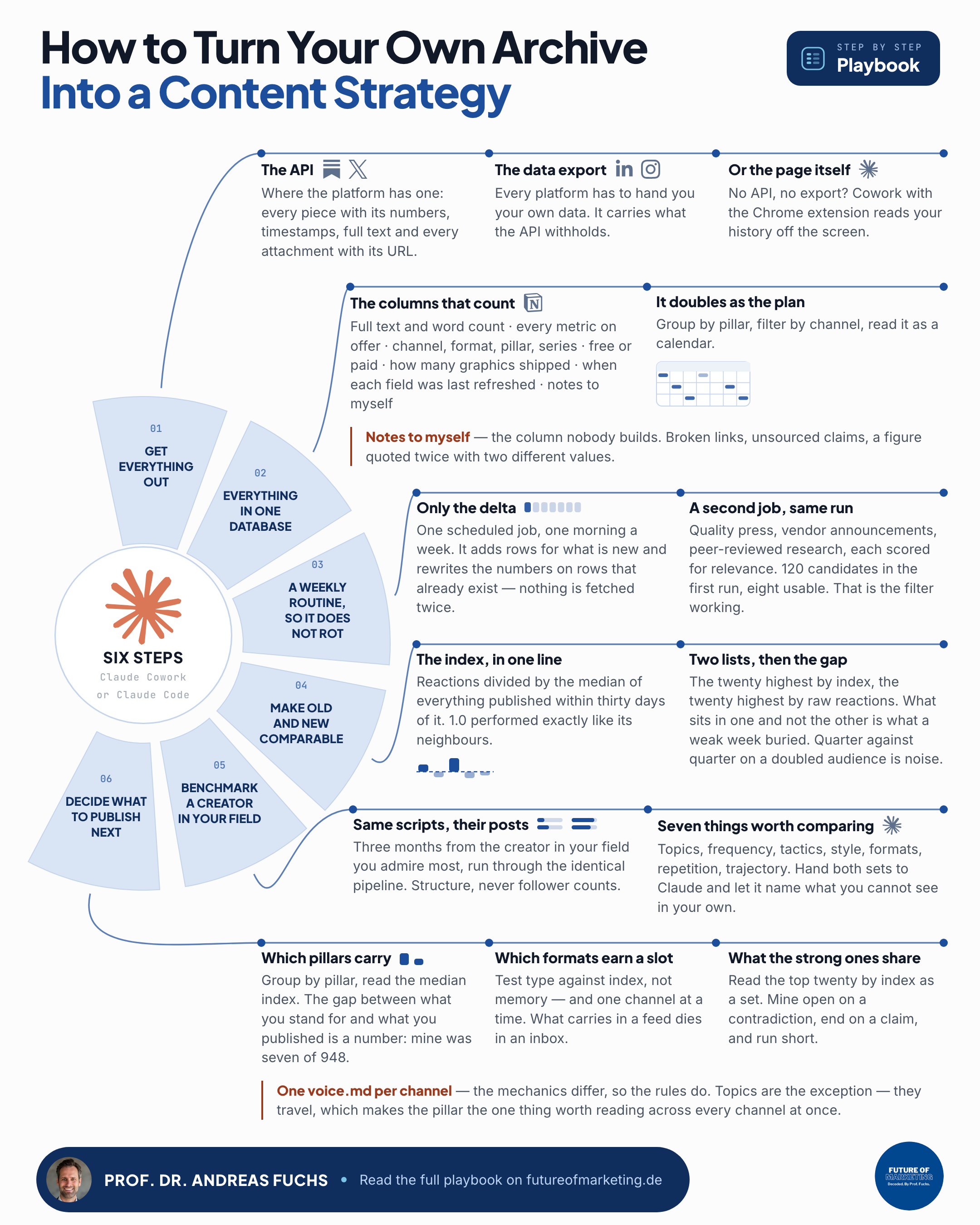
1. Get everything out
Three routes lead in, and you will need at least two of them.
The API, where the platform has one, returns every piece you have published with the numbers it earned: reactions, shares, replies, timestamps, attachments, full text.
The data export exists everywhere, because every platform is obliged to hand you your own data, and it carries what the API withholds: traffic sources, followers by day, per-post opens, clicks and signups.
And where there is neither, there is still the page. Claude Cowork with the Chrome extension reads your own history off the screen and hands it back structured. Slower per item, and it works on anything that will show you your own archive in a browser.
On Substack, the public API gives you the first list in one call and the settings export fills in the second.
LinkedIn takes one extra decision. The quick export gives you profile data and almost nothing you can analyse. Request the complete archive instead: it takes up to a day to generate and it is the only version that carries your posts with their text.
One warning that cost me an hour: the export does not always contain everything the dashboard shows. Audience location, in my case, exists only in the interface. Check both before you conclude a figure is missing.
I want my complete content archive from [platform] in one local file.

Before you start anything, ask me which route to take:
  a) the platform's public API
  b) the Chrome extension, reading my own history in my logged-in
     session while I am sitting at the machine
  c) I request the export in the settings and hand you the file

Take that route and walk back to my first post. Keep everything, not
only the obvious fields:

  the full text, verbatim, with its word count
  the permalink of the piece itself
  every metric the platform exposes — reactions, comments, shares,
    views, opens, clicks, signups, whatever it has
  every attachment with its type and its URL: images, link previews,
    embedded posts, video
  timestamp with the time zone

Keep the raw response next to the parsed fields. I cannot tell you
today which one I will want in three months.

If the route runs out, come back and ask. Do not quietly switch to
another one.

Save it as JSON. Then tell me how many items you found, the date of the
oldest one, and which fields came back empty.
Premium subscribers unlock the full playbook: All six steps in full, each ending with the prompt you paste into Claude Code or Cowork to run it. The five findings the audit handed me that I would have argued against in a meeting the week before. What transfers if you run a marketing team rather than a newsletter. And the seven lines to change on Monday.