

Why read this? Every marketing department answers one question: what do we make ourselves, and what do we buy? For 180 years, the answer leaned toward buying. AI and tight budgets are now tipping that balance, and the knowledge that sets a company apart has become too valuable to rent out. This essay shows where the make-or-buy line runs today and what it means for the budget you’ll have to defend in 2027.
Why Marketing Agencies Exist: 180 Years of Buying Attention
In the early 1840s, a man named Volney Palmer opened an office in Philadelphia and began selling newspaper space to advertisers. He’s often credited with founding the first advertising agency in the United States (Fox, 1984). His business model was simple. Attention was scattered across thousands of local newspapers, and no advertiser had the overview to find it. Palmer did.
For the next 180 years, agencies grew on one premise: attention is hard to find, and someone has to know where it lives. They added creative work, research, strategy and media planning. The Mad Men era turned them into cultural institutions. But the underlying deal stayed the same. Companies bought help because the market for attention was too complex to handle alone.
A century after Palmer, in 1937, the economist Ronald Coase asked a question that sounds almost naive: if markets are so efficient, why do firms exist at all? His answer was that using the market has a price. Searching, negotiating and monitoring partners all cost money, and firms grow whenever doing something internally becomes cheaper than buying it (Coase, 1937). Oliver Williamson later added that this happens above all when the knowledge involved becomes specific to the firm (Williamson, 1985).
Every marketing budget is a silent answer to Coase’s question. And in 2026, the answer is shifting.
Flat Budgets, Rising Expectations: The CMO Trilemma of 2026
Marketing budgets in 2026 stand at 7.8% of company revenue, effectively flat compared with 7.7% in 2025 (Gartner, 2026a). In absolute terms, they grew by just 1.3% (McIntyre & Dooley, 2026). That’s roughly 29% below the 11.0% CMOs reported for 2020, and 18% below the level of four years ago (McIntyre & Dooley, 2026).
Meanwhile, the demands on marketing have gone the other way. 73% of CMOs describe what leadership expects from them, both growth and AI transformation, as high, very high or overly ambitious (McIntyre & Dooley, 2026). 56% say they lack the budget to deliver their 2026 strategy (Gartner, 2026a). Gartner calls this the CMO trilemma: delivering more with limited resources, meeting rising expectations and leading an AI transformation at the same time (McIntyre & Dooley, 2026). The strain already shows in the results, with fewer CMOs exceeding their targets and more falling short on acquisition, retention and ROI (McIntyre & Dooley, 2026).
When resources shrink and pressure grows, organizations reveal what they truly value, and the shifts inside the budget make that visible.
Figure 1. Marketing budget as % of revenue and budget allocation, 2019 to 2026. Data from Gartner (2026b).
Paid Media Rises to 31.4% as Agencies Lose Budget
Paid media absorbs 31.4% of marketing budgets in 2026, funded largely by cuts to agency spend (McIntyre & Dooley, 2026). Agencies have fallen to 19.2% (Gartner, 2026b). Investment concentrates on digital channels and customer acquisition, while spending on loyalty and retention declines (McIntyre & Dooley, 2026).
Look at this through Palmer’s eyes. The job he invented, finding attention and buying it, has largely moved into the auction systems of a handful of platforms, where algorithms set prices in milliseconds. Companies still pay for attention, and more than ever. They simply need fewer intermediaries to do it. Add declining organic reach on many platforms, plus CFOs who want proof by next quarter, and money flows to the line item with the shortest path to a measurable result. That’s my interpretation of the numbers, and it explains why the winner and the loser in the chart move in opposite directions.
Why Labor Spending Rises Again in the Age of AI
After years of decline, labor rises again to 24.5% of the budget (Gartner, 2026b). In the year of AI, this looks like a paradox. Shouldn’t machines replace people?
The data tells a more interesting story. CMOs now allocate 15.3% of their budgets to AI, yet only 30% report mature AI readiness, and 70% say their internal processes can’t yet scale AI (Gartner, 2026a). The bottleneck sits in data foundations, processes, governance and talent (Gartner, 2026a). AI turns out to be a tool that rewards those who understand their own business deeply, and that understanding lives in people. Gartner’s advice follows accordingly: rebalance AI investment toward skills, training and hybrid teams of humans and machines (McIntyre & Dooley, 2026).
The trend has deep roots. 82% of ANA member companies already run an in-house agency, and 65% moved work from external agencies to internal teams within three years (ANA, 2023). AI accelerates a movement that began long before the first chatbot.
Make or Buy: Why Firm-Specific Knowledge Moves In-House
Back to Coase and Williamson. What becomes more valuable when AI does the routine work? Knowledge that belongs to you alone: your customer data, your brand voice encoded in prompts, the workflows that connect your AI tools to your markets. Outsourcing it would mean teaching an outsider the very thing that makes you different. This is exactly the kind of firm-specific knowledge that, according to transaction cost theory, companies prefer to keep inside (Williamson, 1985).
Two questions decide where a task belongs: how specific is the knowledge it requires, and how strategically important is it? The matrix below sorts typical marketing work along both.
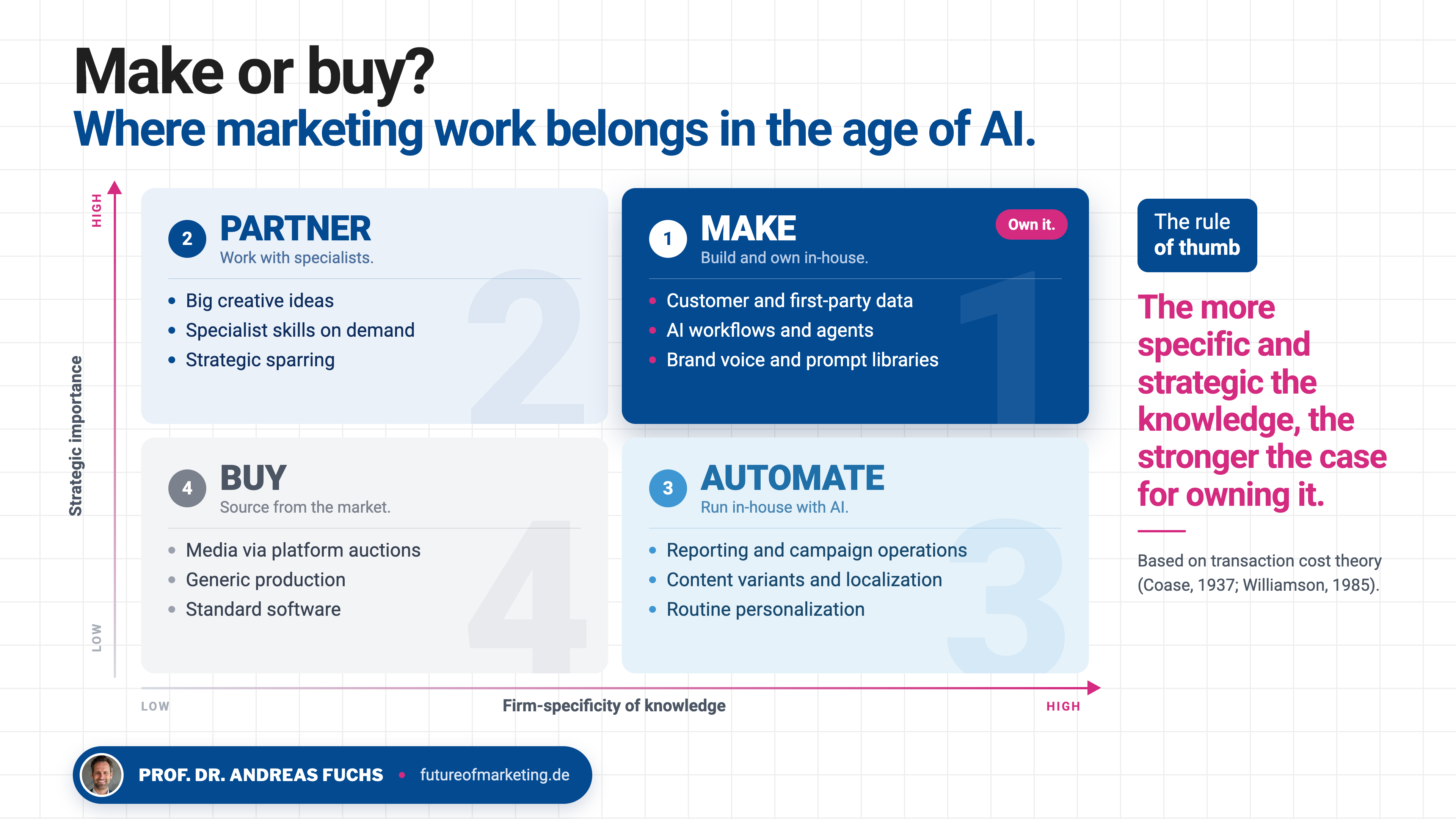
Figure 2. Make-or-buy matrix for marketing work. Own framework based on transaction cost theory (Coase, 1937; Williamson, 1985).
👉 Agencies aren’t disappearing. 92% of surveyed companies still work with external agencies, mainly for extra capacity and specialist skills (ANA, 2023). Their role is moving from producer toward specialist and strategic sparring partner, closer to a consultant than to Palmer’s space broker.
AI-Ready Marketing Teams Work With Bigger Budgets
CMOs with mature AI readiness spend 21.3% of their marketing budgets on AI instead of the average 15.3%, and their total marketing budgets reach 8.9% of revenue instead of 7.8% (Gartner, 2026a). Gartner describes these leaders as AI strategists who pair investment with process maturity, data foundations and adaptability (McIntyre & Dooley, 2026).
A word of caution from the academic side: this is a correlation from a cross-sectional survey. Companies with larger budgets may simply find it easier to build AI maturity, rather than the other way round. Still, a divide is opening up between marketing organizations that can turn AI into growth and those that buy tools without the foundations to use them.
Martech Falls to 19.4% While Half the Stack Sits Unused
Martech falls to 19.4% of the budget, down from nearly 22% a year earlier (Gartner, 2025, 2026b). After a decade-long buying spree, marketers actively use only 49% of their martech capabilities (Gartner, 2025), which makes the stack an easy target in budget reviews. Consumption-based pricing adds flexibility but also cost volatility (McIntyre & Dooley, 2026).
The Hidden Cost of Renting Attention: Short-Term Gains, Long-Term Risk
Efficiency drives tend to leave debts that show up years later. Gartner warns that the shift toward acquisition-focused paid media may lift short-term performance while weakening long-term growth (McIntyre & Dooley, 2026). Many organizations are moving into a defensive posture precisely when bolder decisions would be needed (McIntyre & Dooley, 2026).
A company that only rents attention has to pay rent again every quarter. If retention, brand and event budgets keep shrinking, reaching the same customers will cost more each year. Gartner explicitly advises protecting offline channels such as events and sponsorships, and measuring full-funnel impact beyond last-click attribution (McIntyre & Dooley, 2026).
Four questions for your 2027 marketing budget:
How is your budget split across time horizons? Gartner recommends managing marketing investment as a portfolio across near-term performance, growth and future readiness, with clear targets for each (McIntyre & Dooley, 2026).
What’s firm-specific? Bring data, AI workflows and brand knowledge in-house, and buy what’s generic.
What does your paid media leave behind? Each campaign should also build owned assets such as audiences, first-party data and brand memory.
Which tools and programs earn their place? Audit your stack and legacy programs before adding AI on top, and keep an eye on usage-based contracts.
Key Takeaways
Marketing budgets are flat at 7.8% of revenue in 2026, roughly 29% below their 2020 level, while 73% of CMOs call leadership’s expectations for growth and AI transformation high or overly ambitious (Gartner, 2026a; McIntyre & Dooley, 2026).
Paid media is the biggest winner at 31.4% of budgets, funded mainly by cuts to agencies (McIntyre & Dooley, 2026).
Labor rises to 24.5% because scaling AI requires skilled people: only 30% of CMOs report mature AI readiness (Gartner, 2026a, 2026b).
The move in-house follows a logic economists described almost 90 years ago: firms internalize what becomes specific and strategic (Coase, 1937; Williamson, 1985).
AI-ready marketing organizations work with larger budgets, 8.9% of revenue compared with 7.8% on average (Gartner, 2026a).
Martech’s share drops to 19.4%, while marketers use only 49% of their existing martech capabilities (Gartner, 2025, 2026b).
Acquisition-heavy budgets carry a long-term risk to growth, which makes portfolio thinking across time horizons essential (McIntyre & Dooley, 2026).
Yours,
Prof. Dr. Andreas Fuchs 🦊🎓
References
Association of National Advertisers. (2023). The continued rise of the in-house agency: 2023 edition. ANA.
Coase, R. H. (1937). The nature of the firm. Economica, 4(16), 386–405. https://doi.org/10.1111/j.1468-0335.1937.tb00002.x
Fox, S. (1984). The mirror makers: A history of American advertising and its creators. William Morrow.
Gartner. (2025). Maximize ROI with marketing technology (martech). https://www.gartner.com/en/marketing/topics/marketing-technology
Gartner. (2026a, May 11). Gartner 2026 CMO Spend Survey finds CMOs allocate 15.3% of marketing budgets to AI, but only 30% are ready to scale AI capabilities [Press release]. https://www.gartner.com/en/newsroom/press-releases/2026-05-11-gartner-2026-cmo-spend-survey-finds-cmos-allocate-15-point-3-percent-of-marketing-budgets-to-ai-but-only-30-percent-are-ready-to-scale-ai-capabilities
Gartner. (2026b). Insights from the 2026 CMO Spend Survey [Report]. https://www.gartner.com/document-reader/document/7830017
McIntyre, E., & Dooley, R. (2026, June 25). CMO spend in 2026: Redefining marketing investment under constraint. Gartner. https://www.gartner.com/en/articles/cmo-spend
Williamson, O. E. (1985). The economic institutions of capitalism: Firms, markets, relational contracting. Free Press.