The New Marketing Operating System
A Framework for intelligent, data-driven Marketing
The marketing world has become a paradox.
We have never had more tools, data, and automation. And yet, it has never felt more fragmented.
With more than 15,000 MarTech tools available, teams are drowning in dashboards, chasing integrations, and losing sight of what marketing is really about: creating meaningful, measurable value for their customers.
The truth is simple: marketing doesn’t need more tools
… it needs a new operating system.
Because the future of marketing will not be decided by who has the biggest tech stack, but by who builds the smartest Marketing Operating System (MOS). A system that connects data, process, and AI into one adaptive, learning framework.
The MOS isn’t a software you buy. It’s a system you design. A living architecture that
connects strategy, data, process, and intelligence
keeps learning as the system evolves.
Here’s a preview of the new Marketing OS:
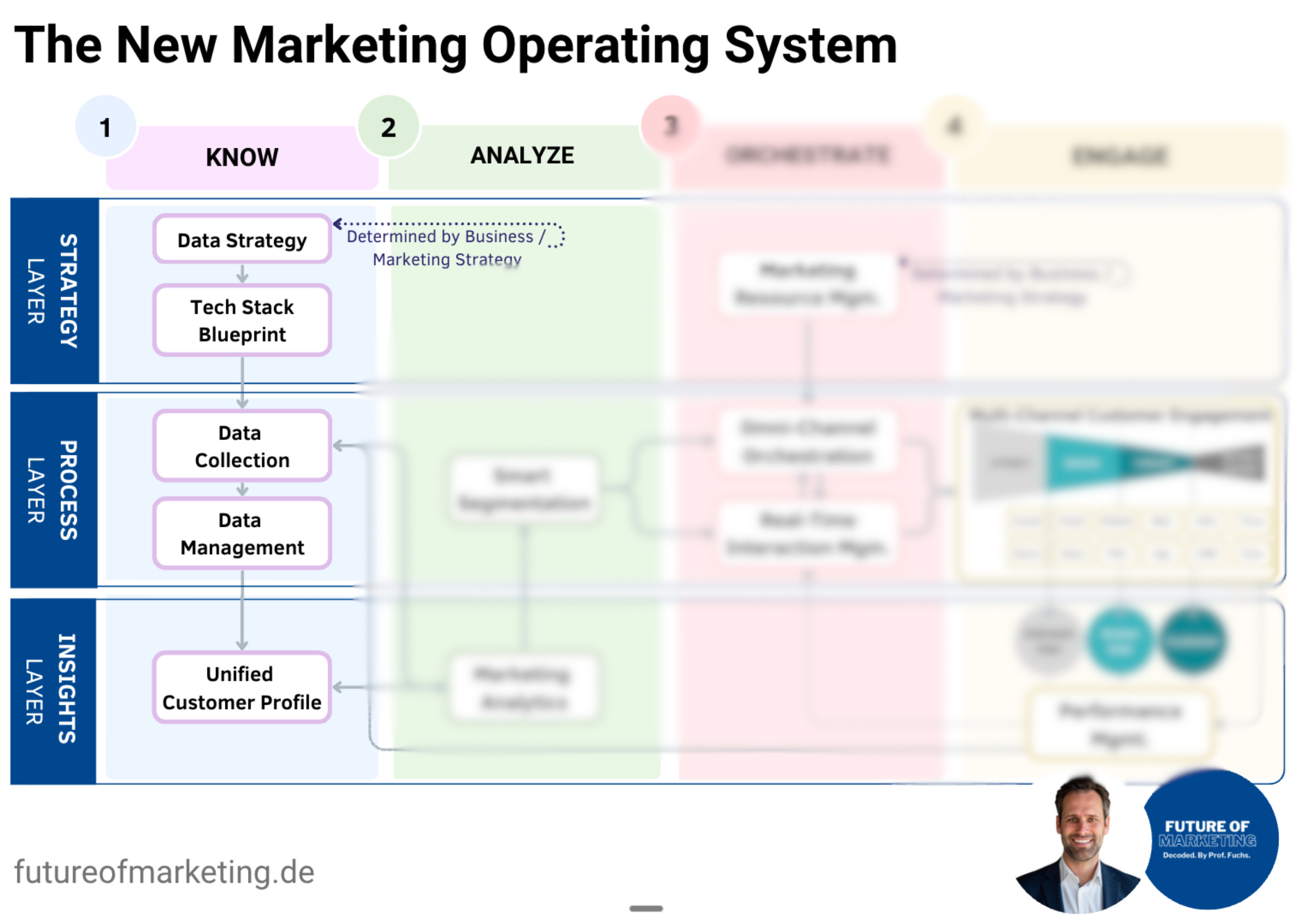
(The uncensored image is at the bottom of the article … keep on reading)
Source: Fuchs (2025).
The Strategic Imperative: Why Marketing Needs an Operating System
Scott Brinker’s famous Martech’s Law explains the problem perfectly:
Technology changes exponentially, but organizations change logarithmically.
While our tools evolve faster than ever, our systems of thinking and working haven’t kept up. That’s why many companies keep adding tools, but not intelligence. They optimize fragments instead of systems.
The Marketing Operating System (MOS) might be the solution.
It’s not about buying the next AI platform. It’s about integrating what you already have into one coherent, intelligent framework.
The MOS provides this structure built on three governing layers and four dynamic phases that form a continuous feedback loop for learning and growth.
How the Marketing Operating System Works
The Marketing OS is built on three layers (strategy, process, and insights) and runs through four dynamic phases: Know, Analyze, Orchestrate, and Engage:
Source: Fuchs (2025).
1) The Three Layers (Strategy, Processes, Insights)
The MOS rests on three interconnected layers that ensure that strategy, execution, and learning form one continuous loop:
1. The Strategy Layer (the compass)
This layer defines the why. It aligns every tool, data source, and process with your broader marketing and business goals.
It’s where direction happens … where data and tech strategy, resource management, and a clear tech-stack blueprint come together.
Without this foundation, marketing becomes tactical instead of transformational.
2. The Process Layer (the backbone):
This is the operational engine that powers execution.
It connects campaigns, automation, CRM, and orchestration workflows into one responsive system.
Here, strategy turns into motion: marketing becomes real-time, adaptive, and scalable.
3. The Insights Layer (the brain):
This layer transforms data into knowledge and feedback into optimization.
It’s where analytics, attribution, and performance management come together to create intelligence.
And this is also where AI and automation live … not as add-ons, but as the cognitive core that helps the system learn, adapt, and improve continuously.
2) The Four Phases of the Marketing OS
While the layers define how the system works, the four phases define how it learns. Together they form a continuous loop: KNOW, ANALYZE, ORCHESTRATE, and ENGAGE & MEASURE.
Let’s dive into it:
1. KNOW: Build the Foundation
The KNOW phase forms the foundation of the Marketing Operating System.
It builds the data-driven backbone every modern marketing organization needs: connecting strategy, data collection, and governance into one unified customer view.
Most companies automate before they understand. They start with campaigns instead of comprehension.
But no amount of automation can fix a broken foundation.
Without deep knowledge of customers and clean, connected data, even the smartest AI will simply make mistakes faster.
The goal here is simple but transformative: Create a Unified Customer Profile (UCP), a single, living record that integrates every customer interaction, both online and offline (applies for both: B2C & B2B).
This isn’t just a database; it’s the system’s memory. Every personalized campaign, predictive model, and AI decision depends on it.
To build that foundation, focus on five essentials:
Start with (data) strategy: Define why you collect data before deciding what to collect. Every data point should serve a measurable business question, not curiosity. Example: Instead of “Let’s track everything our users click,” ask “Which signals predict e.g. customer retention?”
Prioritize first-party data: As third-party cookies disappear, trust and transparency become your true competitive edge. Build direct data relationships through your CRM, mobile apps, loyalty programs, and brand communities.
Ensure data quality: Automate cleaning, validation, and enrichment to keep insights reliable. Dirty data isn’t just inefficient, it leads to wrong decisions, wasted budgets, and eroded trust.
Create unified profiles: Use Customer Data Platforms (CDPs) to merge siloed systems (CRM, eCommerce, analytics, support, etc.) into one consistent view of each customer. When marketing, sales, and service all see the same truth, decisions finally align.
Establish governance: Map ownership, consent, and compliance early.
Privacy is not a checkbox; it’s the new trust currency.
Brands that respect data boundaries win longer-term relationships.
To make this concept tangible, the framework below illustrates how a Unified Customer Profile (UCP) is built inside the Marketing Operating System:
Source: Fuchs (2025) modified from Tata Consultancy Service (2021)
It shows how internal and external data sources come together, through data ingestion, management, and governance, to create one holistic, living customer view that powers every other phase of the Marketing OS.
👉 When the KNOW phase works, marketing stops guessing and starts understanding.
👉 It transforms operations from reactive to intelligent … giving every campaign, every message, and every experiment a solid, data-driven foundation to stand on.
2. ANALYZE: Turn Data into Intelligence
If the KNOW phase gives marketing its memory, the ANALYZE phase gives it a mind.
It is the brain of the Marketing Operating System, transforming raw customer signals into actionable intelligence … the insights that power every decision, every campaign, and every dollar spent.
In traditional marketing, analytics lived in static dashboards. They told you what had already happened, often too late to act. In a true Marketing OS, analytics becomes a living system that learns continuously, predicts behavior, and optimizes outcomes in real time.
The goal is simple: move from knowing what happened to understanding why it happened, and ultimately to anticipating what will happen next.
At its core, the ANALYZE phase connects three key capabilities that turn data into direction:
Smart Segmentation: Use data and machine learning to group customers by real behavior, not static demographics. AI clusters your audience dynamically, by recency, frequency, lifetime value, or emotional engagement, creating fluid segments that evolve as customers do.
This allows marketers to design personalized journeys that feel intuitive rather than intrusive.
Predictive & Prescriptive Analytics: Anticipate the next move. AI models forecast outcomes such as churn risk, next purchase probability, or predicted lifetime value. Marketing shifts from reactive reporting to proactive orchestration … acting before problems occur. Predictive dashboards turn planning meetings from “What went wrong?” to “What’s about to happen?”
Attribution and Optimization: No more guessing which channel worked. Advanced methods like Multi-Touch Attribution (MTA) and Media Mix Modeling (MMM) reveal how each touchpoint contributes to conversion. Instead of last-click bias, you gain a true view of customer journeys … guiding smarter, data-backed budget allocation.
Modern analytics systems integrate data from multiple channels, automate reporting, and deliver insights instantly. They provide a 360-degree view of the customer, where data no longer supports marketing … it drives it.
Here are some marketing analytics by the four levels of analytical maturity: from describing what happened to prescribing what to do next. Each level increases in complexity and value, moving from retrospective reporting to proactive, AI-driven decision-making:
Source: Fuchs (2025)
👉 The result is a self-learning feedback loop: Every campaign feeds the next. Every insight sharpens the next decision. The system becomes smarter with each interaction.
👉 When the ANALYZE phase works, marketing stops being a guessing game. It becomes a science of precision, where every insight feeds action, every experiment builds intelligence, and every outcome strengthens the next iteration.
3. ORCHESTRATE: From Data to Experience
The ORCHESTRATE phase is where the Marketing Operating System comes to life.
It connects insights from the Analyze layer with real-time execution and turns intelligence into action.
While KNOW builds the data foundation and ANALYZE provides intelligence, ORCHESTRATE ensures that everything works together: technology, channels, and people.
Its goal is simple yet ambitious: to deliver the right message to the right person at the right time across every touchpoint.
Modern marketing no longer runs in isolated campaigns: It operates like a living network where channels are synchronized, data flows in real time, and every customer experience feels coherent and personal.
Source: Fuchs (2025)
The orchestration process connects five building blocks:
Data Sources: Marketing data comes from many origins, like warehouses, lakes, MarTech applications, APIs, and SDKs. The system collects, structures, and harmonizes this information continuously.
Customer Data Platform (CDP): The CDP acts as the central intelligence hub. It builds a 360° customer profile, manages identities, predicts intent, and personalizes experiences … all in real time.
Omni-Channel Orchestration: This layer transforms insights into synchronized action. Journey Orchestration and Workflow Automation tools ensure that ads, email, CRM, and AdTech platforms work as one continuous flow, not as separate systems.
Customer Engagement: Across channels (from social to apps to service bots) every message is contextual, consistent, and connected. Instead of campaigns, customers experience dynamic, evolving journeys.
Performance Analytics & Attribution: Every interaction generates data that flows back into the system. Real-time attribution measures what works, what doesn’t, and automatically optimizes the next iteration.
This creates a closed real-time loop:
Data from the CDP fuels personalization, which triggers orchestrated actions, which lead to customer engagement, which in turn feeds back performance insights, improving the system with every cycle.
Think of orchestration as the operating logic of the Marketing OS.
It ensures that intelligence turns into impact … that every signal becomes an action, and every action strengthens the next one.
👉 When ORCHESTRATE works, marketing feels effortless not because it is simple, but because the system is synchronized.
Outcome: experiences that are not just automated but orchestrated.
4. ENGAGE & MEASURE: Close the Loop
The ENGAGE & MEASURE phase is where the Marketing Operating System completes its cycle.
After data is collected, analyzed, and orchestrated, this phase activates real customer interaction … and measures how well the system performs.
At its heart, this phase connects two disciplines that often operate separately: Customer Engagement and Performance Management.
The goal is to turn interaction into loyalty and data into insight.
Customer Engagement means more than a transaction. It is the ongoing, emotional relationship between a customer and a brand that grows across touchpoints. Companies that actively manage engagement build stronger loyalty, higher profitability, and more resilient customer relationships.
Engaged customers:
stay longer and spend more,
forgive mistakes more easily,
and become brand advocates who drive organic growth through referrals and social proof.
True engagement is measurable. Metrics like repeat visits, open rates, dwell time, and social interactions show how relevant content really is. High engagement is not a vanity metric; it is proof that marketing creates value.
Yet engagement alone is not enough. The MOS combines engagement with a data-driven performance management system that measures every activity against business outcomes.
This starts with defining clear metrics:
Strategic KPIs connect marketing to business results such as revenue growth, Customer Lifetime Value (CLV), and Customer Acquisition Cost (CAC).
Operational KPIs track performance across campaigns and channels — from lead quality to conversion rates.
Tactical KPIs provide real-time feedback through clicks, form-fills, and engagement rates to continuously optimize campaigns.
When these layers work together, marketing becomes a feedback system that learns. Every customer action provides new data, which feeds back into the KNOW and ANALYZE phases.
Finally, the phase introduces data-driven optimization. Machine learning and automation enable marketing systems to test, learn, and adapt in real time. Campaigns no longer rely on quarterly reviews; they evolve continuously based on live performance data.
For example, AI-driven attribution models automatically adjust budgets to the most effective channels, and CRM systems trigger personalized actions instantly when customer behavior changes.
👉 The result is a self-correcting system. Every interaction strengthens engagement, every data point improves precision, and every campaign teaches the system how to perform better next time.
Outcome: marketing that learns, optimizes, and compounds value … closing the loop of the Marketing OS.
5. AI & Automation: The Cross-Functional Engine of the Marketing OS
AI and automation are not another phase of the Marketing Operating System.
They are the invisible layer that connects everything: the nervous system that keeps the MOS learning, adapting, and improving.
AI runs through all four phases: it cleans data, finds patterns, personalizes experiences, and optimizes performance … not occasionally, but continuously.
In KNOW, it helps clean, connect, and enrich customer data to build unified profiles.
In ANALYZE, it identifies patterns, predicts outcomes, and drives smarter decisions.
In ORCHESTRATE, it powers personalization, dynamic journeys, and real-time interactions.
In ENGAGE, it automates optimization, learning from every result to improve the next action.
To understand how AI and automation connect across the entire system, the following chart shows where they create the most impact: from strategy to execution.
Source: Fuchs (2025).
6. Putting it all together: The Marketing OS at a Glance
When you connect all layers and phases, the Marketing Operating System reveals its full logic:
Source: Fuchs (2025).
Strategy defines direction. Processes ensure execution. Insights drive learning.
The four phases (Know, Analyze, Orchestrate, Engage) form a living loop where every signal strengthens the next decision.
Now It’s Your Turn: Build a Marketing Operating System
For years, marketing has been a maze of platforms, plugins, and dashboards — optimized in parts but disconnected as a whole.
No single tool can fix a broken system. Only a system can.
The Marketing Operating System (MOS) provides this missing foundation. It turns marketing from isolated activities into a coherent architecture, where every layer learns from the others and every signal strengthens the whole.
The future of marketing will be decided by one thing: whether a company can build its own operating system.
When data flows, processes align, and AI connects the dots, marketing evolves from execution to cognition, from campaigns to continuous learning.
Every company must design its own system,
tailored to its strategy, customers, and maturity.
This blueprint shows what that could look like: a system built on knowledge, driven by insight, powered by orchestration, and refined through continuous measurement.
That is the real future of marketing: not more tools, but the operating systems that connect them all.
👉 When will you start building your own Marketing Operating System?
Yours, Prof. Dr. Andreas Fuchs 🦊


What a thorough post! It was very insightful. 💡
The insights layer is so pivotal too cause it drives the next decisions