

Why read this article:
This is a practical guide to building a AI-powered CMO Cockpit: a five-layer decision system that replaces dashboards, spreadsheets, and Monday morning guesswork. You will see exactly what goes into each layer (forecasts, playbook, KPIs, operations, market intelligence), how to connect real data sources via MCP (Notion, Slack, CRM, and more), and how AI turns raw data into recommendations. The article includes an interactive prototype you can click through yourself: every tab, every filter, every forecast is live. Inspired by a conversation with a tech startup CEO, I built the whole thing with Claude in a single afternoon.
Stop Staring at Dashboards. Start Steering.
Let me skip the part where I tell you dashboards are important. You already have one. Probably several.
The question worth asking is: when was the last time a dashboard actually changed a decision you made?
Most CMOs I talk to describe the same experience. The numbers are there. Revenue, leads, pipeline, cost per acquisition. Neatly formatted. Updated weekly. And completely disconnected from the question that matters on Monday morning: what should we do differently?
That disconnect has a price. In a recent survey of 678 executives, 63% of CMOs said they miss opportunities because they cannot make decisions fast enough (PwC, 2025). Not because they lack data. Because the data lives in one place and the decisions happen in another.
Meanwhile, 84% of marketing organizations remain stuck in what IBM calls “pilot purgatory” when it comes to AI. Only 19% of pilots have delivered expected ROI (IBM IBV, 2025). The tools are getting smarter. The organizations are not keeping up.
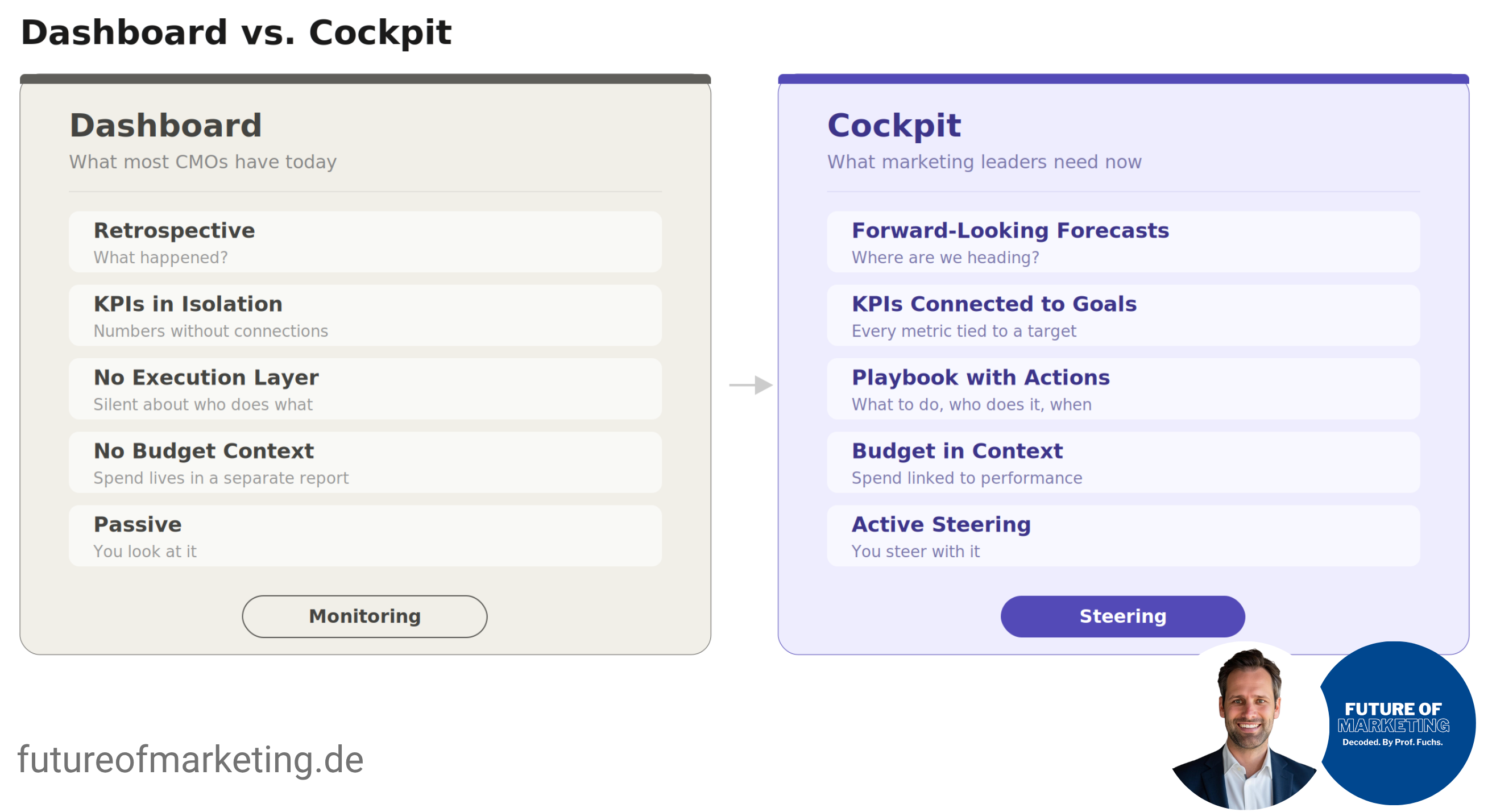
Dashboards were built for an era when the primary challenge was visibility. That era is over. What marketing leaders need now is a system that connects numbers to actions, actions to owners, and owners to outcomes.
That system is a cockpit.
What a CMO Cockpit Actually Is
A cockpit is what happens when you stop treating data as something to look at and start treating it as something to steer with.
Think about how a pilot works. There is no screen in one room showing altitude and a separate room where you adjust the engine. Everything is in one place: current state, trajectory, instruments, controls. You see where you are, where you are heading, and you can intervene immediately.
A CMO Cockpit follows the same logic. It brings five layers together into one decision environment:
Layer 1: Headquarters. The morning briefing. Where are we? What needs attention? Where are we heading? A multi-KPI forecast that shows year-end projections across three scenarios (optimistic, base, conservative) for revenue, leads, pipeline, win rate, and CAC. Alerts that combine KPI anomalies with signals from inside the organization. Quarterly milestones that show what has been achieved and what is at stake. Everything a CMO needs to orient, on one screen.
Layer 2: Playbook. The bridge between analysis and action. What should we do this week, this month, this quarter? Each action prioritized, tied to a goal, assigned to an owner. Fed by an interactive quarterly review (wins, misses, decisions) that the system generates and the CMO can edit. Below that, goal coverage: for each target, are the planned measures sufficient? If projected leads fall short even with all measures active, the cockpit flags it now, not in the quarterly review.
Layer 3: Performance. KPIs and budget in one view, because they belong together. Sixteen metrics across pipeline, leads, efficiency, and engagement. Revenue versus prior year. Channel performance with CPL, conversion rates, and trend sparklines. An interactive budget allocator that lets you model: what happens if we shift 30% of the event budget to content? The system recalculates projected leads in real time.
Layer 4: Operations. The layer most dashboards ignore entirely. Every running campaign, event, and program with the KPIs that actually matter for that specific activity. LinkedIn Ads shows impressions, CTR, CPL, conversion rate. An event shows meetings booked, leads captured, pipeline generated. Outbound shows emails sent, reply rate, SQLs. Filterable by type, status, owner. Plus project tracking, team workload with capacity indicators, AI agent reliability monitoring, and a marketing calendar with preparation status.
Layer 5: Market Insights. The outward-looking layer. Competitive intelligence with funding rounds, product moves, and (crucially) which customers they won and which they lost to you. Market signals with strategic implications. Organization signals aggregated from Slack, Teams, Notion: product shipped a feature, CEO confirmed pricing changes, a customer escalated. Pipeline intelligence across four quadrants: hot, at-risk, churn watch, expansion.
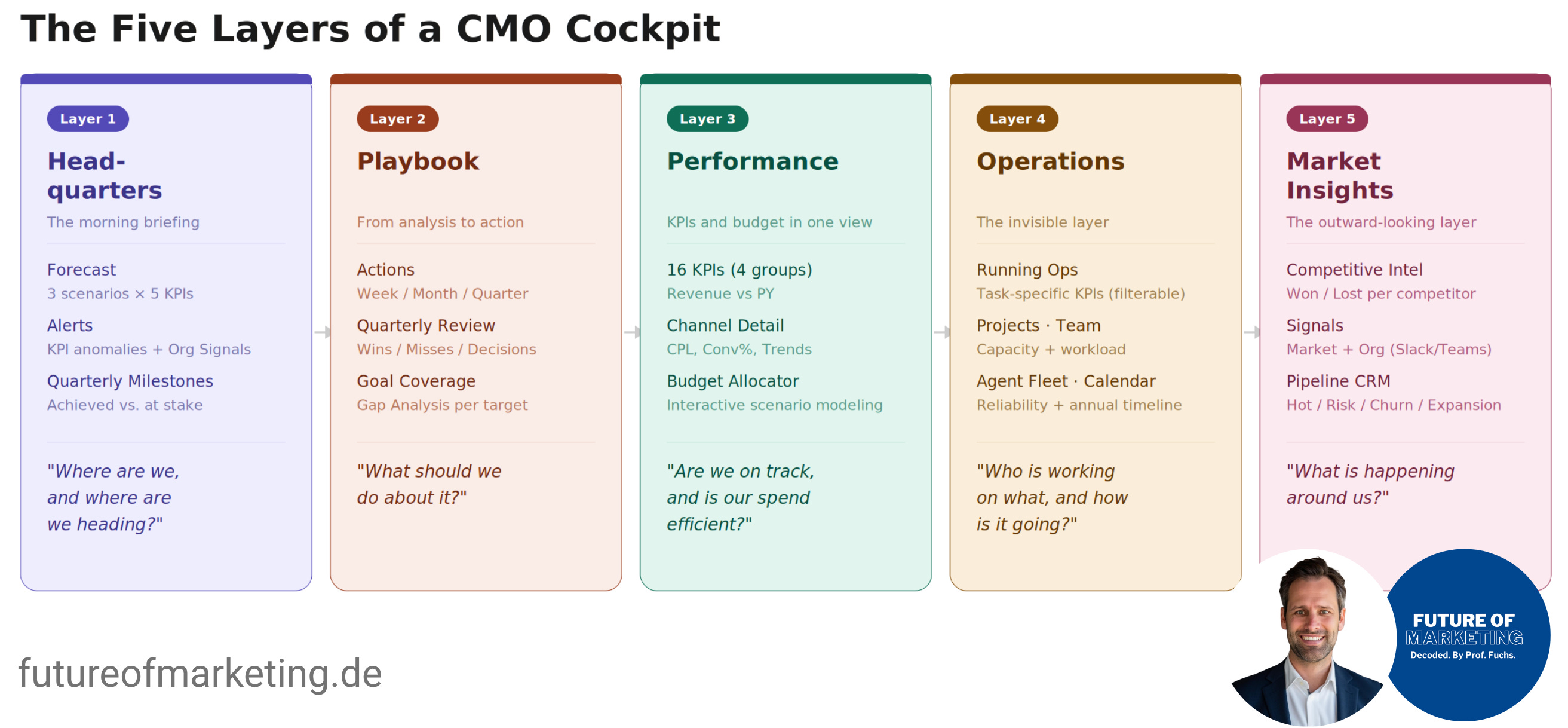
These five layers form a loop. A forecast that shows a lead gap triggers a playbook action. That action needs budget. The budget needs someone (or an agent) to execute. And market signals might reshape the whole strategy before the quarter is over. Every layer feeds the next. Cut one and the system breaks.
This is what moves CMOs from monitoring to steering.
👉 Premium subscribers unlock: How to actually build this cockpit, step by step. The technology shift that makes it possible now (Cowork, MCP connectors, Skills). A real build story showing what Claude produced in a single afternoon. The three evolutionary stages from cockpit to Virtual CMO. A six-step roadmap with practical guidance on connecting data sources. The full interactive prototype to click through. Plus the Key Takeaways.