The Attention Economy Is Dead. Long Live the Relevance Economy.
Why visibility alone no longer wins customers, and what marketing leaders need to understand right now.
Why read this article: For decades, marketing ran on one rule. More reach meant more customers. That rule is breaking down as AI summaries and AI agents step between brands and buyers. This piece explains the shift from the Attention Economy to the Relevance Economy, what the data already shows, and the four levers that decide whether your brand appears in AI-generated answers.
This is the follow-up I promised at the end of Google I/O 2026 Explained: The Search Bar Is Dead. Long Live the Search Agent: a way to think about the Relevance Economy, and four levers to act on it.
There is a number that should make every CMO pause.
When Google shows an AI summary at the top of a search result page, the click-through rate for organic results drops by 61 percent.
Not 6 percent. Sixty-one.
For paid ads, it’s even worse: 68 percent fewer clicks on the same queries (Seer Interactive, analysis of 3,119 queries across 25 million impressions, November 2025).
This isn’t a blip. It’s a structural shift. And it’s only the beginning.
The logic of the Attention Economy
Marketing has operated on one core assumption for decades: reach equals influence. Whoever gets the most eyeballs wins. That assumption is quietly breaking down.
The concept of the Attention Economy has shaped marketing for at least three decades. The idea is simple: human attention is finite. Platforms compete for it. Brands pay to access it.
The whole system, from TV spots to display ads to social media campaigns, is built on this logic. Spend money. Get in front of people. Repeat.
It worked. For a long time.
But two things are now breaking it simultaneously.
What is breaking it
Humans are getting better at ignoring ads: 85 percent of digital ads receive fewer than 2.5 seconds of attention, the minimum needed to create a memorable impression (Amplified Intelligence, Dr. Karen Nelson-Field). Gen Z loses active attention to ads after just 1.3 seconds. And the share of consumers who say social media ads capture their attention has dropped from 43 to 31 percent in just a few years (Kantar Media Reactions, 2024). More reach is increasingly reach into distraction.
The bigger shift, AI is stepping between brands and buyers: Search used to work like this: a customer has a question, types it into Google, sees ten blue links, clicks one, lands on your website. That chain is breaking. Today, AI summaries answer the question directly. No click needed. No visit. No conversion path as it used to exist.
👉 Only 8 percent of users click a traditional search result when an AI summary is present, versus 15 percent without one. And 26 percent end their browsing session entirely after reading the AI answer (Pew Research Center, July 2025, based on 68,879 Google searches).
That’s not a traffic problem. It’s a visibility problem at a structural level.
The new Intermediary: AI Agents
The shift goes even further than AI search summaries.
A growing number of buying decisions are now shaped, or made entirely, by AI agents. Not just ChatGPT, Claude or Perplexity. Think of Amazon’s Rufus, Google’s shopping agents, OpenAI’s Instant Checkout, or the AI assistants embedded in enterprise procurement systems.
45 percent of consumers now use AI during their buying journeys, to research products, interpret reviews, compare options (IBM Institute for Business Value and National Retail Federation, 2026, survey of more than 18,000 consumers across 23 countries).
Gartner forecasts that by 2028, 90 percent of B2B buying will be intermediated by AI agents, channeling more than 15 trillion dollars in spending through automated exchanges (Gartner, 2025).
And here’s the critical implication: an AI agent doesn’t see your ad. It can’t be reached with a banner. It doesn’t respond to a brand campaign. It selects based on structured information, third-party signals, and trust indicators it can read and process.
Visa’s global CMO Frank Cooper III framed this shift in April 2026 as the rise of “Business-to-AI,” arguing that AI agents are becoming a new customer segment that brands must learn to sell to. As he put it, companies will need to rethink how they show up inside the decision architectures that agents use.
What replaces attention: Relevance
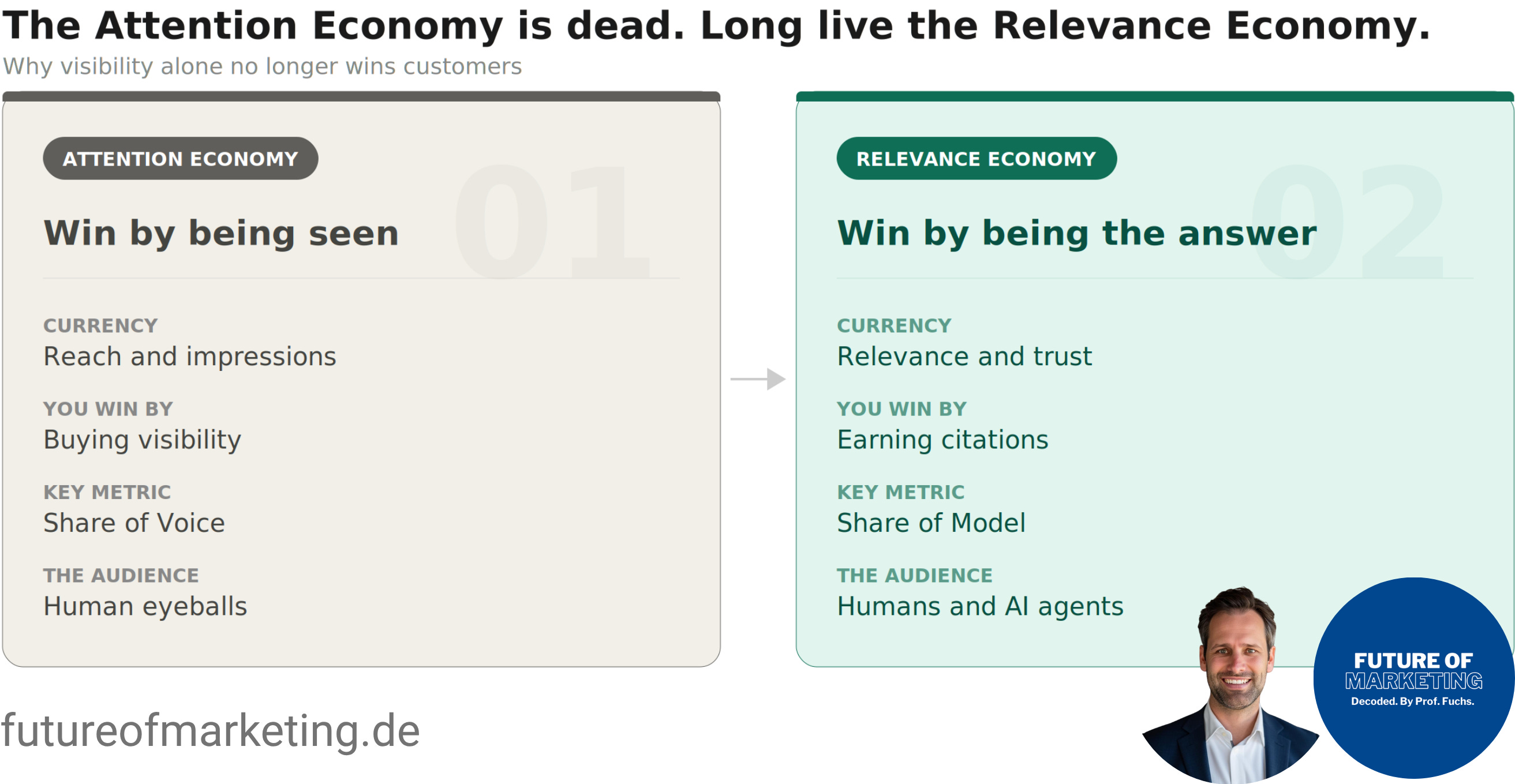
If attention was the old currency, relevance is the new one.
Relevance means being the right answer, in the right context, for the right intent, whether the decision-maker is a human or a machine.
This is a fundamentally different game.
In the Attention Economy, you could buy your way in. More budget, more reach, more impressions. It was a volume game.
In the Relevance Economy, you have to earn your place. Not through media weight, but through four things:
Expertise and depth. AI systems reward content that actually answers questions with substance and specificity.
Third-party credibility. Roughly 82 to 89 percent of AI citations come from earned media, press coverage, expert mentions, independent reviews, rather than from brand-owned channels. When paid placements are excluded entirely, the share of non-paid sources rises to around 94 percent (Muck Rack, analysis of more than one million AI citations, 2025). A brand blog that no one references is close to invisible to an AI agent.
Consistent brand signals. AI models build their “knowledge” of a brand from hundreds of sources: Wikipedia, LinkedIn, review platforms, trade press, analyst reports. If these signals are inconsistent or thin, the brand simply doesn’t appear in AI-generated answers.
Structured, extractable information. Websites that use clear headings, structured data, and FAQ formats are cited far more often in AI answers than those that don’t. Statistics, tables, and answer-first formatting measurably improve citation rates (BrightEdge AI Search Study, 2025; corroborated by multiple 2026 citation analyses).
The new metric: Share of Model
In the Attention Economy, the dominant metric was Share of Voice, how much of the total media landscape you occupied.
A new metric is emerging: Share of Model.
It measures how often your brand appears in AI-generated answers, with what frequency, in what position, and with what sentiment.
Early data is striking:
Brands cited in AI Overviews earn 35 percent more organic clicks and 91 percent more paid clicks on the same queries than brands not cited (Seer Interactive, 2025).
AI-referred website traffic converts at far higher rates than traditional organic search. One benchmark of 312 technology firms found AI visitors converting at 14.2 percent on average, versus 2.8 percent for Google organic, roughly a fivefold advantage (Opollo 2026 AI Search Benchmark Report). The magnitude varies widely across studies, from under 2x in some e-commerce contexts to over 20x in research-heavy B2B, and most datasets skew toward tech audiences, so treat the exact multiple with caution. The direction, though, is consistent across every major study: AI-referred visitors arrive further along the buying journey and convert more readily.
Vercel, a developer platform, grew ChatGPT from less than 1 percent to 10 percent of all new signups in six months, by consistently being recommended in AI answers about its category (Vercel CEO Guillermo Rauch, 2025).
Tally, an 8-person SaaS team, made ChatGPT its number-one referral source, with more than 2,000 new users per week arriving from AI platforms, without increasing ad spend.
These aren’t isolated cases. They’re early signals of a channel shift.
What this means for marketing leaders
The Relevance Economy doesn’t make brand-building irrelevant. If anything, trust matters more than ever. The 2025 Edelman Trust Barometer shows that consumers trust the brands they use more than they trust governments, media, or NGOs.
But the way you build and maintain that trust needs to change.
Three practical implications:
Impressions and reach are necessary but no longer sufficient KPIs. If your marketing measurement still centers on reach, frequency, and media spend efficiency, you’re measuring a world that’s gradually receding. Add AI citation rate, Share of Model, and conversion quality from AI-referred traffic to your dashboard.
Content quality is now a competitive advantage in a new way. Being cited by ChatGPT or Google AI Overviews isn’t luck. It’s the result of producing content that’s specific, authoritative, and externally validated, the kind of content that earns third-party mentions in credible publications. Treat PR as AI training strategy.
Think beyond the click. The conversion path is getting longer and less visible. Buyers research with AI, form opinions with AI, and sometimes complete transactions with AI. Your brand needs to be present at each stage, not just at the moment of the ad impression.
How to compete in the Relevance Economy
The three implications above tell you what needs to change at the measurement and mindset level. What follows is the operational framework for making it happen.
There are four levers.
They work together.
Pulling only one of them won’t move the needle.
Lever 1: Know your current Share of Model
You can’t manage what you don’t measure. And most organizations have no idea where they stand in AI-generated outputs.
The Share of Model Audit is a structured diagnostic that takes about two hours the first time and fifteen minutes once it becomes a monthly habit.
Run it across three AI surfaces: ChatGPT, Google AI Overviews, and Perplexity. For each, ask the questions your target customers are most likely to ask in your category.
A compact starter set of prompts to run:
“What are the best [category] options for [use case]?”
“How do I choose between [your brand] and [top competitor]?”
“What does [your brand name] specialize in?”
“Which [category] tools or brands do experts recommend?”
“What should a decision-maker in [your segment] know about [your category] in 2026?”
For each answer, record: Does your brand appear? In what position? With what framing? What sources does the AI cite? That last question matters most. The sources the AI cites are your editorial target list for Lever 3.
Run it monthly. Track trends, not just snapshots.
Lever 2: Build the content architecture AI can cite
AI systems don’t read your website the way a human does. They extract structured, authoritative, verifiable information. If your content isn’t structured for extraction, it simply won’t appear.
The content that earns citations tends to share four traits: a crisp, authoritative definition of the core concepts in your category; honest, data-grounded comparisons of options across buyer scenarios; verifiable evidence in the form of case studies, numbers, and sourced claims; and clean structural signals such as clear headers, FAQ sections, and schema markup.
The brands winning in AI-generated answers aren’t necessarily the largest or the oldest. They’re the ones that have built the most structured, most cited, most externally validated knowledge base in their category.
If you want the step-by-step process for structuring content this way, I covered the full five-step approach in Generative Engine Optimization: A 5-Step GEO Playbook for the Age of AI Search. This article gives you the strategic frame. That one gives you the execution detail.
Lever 3: Earn the citations that train AI models
Roughly four out of five AI citations trace back to earned media, not brand-owned content (Muck Rack, 2025).
This means your PR and communications strategy is now, in a very direct sense, your AI visibility strategy.
Every article that quotes your leadership in a respected trade publication is a data point that AI models absorb. Every analyst report that names your brand is a citation that carries forward. Every third-party review, every award, every credible industry voice that mentions you, contributes to the signal AI systems use to decide whether your brand is worth citing.
The practical implications:
Target the publications your category’s AI answers already cite. Run a Share of Model audit (Lever 1) and look at which sources appear in the answers. Those are your priority editorial targets.
Build consistent thought leadership in formats AI can parse: expert opinions, structured analyses, data-backed frameworks, published on platforms that carry independent authority.
Make it easy for analysts, journalists, and peers to find and reference your data and frameworks. A well-structured, publicly accessible research repository, even a simple one, increases your citability significantly.
Consistency matters more than volume. A brand mentioned reliably across twenty relevant, credible sources will outperform one mentioned once across a hundred low-authority places.
Lever 4: Integrate Relevance Economy thinking into your 2026 planning
This is where strategy meets execution. Most 2026 marketing plans were built around reach, impressions, and cost-per-click. Those metrics aren’t wrong. They’re incomplete.
The planning additions that reflect the Relevance Economy:
Add a GEO budget line. Content structured for AI extraction, PR with AI-citation targeting, and technical hygiene deserve explicit resource allocation, not just good intentions.
Set a Share of Model baseline by end of Q2 2026. If you don’t have one by mid-year, you’ll have no way to know whether your efforts are working by year end.
Reframe your content strategy around query coverage, not just topics. Map the questions your buyers ask at every stage of the journey. For each one, check whether your brand currently appears in AI answers. The gaps are your editorial roadmap.
Evaluate your conversion attribution model. AI-referred traffic converts well above traditional organic search, yet much of it is misattributed to direct or branded search in standard analytics. If your attribution isn’t capturing this channel, you’re systematically undervaluing the content and PR work that drives it.
Finally, designate someone to own Share of Model. It doesn’t matter whether this sits in SEO, PR, or content. What matters is that someone has a quarterly target and a dashboard. The Relevance Economy rewards organizations that treat it as a function, not an afterthought.
Key Takeaways
AI summaries in Google reduce organic click-through rates by up to 61 percent. Attention-based metrics are structurally devaluing across the board.
45 percent of consumers already use AI during their buying journeys, and Gartner projects 90 percent of B2B buying will be AI-agent-intermediated by 2028.
The new competitive currency is Relevance: being present and credible in AI-generated answers, not just in paid placements or organic rankings.
AI-referred website traffic converts well above traditional organic search, by roughly four to five times in cross-industry benchmarks, making Share of Model a high-ROI strategic priority.
“Share of Model,” how often and how favorably your brand appears in AI outputs, is the emerging successor to Share of Voice, and most organizations have no baseline for it yet.
Building relevance requires four levers working together: measuring Share of Model, structuring content for AI extraction, earning citations in credible third-party sources, and embedding Relevance Economy KPIs into 2026 planning.
The bottom line
The organizations that ignore this shift will spend the next two years watching their Share of Model erode, one AI answer at a time, while their conversion rates quietly decline and their attribution models show nothing wrong.
The organizations that act now will build something that compounds: a knowledge footprint so structured, so credible, and so externally validated that AI systems default to citing them. That kind of relevance can’t be bought in a media auction. It has to be earned, and it takes time, which is precisely why starting now is the advantage.
How are you measuring AI visibility in your category? I’d be curious to hear where your organization stands. Feel free to share in the comments.
Yours,
Prof. Dr. Andreas Fuchs 🦊🎓
References: Seer Interactive, AIO Impact on Google CTR (November 2025); Pew Research Center, Google AI summaries study (July 2025); IBM Institute for Business Value and National Retail Federation, consumer study (January 2026); Gartner, Top Strategic Predictions for 2026 and Beyond (October 2025); Muck Rack, AI citation analysis (2025); Opollo 2026 AI Search Benchmark Report; BrightEdge AI Search Study (2025); Edelman Trust Barometer (2025); Amplified Intelligence, Dr. Karen Nelson-Field; Kantar Media Reactions (2024); Frank Cooper III, Visa, Fortune (April 2026); Guillermo Rauch, Vercel (2025).


