

Every generation of marketers believes its tools are new enough to make the old thinking obsolete. Every generation has been wrong about that, and for the same reason: tools change how work gets done, while theories describe why the work matters at all.
A good theory is a compressed answer to a question someone spent a career getting right. It tells you where to look before you have data, and it tells you what your data means once you have it. That’s precisely the capability AI hasn’t replaced. Large language models are extraordinary at producing plausible marketing artifacts. They’re weaker at telling you that the artifact answers the wrong question.
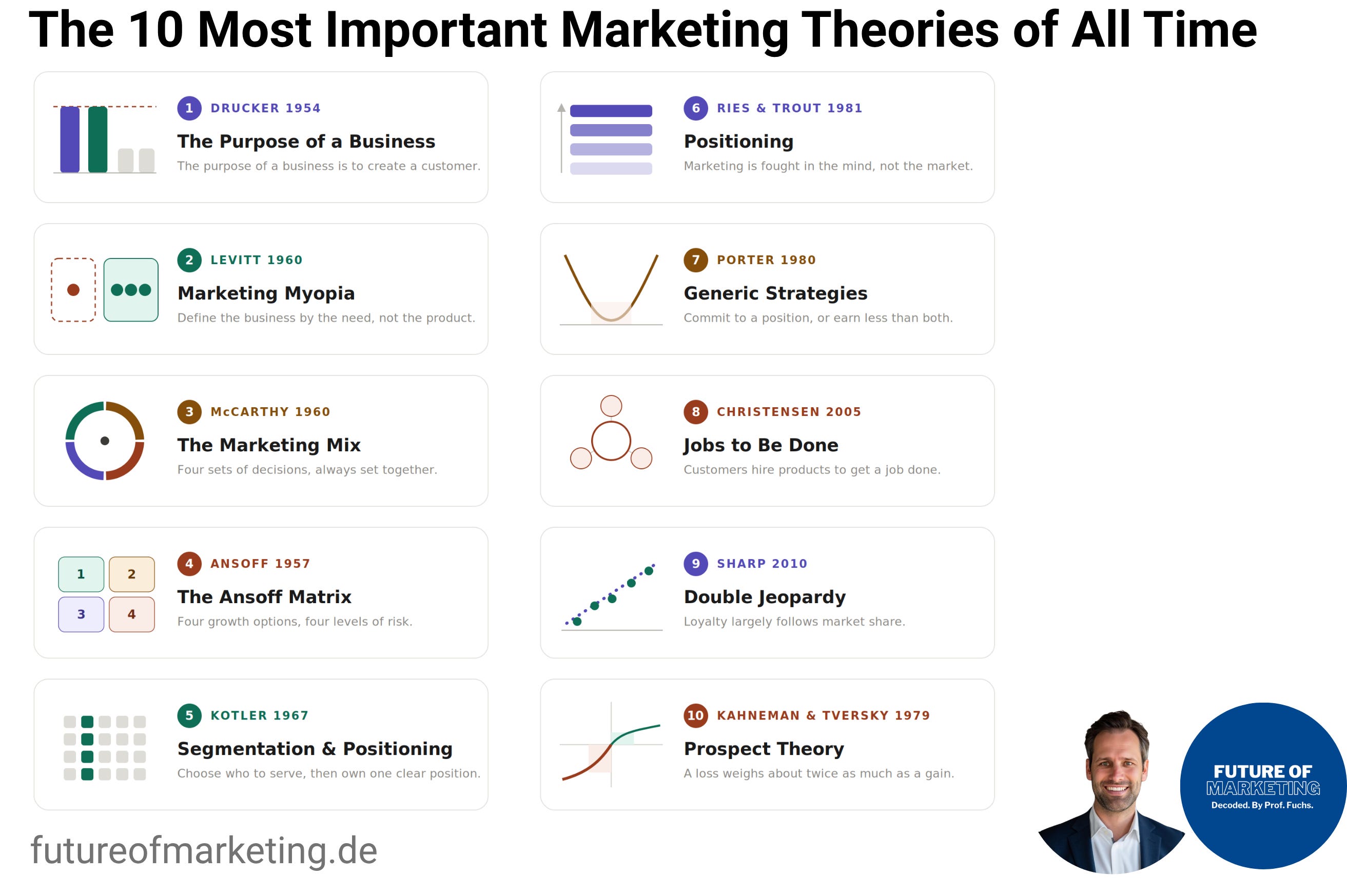
The ten theories below made this list on three criteria. Each one changed how practitioners actually work, each has survived at least one technology shift that was supposed to kill it, and each still generates a decision rather than just a description. They’re ordered roughly by publication, which also happens to trace marketing’s shift from a descriptive corner of economics into a management science with its own empirical base. Together they’re the set of ideas every marketer and CMO is expected to have an opinion about.
Two caveats before we start. Any list of ten is a set of choices, and reasonable people put Kotler’s 4Cs, Aaker’s brand equity, or Vargo and Lusch’s service-dominant logic on theirs. And a theory surviving isn’t the same as a theory being complete. Several of the ten below directly contradict each other, which is part of what makes them useful.
1. The Purpose of Business (Peter F. Drucker, 1954)
“Because it is its purpose to create a customer, any business enterprise has two, and only two, basic functions: marketing and innovation. Marketing and innovation produce results; all the rest are costs.” (Drucker, 1954, p. 37)
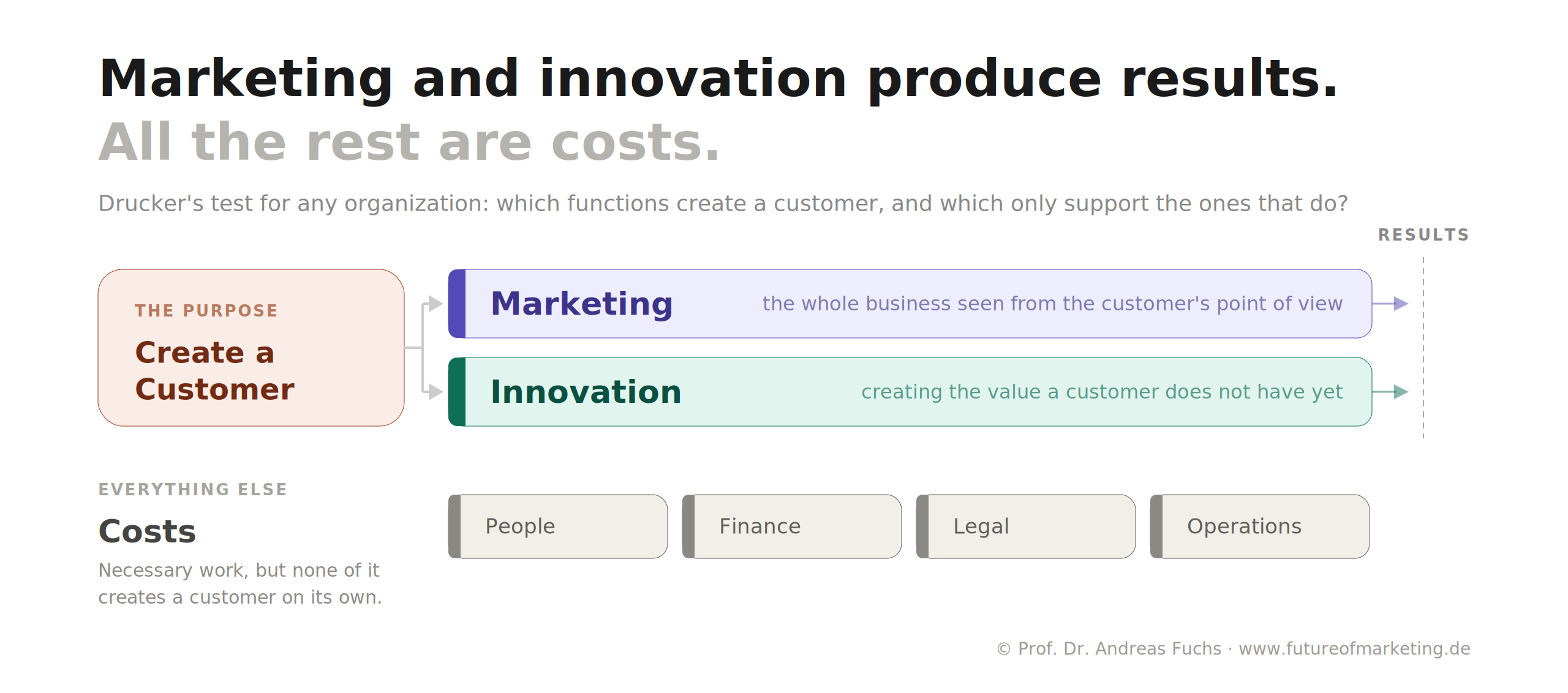
The idea. Drucker’s move was philosophical before it was managerial. A business is an organ of society, so its purpose has to sit outside itself. Profit isn’t the reason a company exists; profit is the test of whether its decisions were right (Drucker, 1954). From that single premise he derived the claim that still unsettles most org charts: marketing isn’t a department, it’s the whole business seen from the customer’s side. Drucker went further and argued that marketing done well makes selling largely unnecessary, because a genuinely understood customer arrives ready to buy.
Why it still matters. Every serious go-to-market conversation eventually collapses back into Drucker’s three questions: who’s the customer, what do they consider value, and who are the non-customers we’ve stopped noticing. That last one is where most hidden growth sits, and it’s the question quarterly dashboards are structurally bad at asking.
In the age of AI. AI is a scaling mechanism for Drucker’s ideal rather than a replacement for it. Systems can now hold far more customer detail than any account team could, which moves the enterprise closer to the state where the product sells itself. What doesn’t transfer is the definition of value, which stays a human judgment about what people are actually trying to achieve.
2. Marketing Myopia (Theodore Levitt, 1960)
“Selling is preoccupied with the seller’s need to convert his product into cash; marketing with the idea of satisfying the needs of the customer by means of the product and the whole cluster of things associated with creating, delivering and finally consuming it.” (Levitt, 1960, p. 50)
The idea. Levitt argued that industries don’t decline because markets saturate. They decline because management defines the business too narrowly (Levitt, 1960). The American railroads didn’t lose to trucks and airlines because demand for transport fell. They lost because they thought they were in the railroad business rather than the transportation business. Levitt named four assumptions that produce this blindness: that a growing population guarantees growth, that no substitute for your product exists, that scale and falling unit costs are protection, and that technical product refinement counts as customer focus.
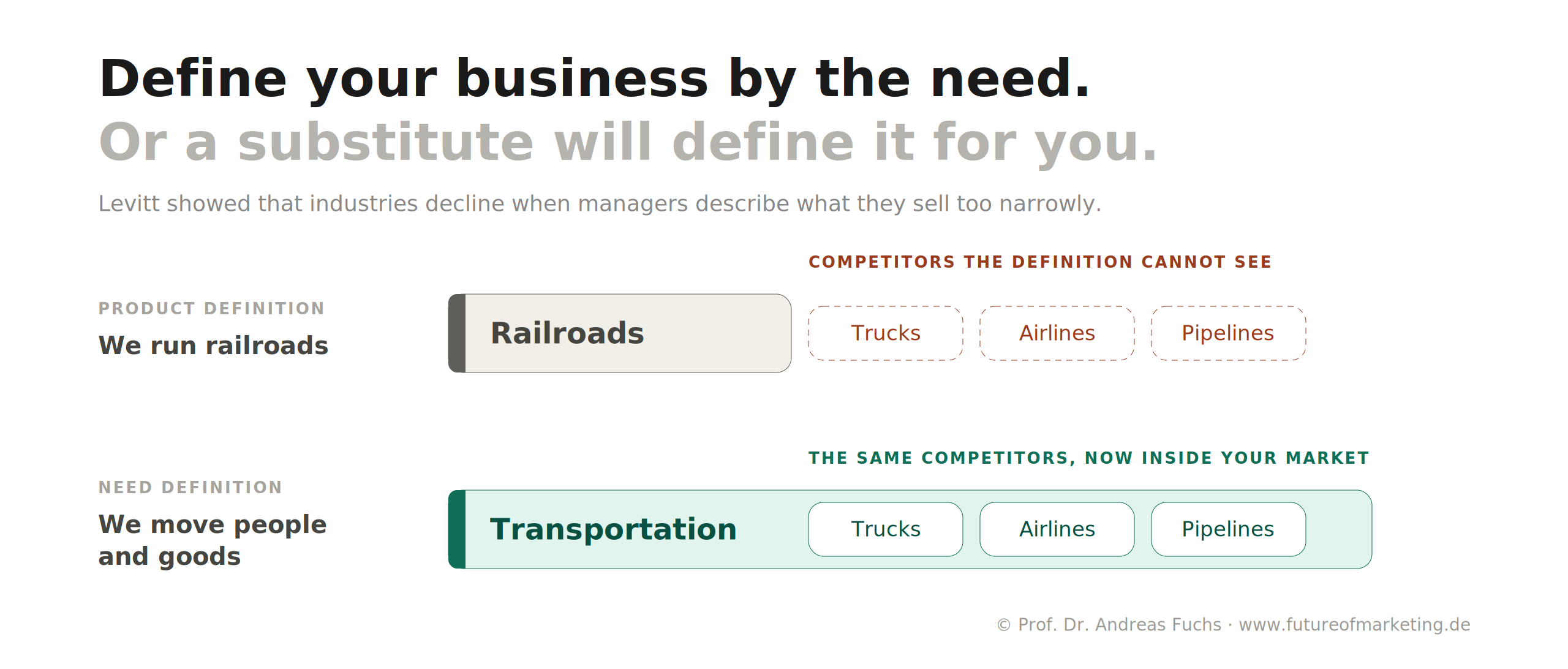
Why it still matters. Myopia is the cheapest failure mode available to a well-run company, because everything looks fine right up until it doesn’t. The corrective is a definitional exercise most leadership teams avoid: state what need you satisfy in language that doesn’t mention your product.
In the age of AI. A newer form of the same error has appeared, sometimes described as new marketing myopia, where firms treat customers as data points rather than people with lives and stakeholders (Smith, Drumwright, & Gentile, 2010). The AI version is automating a legacy process very efficiently instead of asking whether the process should exist.
3. The Marketing Mix, or 4Ps (E. Jerome McCarthy, 1960)
Core claim: the marketing manager’s controllable variables reduce to four, Product, Price, Place and Promotion, and they have to be mixed as a set rather than decided separately (McCarthy, 1960).
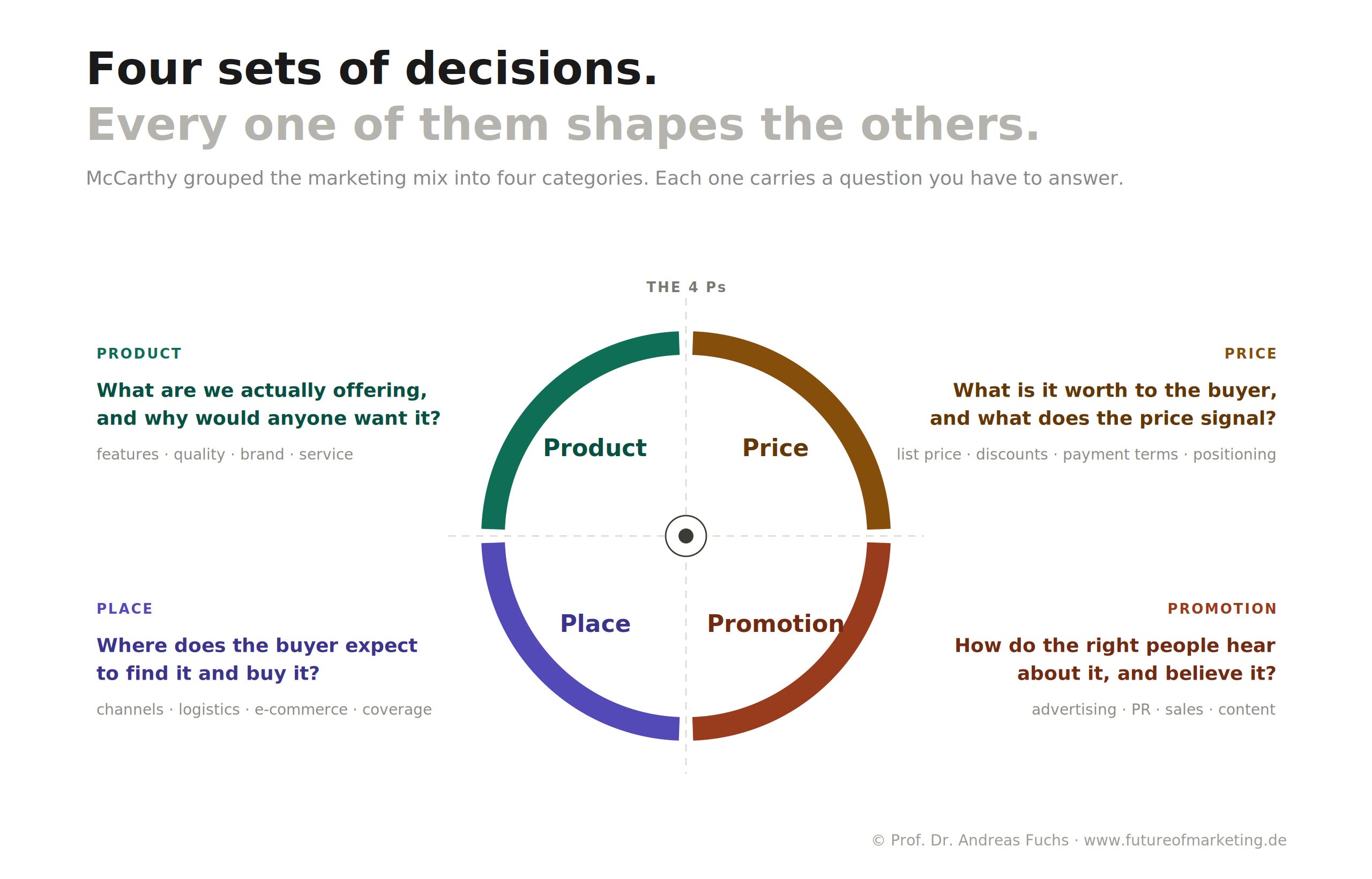
The idea. McCarthy condensed Neil Borden’s sprawling checklist of marketing variables into a four-part taxonomy that a manager could actually hold in their head (McCarthy, 1960). The pedagogical genius was the alliteration; the analytical substance was the insistence that these are a mix. Change the price and you’ve changed what the promotion has to accomplish. Change the channel and you’ve changed what the product needs to be. The 4Ps turned marketing from something you described into something you decided.
Why it still matters. It’s still the default teaching frame worldwide, and it still does the one job most marketing plans fail at, which is forcing attention onto product design and distribution instead of letting communication absorb the whole budget. Services marketing extended it to 7Ps with People, Process and Physical Evidence (Booms & Bitner, 1981).
In the age of AI. The boundaries between the four have gone porous. Product gets co-created with user communities, Price is set by algorithms that retest continuously, Place has become an algorithmic feed and increasingly an AI assistant’s recommendation, and Promotion is generated at a volume no team could review. The mix logic survives; the assumption that a human sets each dial by hand doesn’t.
4. The Product-Market Growth Matrix (H. Igor Ansoff, 1957)
“The product-market strategy is a joint statement of a product line and the corresponding set of missions which the products are designed to fulfill.” (Ansoff, 1957, p. 114)
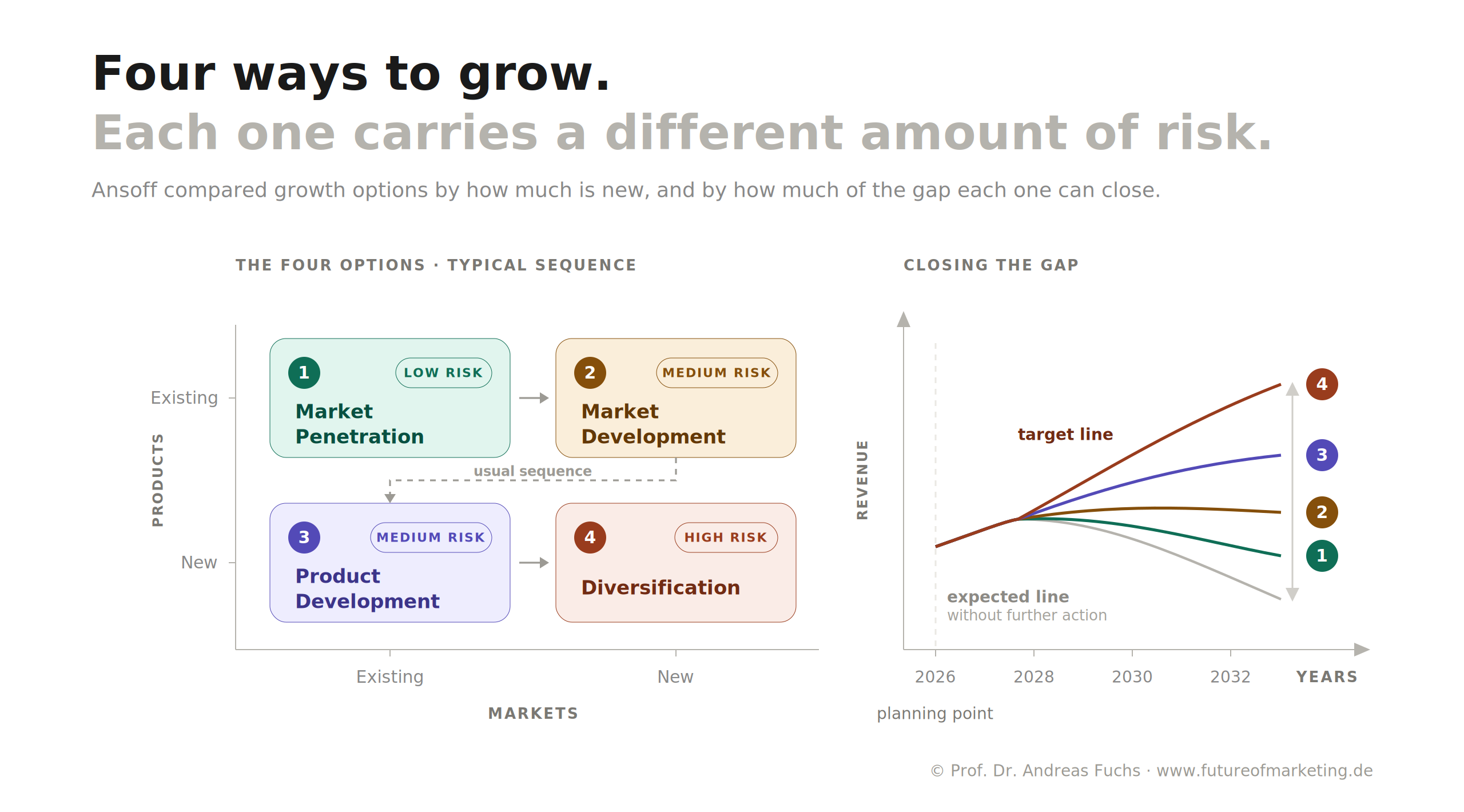
The idea. Ansoff’s contribution was to make growth options comparable by risk. Cross existing versus new products against existing versus new markets and you get four strategies: Market Penetration (more share of what you already sell to whom you already sell it), Market Development (existing products, new segments or geographies), Product Development (new products, current customers), and Diversification (new on both axes, and therefore the riskiest by construction) (Ansoff, 1957). Diversification splits further into concentric, horizontal and conglomerate paths depending on how much of the existing capability base carries over.
Why it still matters. The matrix is the fastest available sanity check on a growth plan. Most plans that feel ambitious turn out to be three simultaneous diversifications wearing a single label, and the matrix makes that visible in about ten minutes.
In the age of AI. AI has genuinely repriced two quadrants. Predictive analytics, automated localisation and translation have lowered the cost of Market Development, and small firms can now test international segments at a cost that used to require a subsidiary. The risk hierarchy holds; the absolute risk levels have moved.
5. Segmentation, Targeting, Positioning (Philip Kotler, 1967)
Core claim: strategic marketing is the sequence of dividing a heterogeneous market into segments, choosing which to serve, and designing a distinct position in the minds of that chosen group (Kotler, 1967; Kotler & Keller, 2016).
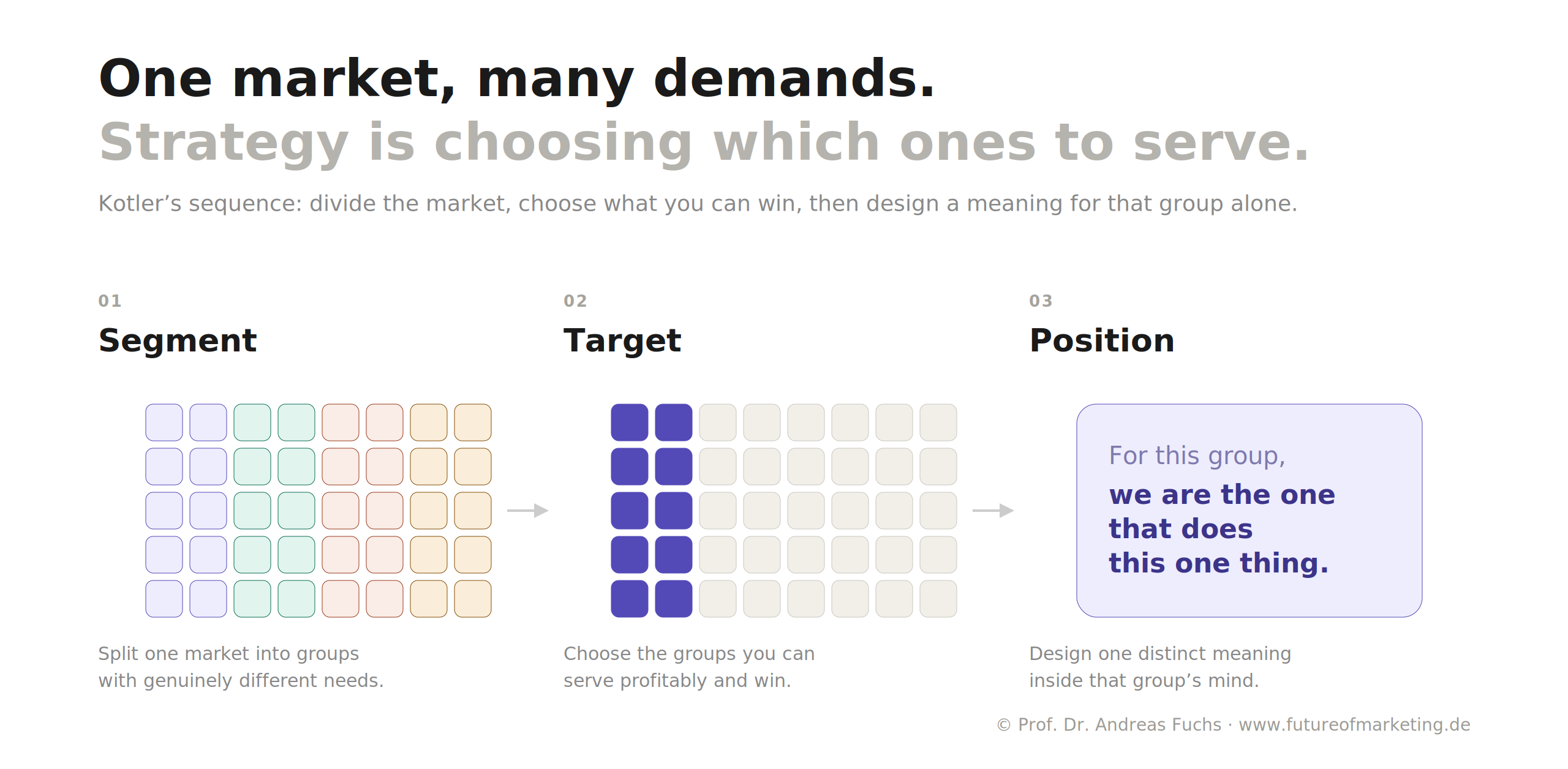
The idea. Wendell Smith had already argued that markets are collections of unlike demand curves rather than one large one (Smith, 1956). Kotler turned that insight into a repeatable managerial sequence and put it at the centre of the first edition of Marketing Management (Kotler, 1967), refining it across later editions into the STP formulation taught today. The criteria for a segment worth serving are the practical heart of it: it has to be measurable, substantial, accessible, differentiable and actionable (Kotler & Keller, 2016). Targeting then ranks segments by attractiveness against your ability to win them profitably. Positioning designs what the brand should mean, relative to alternatives, inside that specific group’s head.
Why it still matters. STP is the bridge between analysis and the marketing mix. Without it, the 4Ps get set against an imaginary average customer who doesn’t exist.
In the age of AI. Machine learning has pushed segmentation toward the segment of one, with targeting decided in real time per impression. Worth noting that this is exactly where theory nine on this list disagrees, and the disagreement is the most productive argument in modern marketing.
6. Positioning (Al Ries & Jack Trout, 1981)
“Positioning is not what you do to a product. Positioning is what you do to the mind of the prospect.” (Ries & Trout, 1981, p. 2)
The idea. Ries and Trout started from a claim about the audience rather than the brand: we live in an over-communicated society, and the mind defends itself by radically simplifying (Ries & Trout, 1981). It sorts categories into mental ladders and remembers roughly the top rungs. Winning therefore means occupying a position first, since dislodging an established rung is far more expensive than claiming an empty one. Their tactical advice followed from the cognitive claim: prefer descriptive names that anchor immediately, look for the gap nobody has taken, and where no gap exists, reposition the competitor by making their strength the reason to doubt them.
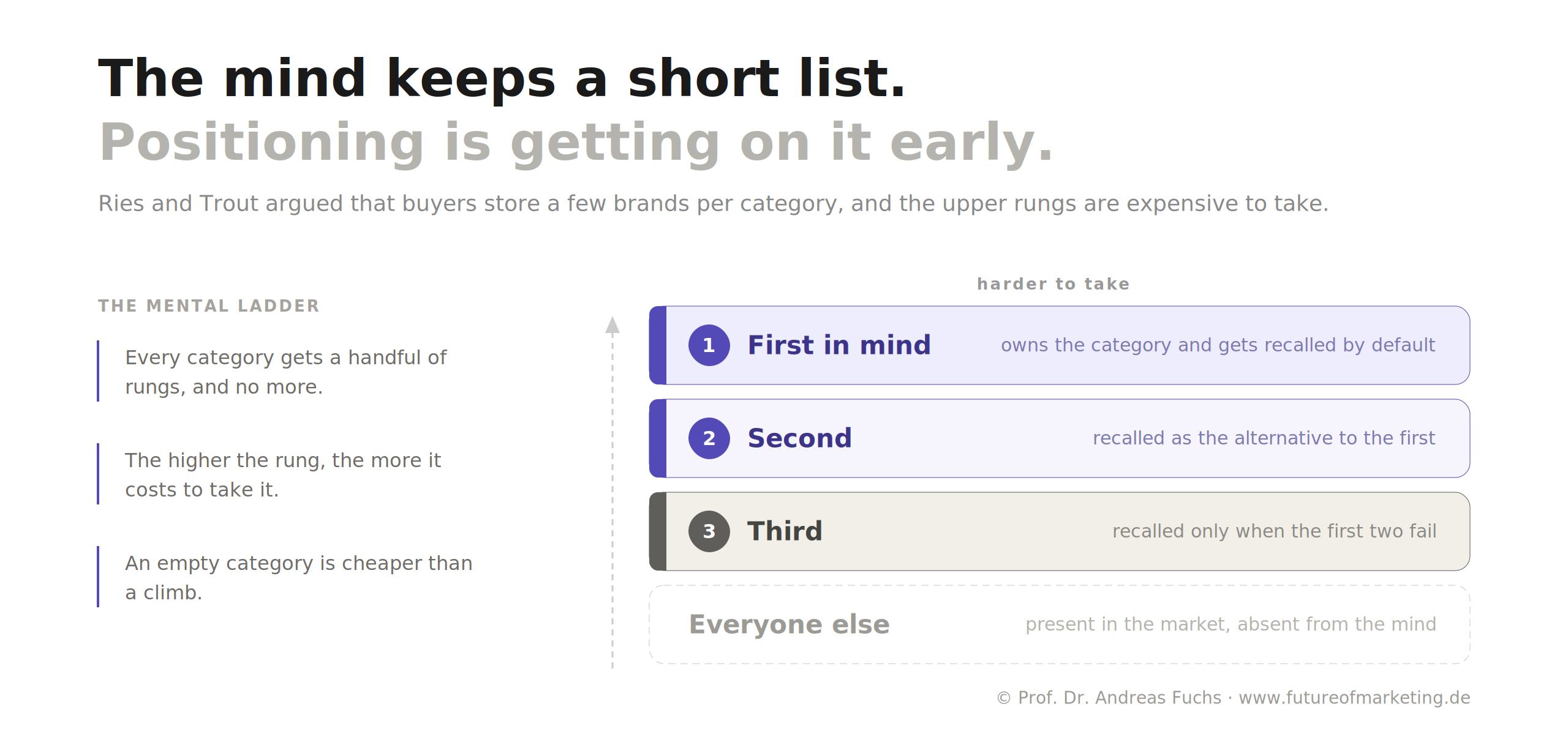
Why it still matters. Most positioning statements fail because they describe the company accurately instead of describing something a customer could plausibly store. Simplicity isn’t a stylistic preference here, it’s a constraint imposed by how attention works.
In the age of AI. The gatekeeper has changed. When a buyer asks an AI assistant rather than searching a list, the relevant question becomes whether the model retrieves you for the category, which is Generative Engine Optimization territory. The mental ladder now has a machine-readable twin, and brands need a rung on both.
7. Generic Competitive Strategies (Michael E. Porter, 1980)
“The firm stuck in the middle is almost guaranteed low profitability.” (Porter, 1980, p. 41)
The idea. Porter imported industrial organisation economics into strategy and argued that long-run profitability is set by industry structure, specifically the five forces of rivalry, new entrants, substitutes, supplier power and buyer power (Porter, 1980). Within that structure, a firm has three coherent paths to advantage: cost leadership, differentiation, or focus on a narrow segment. His sharpest warning concerned the firms that pick none of them. Trying to be somewhat cheap and somewhat special produces a blurred culture, contradictory investments, and margins that lose at both ends.
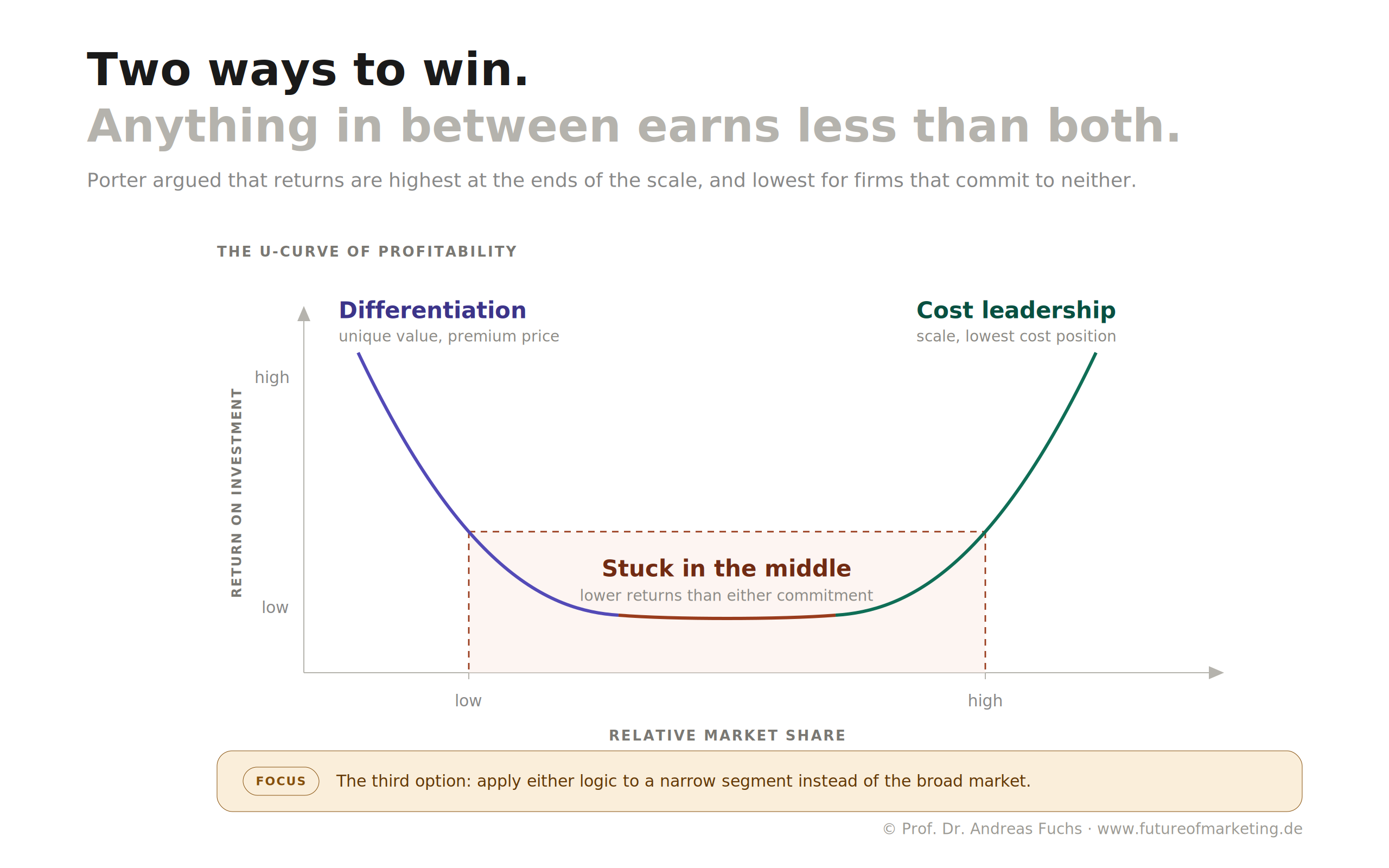
Why it still matters. The stuck-in-the-middle diagnosis is uncomfortable precisely because most companies are in it. Porter’s framework gives marketing a way to argue about strategy in economic terms rather than aesthetic ones. It has drawn substantial empirical challenge, with several studies finding hybrid positions that perform well, so treat it as a strong prior rather than a law.
In the age of AI. AI is widening both ends. Self-optimising operations push cost leadership toward a level of efficiency that’s hard to match manually, while generative systems make individualised experience cheap enough to serve as differentiation at scale. The middle is getting less habitable, not more.
8. Jobs to Be Done (Clayton M. Christensen, 2005)
Core claim: customers don’t buy products, they hire them to make progress in a specific circumstance (Christensen, Cook, & Hall, 2005).
The idea. Christensen’s reframing was to make the unit of analysis the situation rather than the person (Christensen, Cook, & Hall, 2005). A job has a functional dimension (the practical task), a social one (how it makes you look), and an emotional one (how it makes you feel). The milkshake study is the standard illustration: a large share of morning purchases came from commuters who weren’t buying a beverage so much as hiring something viscous enough to occupy a boring twenty-minute drive and keep them full until lunch. Its real competitors were bananas and bagels, none of which appear in a beverage category report.
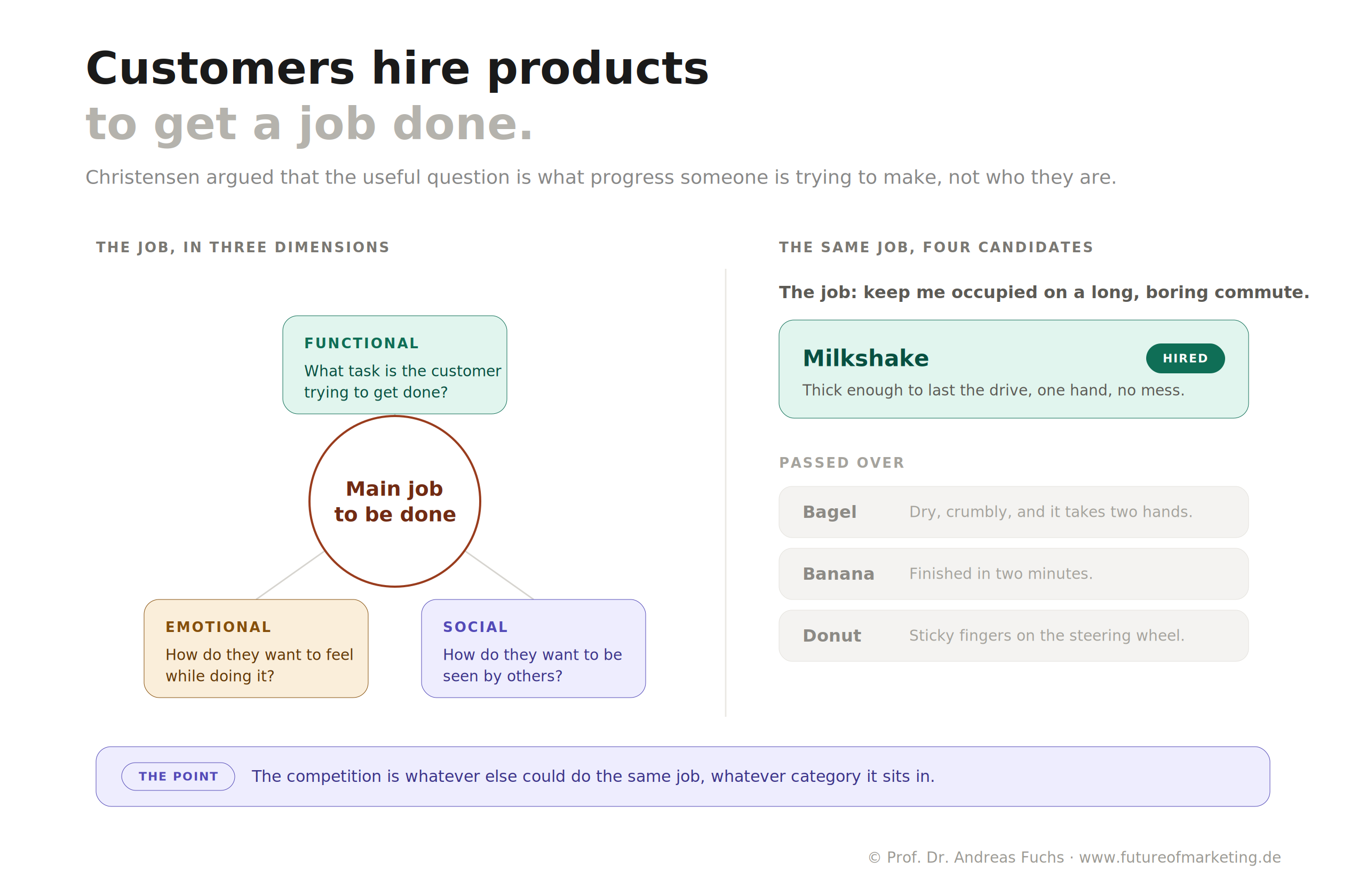
Why it still matters. Demographics tell you who bought. Jobs tell you why, and therefore what would have to change for someone to buy again. The most useful derivative question is which product a customer has to fire in order to hire yours.
In the age of AI. The framework is unusually stable under technological change, because the jobs people want done move far more slowly than the tools built to do them. That’s also the practical guide to which AI features will last: the ones attached to a durable job survive, the ones attached to a current interface don’t.
9. Empirical Laws of Brand Growth (Byron Sharp, 2010)
Core claim: brands grow mainly by acquiring light and non-buyers through broad reach, and loyalty follows from size rather than causing it (Sharp, 2010).
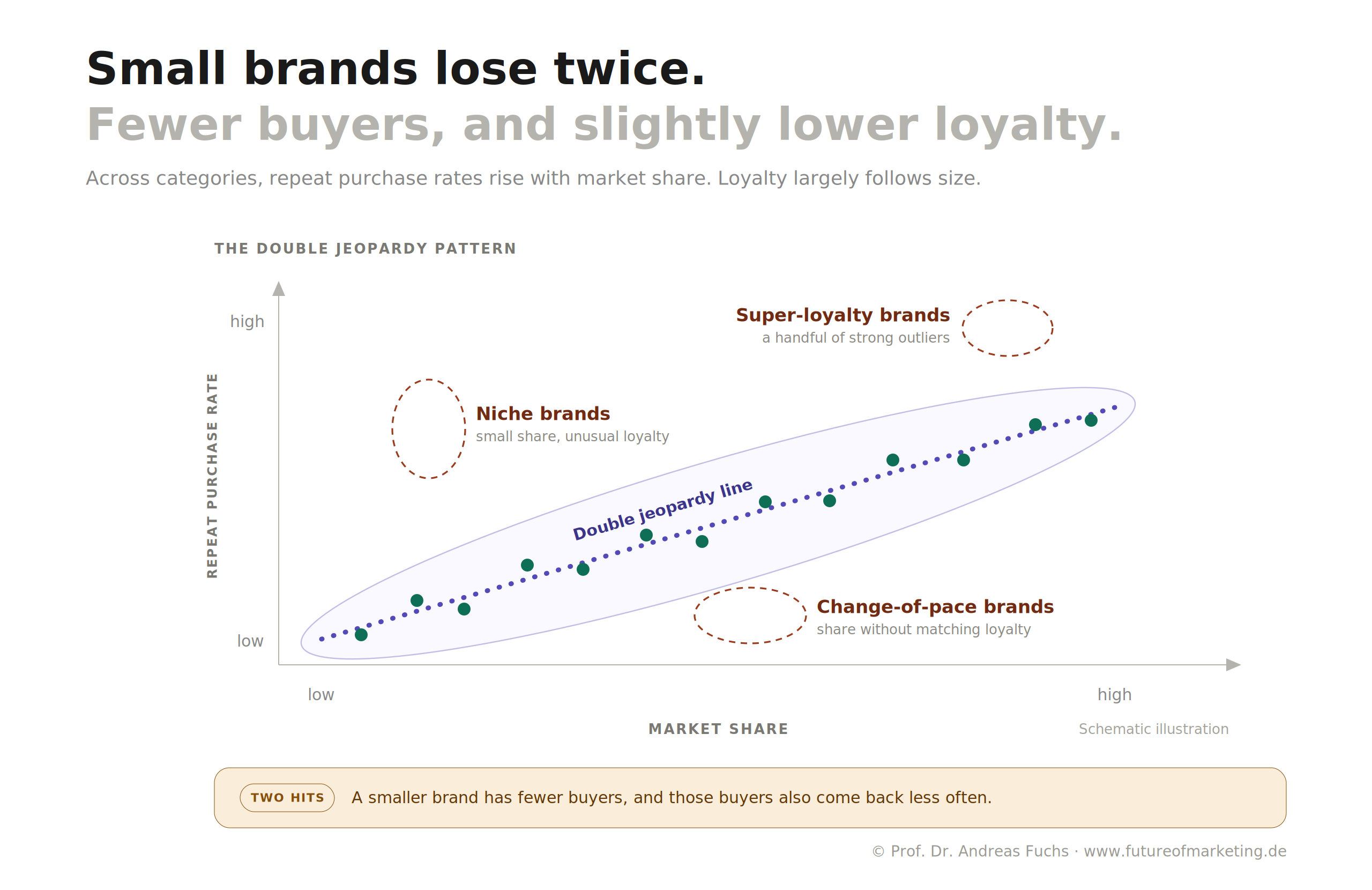
The idea. Sharp’s book synthesised decades of purchase-panel research from the Ehrenberg-Bass Institute and used it to test marketing beliefs against data (Sharp, 2010). The central finding is the law of double jeopardy, documented earlier by Ehrenberg and colleagues: smaller brands are penalised twice, with fewer buyers and slightly lower loyalty among the buyers they have (Ehrenberg, Goodhardt, & Barwise, 1990). Since loyalty varies far less than penetration does, growth comes overwhelmingly from reaching more category buyers. Sharp’s operational programme follows: build mental availability so the brand comes to mind in buying situations, build physical availability so it’s easy to buy, and do both through distinctive brand assets such as colours, characters and sonic cues that aid recognition without requiring a functional difference.
Why it still matters. This is the most consequential empirical challenge to the segmentation-first tradition, and it changed budget allocation at companies including Coca-Cola and Mars. Taking it seriously means accepting that some cherished targeting precision is expensive noise.
In the age of AI. Programmatic systems optimise beautifully for the narrow targeting Sharp argues against, which is worth watching when you read your own performance reports. On the other hand, AI-mediated purchasing raises the stakes on physical availability, since being absent from the assistant’s retrievable set is the modern equivalent of being out of stock.
10. Prospect Theory (Daniel Kahneman & Amos Tversky, 1979)
“The value function is normally concave for gains, commonly convex for losses, and is generally steeper for losses than for gains.” (Kahneman & Tversky, 1979, p. 279)
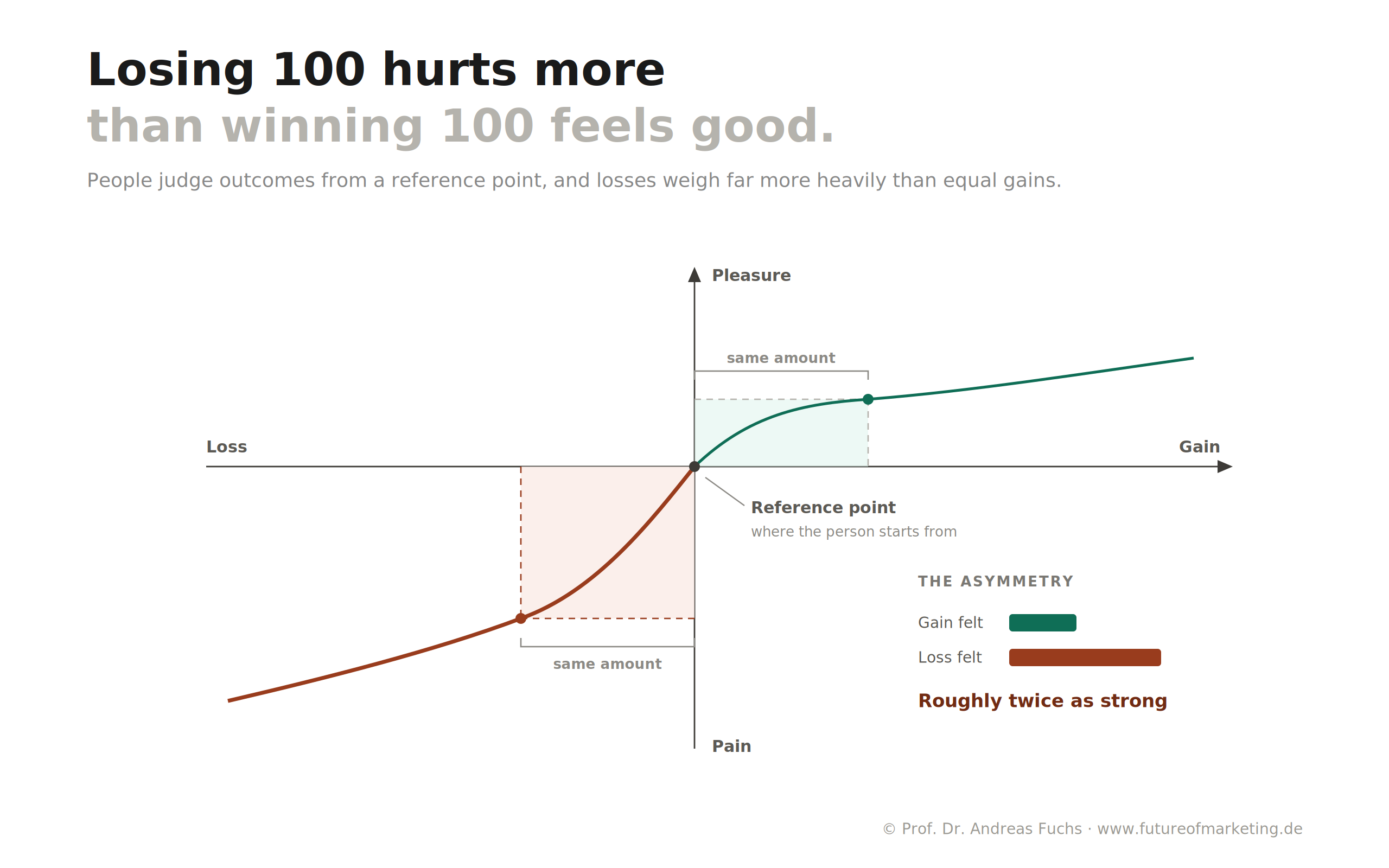
The idea. Prospect theory replaced the rational utility maximiser with a description of how people actually decide under risk (Kahneman & Tversky, 1979). Three findings do most of the work. Reference dependence: outcomes are judged as changes from a reference point, not as absolute states. Loss aversion: losing hurts more than an equivalent gain pleases, with later estimates putting the ratio near 2:1 (Tversky & Kahneman, 1992). Diminishing sensitivity: the difference between 10 and 20 feels larger than between 110 and 120. Together they explain why framing changes decisions when the underlying facts don’t, and why the identical clinical outcome reads differently as a survival rate than as a mortality rate.
Why it still matters. Pricing, packaging, onboarding and churn prevention all run on reference points. Free trials work partly because they install ownership as the reference point, after which cancelling registers as a loss. Anchor design, default selection and how a discount is expressed all shift behaviour without changing economics.
In the age of AI. Optimisation systems find these biases whether or not anyone intended them to, which is how artificial scarcity, countdown timers and confirmshaming became standard. The same mechanics can be pointed the other way, toward defaults that help people choose what they’d endorse on reflection. That’s an ethical choice made in the objective function, not in the copy.
👉 Key Takeaways
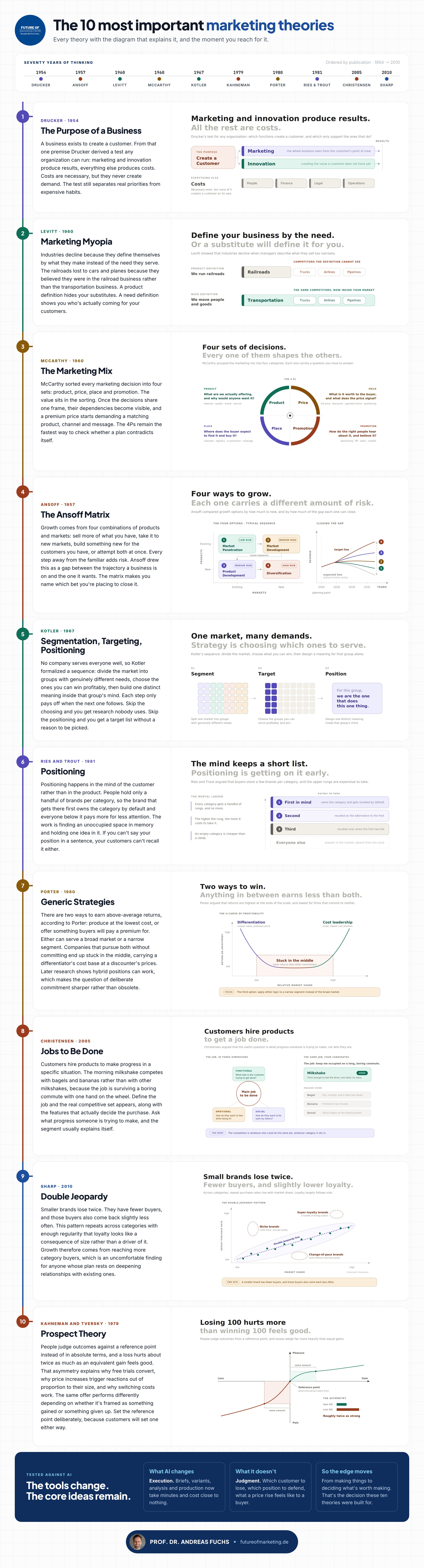
Here are all ten marketing theories summarized in one infographic:
A business exists to create a customer. Drucker’s test still separates the two functions that produce results, marketing and innovation, from everything else that only costs money.
Define the business by the need, not the product. Levitt’s warning is the cheapest insurance a well-run company can buy, because myopia looks like health right up until a substitute arrives.
Frameworks earn their keep by forcing decisions. The 4Ps, STP and the Ansoff matrix each turn a vague growth ambition into a specific choice with a known cost attached.
An unclear position is expensive. Ries and Trout price it in memory, Porter prices it in margin, and Sharp and Kotler still disagree about how wide to aim.
Demand is human before it’s data. Jobs to be done and prospect theory explain why identical offers perform differently, and AI will optimise against those human quirks by default unless you specify otherwise.
Theories have never been less fashionable and never been more useful. When producing a campaign took weeks, the constraint was execution, and a framework was a nice-to-have. Now that a competent draft of almost anything arrives in seconds, the constraint has moved to judgment. Which customer, which position, which trade-off you’re willing to live with. That’s the work these ten theories were built for, and it’s the work that doesn’t get easier when the output gets cheaper.
The practical value is that a theory travels. A tactic that worked last quarter tells you what happened once. A theory tells you what to look for in a situation you haven’t seen yet, which is most situations right now.
Now I’d like to hear from you: Which theory is missing from this list? Kotler’s 4Cs, Aaker on brand equity, service-dominant logic and the diffusion of innovations were all serious candidates. And which one is your favourite, the one you actually reach for when a decision gets hard? Leave a comment, disagree with my selection, and tell me which theory earned its place in your own practice.
Yours,
Prof. Dr. Andreas Fuchs 🦊🎓
References
Ansoff, H. I. (1957). Strategies for diversification. Harvard Business Review, 35(5), 113–124.
Booms, B. H., & Bitner, M. J. (1981). Marketing strategies and organization structures for service firms. In J. H. Donnelly & W. R. George (Eds.), Marketing of services (pp. 47–51). American Marketing Association.
Christensen, C. M., Cook, S., & Hall, T. (2005). Marketing malpractice: The cause and the cure. Harvard Business Review, 83(12), 74–83.
Drucker, P. F. (1954). The practice of management. Harper & Brothers.
Ehrenberg, A. S. C., Goodhardt, G. J., & Barwise, T. P. (1990). Double jeopardy revisited. Journal of Marketing, 54(3), 82–91.
Kahneman, D., & Tversky, A. (1979). Prospect theory: An analysis of decision under risk. Econometrica, 47(2), 263–291.
Kotler, P. (1967). Marketing management: Analysis, planning, and control. Prentice-Hall.
Kotler, P., & Keller, K. L. (2016). Marketing management (15th ed.). Pearson.
Levitt, T. (1960). Marketing myopia. Harvard Business Review, 38(4), 45–56.
McCarthy, E. J. (1960). Basic marketing: A managerial approach. Richard D. Irwin.
Porter, M. E. (1980). Competitive strategy: Techniques for analyzing industries and competitors. Free Press.
Ries, A., & Trout, J. (1981). Positioning: The battle for your mind. McGraw-Hill.
Sharp, B. (2010). How brands grow: What marketers don’t know. Oxford University Press.
Smith, N. C., Drumwright, M. E., & Gentile, M. C. (2010). The new marketing myopia. Journal of Public Policy & Marketing, 29(1), 4–11.
Smith, W. R. (1956). Product differentiation and market segmentation as alternative marketing strategies. Journal of Marketing, 21(1), 3–8.
Tversky, A., & Kahneman, D. (1992). Advances in prospect theory: Cumulative representation of uncertainty. Journal of Risk and Uncertainty, 5(4), 297–323.
This article is an amazing journey through the history of marketing.
A useful reminder that AI does not make marketing theory obsolete. It makes theory more important.
When execution becomes cheaper and faster, the real constraint shifts from production to judgement: which customer to serve, which problem to solve, which position to occupy, and which trade-offs to accept. That is why frameworks from Drucker, Levitt, Porter, Kotler, Christensen or Kahneman remain highly relevant even in an AI-driven environment. (Future of Marketing)
I would add one important observation: some of these theories become even more powerful when applied to complex, regulated B2B markets.
Levitt’s Marketing Myopia is particularly relevant. An IVD company should not define itself as selling analysers, reagents or assays, but as helping laboratories improve diagnostic quality, workflow efficiency, clinical decision-making and operational resilience.
Jobs to Be Done is equally powerful. An IVD clinical laboratory does not “hire” a new diagnostic platform simply to run tests. It may be hiring it to reduce turnaround-time variability, compensate for staff shortages, standardise multiple sites, reduce reruns, mitigate regulatory risk or improve uptime.
Porter and STP also remain essential because specialised IVD companies cannot realistically compete everywhere. Choosing the right segment, and deliberately deciding where not to compete, is often more important than adding another campaign or another channel.
I would also give Prospect Theory a particularly important role in healthcare. In diagnostics, customers are highly loss- and risk-sensitive. The perceived risk of changing platforms, downtime, LIS integration, retraining, validation and disruption to patient care, may outweigh the promised upside of superior technology. Successful marketing therefore needs to reduce the perceived risk of change, not simply communicate more benefits.
If I were to add one theory to the list for healthcare and IVD, it would probably be Diffusion of Innovations. Diagnostic technologies rarely move directly from launch to broad adoption. KOLs, reference laboratories, early adopters, peer evidence and successful implementation sites strongly influence how the rest of the market reduces uncertainty and follows.
The broader lesson is compelling: AI can generate the artefact, but it cannot decide whether we are solving the right problem.
In complex markets, strategy still begins with theory, evidence and judgement, not with the prompt.