

I’ve been quiet for three weeks.
Not because the world slowed down.
But because mine did.
My son was born.
And nothing recalibrates your sense of relevance, urgency, and signal versus noise more effectively than that.
When you return after such a pause, one thing becomes painfully obvious:
Most debates in marketing are far too narrow for the moment we are living in.
The Illusion of AI as the Single Big Theme
If you’ve followed my recent writing, you might think everything currently revolves around agentic marketing: AI agents. Task-driven organizations. Machines mediating choice. All of that matters. Deeply.
But it is not the whole story.
Marketing leaders are not obsessed with a single technology shift. They are navigating a stack of simultaneous tensions:
trust and efficiency
brand and ROI
data and privacy
speed and meaning.
And this becomes visible only when you step back from individual essays and consider the broader pattern they form.
👉 Read this article to the end.
What CMOs Are Actually Thinking About
McKinsey’s State of Marketing Europe 2026 report offers a rare empirical snapshot of this reality. Based on interviews with 500 senior marketing leaders across Europe, it doesn’t ask what should matter, but what does.
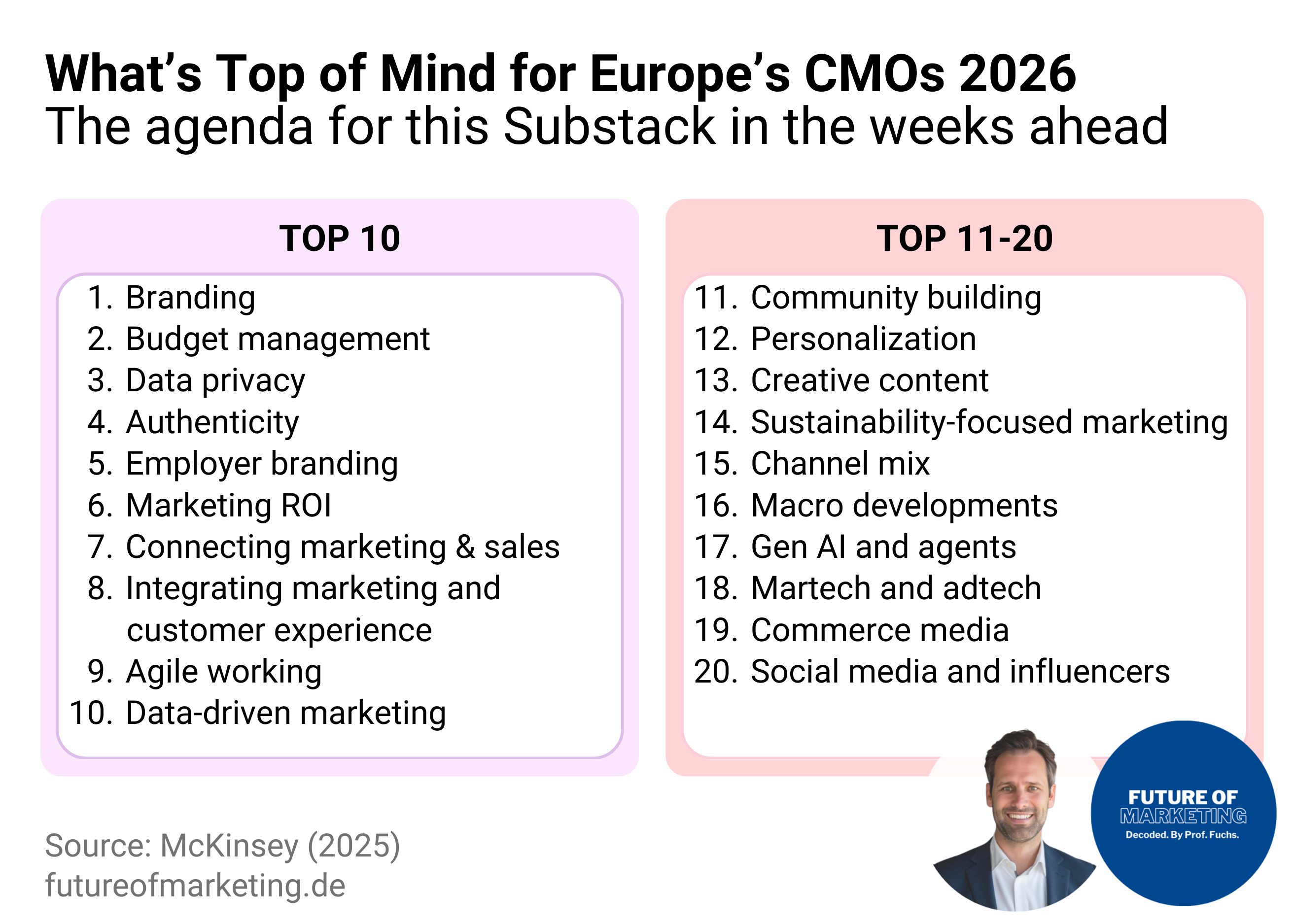
The result is not a hype list. It is an agenda.
What follows is not just an overview of topics, but a preview of what this Substack (Future of Marketing) will explore in depth over the coming weeks and months. Each of these themes will be unpacked in dedicated deep dives here on Substack. One topic at a time. One structural lens at a time.
Top 10: The Core Agenda of the next months
A preview of the deep dives to come:
Branding: Branding has returned to the top not despite technological acceleration, but because of it. As interfaces, platforms, and algorithms increasingly mediate choice, brand becomes the last stable orientation point for customers. In the coming deep dive, we’ll look at branding as long-term infrastructure: how emotional relevance, distinctiveness, and consistency function as economic assets in volatile markets, and why CMOs are doubling down on brand building precisely when pressure to cut grows strongest.
Budget Management: Budget management is no longer an operational concern; it is a governance question. CMOs are expected to allocate capital with CFO-level rigor while still defending long-term investments that don’t pay back within a quarter. This topic will explore how marketing leaders balance short-term efficiency with through-cycle investment logic, and why disciplined allocation is now inseparable from strategic credibility in the C-suite.
Data Privacy: Privacy has evolved from compliance to competitive signal. In Europe especially, how a company governs data has become inseparable from how much it is trusted. The deep dive will examine why privacy failures destroy brand equity faster than failed campaigns, how consent and governance shape customer relationships, and why trust is increasingly encoded in systems rather than statements.
Authenticity: Authenticity is no longer about tone of voice or storytelling techniques. In a world of synthetic content and AI-generated media, credibility emerges from coherence over time. This section will explore authenticity as a systemic property: how transparency, consistency, and proof replace performance, and why audiences now infer truth rather than accept claims.
Employer Branding: Talent markets have become belief markets. Employer branding now mirrors consumer branding, driven by purpose, culture, and credibility rather than compensation alone. What has changed fundamentally is ownership: employer branding is no longer an HR topic, but a marketing one. Candidates trust people more than promises, and employees have become the most credible media channel an organization has. As internal and external brand narratives collapse into one, corporate influencers play a growing role in shaping employer reputation through lived experience rather than managed messaging.
Marketing ROI: Marketing ROI sits at the intersection of legitimacy and survival. Boards demand proof, yet traditional attribution models increasingly fail in privacy-constrained, multi-touch environments. This deep dive will unpack why CMOs are shifting toward probabilistic measurement, incrementality, and holistic models, and how ROI is becoming a shared language between marketing, finance, and strategy.
Connecting Marketing and Sales: Growth does not happen in departments; it happens in systems. The persistent gap between marketing and sales is no longer an inefficiency but a structural risk. We’ll explore how leading organizations are dissolving functional boundaries, aligning incentives, and redesigning operating models so that demand generation and conversion operate as one continuous mechanism.
Integrating Marketing and Customer Experience: The brand promise is no longer communicated; it is executed. Customer experience has become the most powerful brand channel, whether organizations intend it or not. This topic will examine how CMOs increasingly take custody of the end-to-end journey, why experience consistency matters more than message consistency, and how systems deliver meaning repeatedly or not at all.
Agile Working: Agility has moved from methodology to survival trait. Annual plans fracture under volatility, and static hierarchies struggle with exponential change. We’ll look at how agile ways of working reshape decision rights, speed, and accountability, and why cultural change, not process theater, determines whether agility creates clarity or chaos.
Data-Driven Marketing: Data-driven marketing is no longer about dashboards. It is about shared reality. As organizations scale analytics, the challenge shifts from access to alignment: which numbers matter, who trusts them, and how decisions are made. This deep dive will explore data as a coordination mechanism across teams rather than a reporting layer.
Top 11–20: The Orbiting Forces
A preview of the extended list of deep dives to come in the next months:
Community Building: Community is re-emerging as a counterweight to fragmentation and algorithmic mediation. Beyond reach and engagement, communities create belonging, resilience, and advocacy. We’ll explore why CMOs increasingly invest in two-way relationships, how communities function as trust reservoirs, and why they resist short-term optimization logic.
Personalization: Personalization is moving from rules to systems. With GenAI, one-to-one experiences become technically feasible, but organizationally complex. This topic will examine where personalization truly creates value, how privacy and relevance interact, and why poorly governed personalization erodes trust faster than generic communication.
Creative Content: Creativity has quietly slipped down the ranking, yet its importance has not diminished. In oversaturated environments, creativity is the only sustainable differentiator. We’ll look at why creativity is being reframed as an efficiency lever, how GenAI raises the creative floor but not the ceiling, and why human judgment remains irreplaceable.
Sustainability-focused Marketing: Sustainability is shifting from positioning to proof. As greenwashing fatigue rises, only operational substance survives scrutiny. This deep dive will explore how sustainability claims intersect with trust, regulation, and long-term brand value, and why CMOs must increasingly align messaging with verifiable impact.
Channel Mix: Channel strategy is becoming fluid, not optimized. As discovery fragments across platforms, creators, and AI-driven interfaces, channel mix decisions turn into portfolio bets under uncertainty. We’ll explore how CMOs balance reach, attention quality, and control, and why channel strategy is increasingly revisited rather than fixed.
Macro Developments: Marketing does not operate outside history. Geopolitics, inflation, demographic shifts, and technological power concentrations shape consumer behavior long before campaigns do. This topic will connect macro uncertainty to brand trust, pricing power, and investment logic, highlighting why CMOs are becoming students of systems again.
GenAI and Agents: GenAI ranks low in priority but high in urgency. This contradiction defines the current moment. We’ll examine why many CMOs underestimate AI’s structural impact, how efficiency gains translate into strategic advantage, and why agentic systems represent a qualitative shift from automation to delegation.
MarTech and AdTech: The tech stack has become both enabler and bottleneck. Fragmentation, integration debt, and capability gaps limit value realization. This deep dive will focus on MarTech not as tooling, but as operating infrastructure, and why architecture decisions increasingly shape organizational speed and optionality.
Commerce Media: Commerce media blurs the line between marketing, sales, and platform economics. As retailers become media owners, attention turns into inventory. We’ll explore how this reshapes power dynamics, measurement logic, and the role of marketing within revenue engines.
Social Media and Influencers: Social platforms are no longer distribution channels; they are cultural arenas. Influencers function as trust proxies in fragmented attention economies. This topic will examine how credibility is borrowed, lost, or compounded through creators, and why social media increasingly reflects identity rather than promotion.
What Comes Next on This Substack
This essay is not a conclusion. It is a starting point.
The agenda outlined above is not about predicting the next tool or tactic. It is about understanding the pressures, trade-offs, and contradictions that define marketing leadership right now. Between growth and trust. Between efficiency and meaning. Between automation and responsibility.
Over the coming weeks and months, I will take each of these themes and explore them here on Substack. One at a time. In depth. Not as isolated trends, but as interconnected forces reshaping how marketing is practiced, governed, and judged.
This work is written for CMOs and senior marketing decision-makers who carry responsibility not just for performance, but for direction. For those who sit between the boardroom and the market, between strategy and execution, and who feel the weight of choices that compound over time.
Because marketing does not change when technology changes.
It changes when its underlying assumptions no longer fit reality.
This Substack is my attempt to examine that shift with distance rather than urgency, with structure rather than noise, and with a longer time horizon than the next quarter allows.
If marketing is becoming less about persuasion and more about coordination, then clarity, judgment, and restraint will matter more than speed.
That is the work ahead.
Yours,
Prof. Dr. Andreas Fuchs 🦊🎓
It's interesting how a new perspective, perhaps even a tiny human, can really recalibrate the whole AI 'single theme' narrative; very sharp insigth.
Congratulations on the new arrival Andreas! And welcome back. This was such an insightful piece and I loved point 11 about the importance of true community building for leveraging meaningful results. 🙏