

Why read this? Everyone is talking about AI agents, yet hardly anyone could sketch what an agent actually looks like. Vendors sell them, consultants recommend them, and boards ask for an agent strategy, while the thing itself stays a black box. A new study (preprint) opened the source code of eleven leading coding-agent systems: the flagship products Claude Code (Anthropic), Codex (OpenAI), Gemini CLI (Google) and Mistral Vibe (Mistral AI), plus the open-source projects OpenHands, Aider, Mini-SWE-Agent, Hermes, Pi, OpenCode and OpenClaw. The authors took them apart piece by piece. The result is the most concrete definition of an AI agent I’ve come across so far.
In 15 minutes you’ll know what’s inside an agent, where its real value sits, and which questions to ask before you let one work on your brand, your customers or your budget.
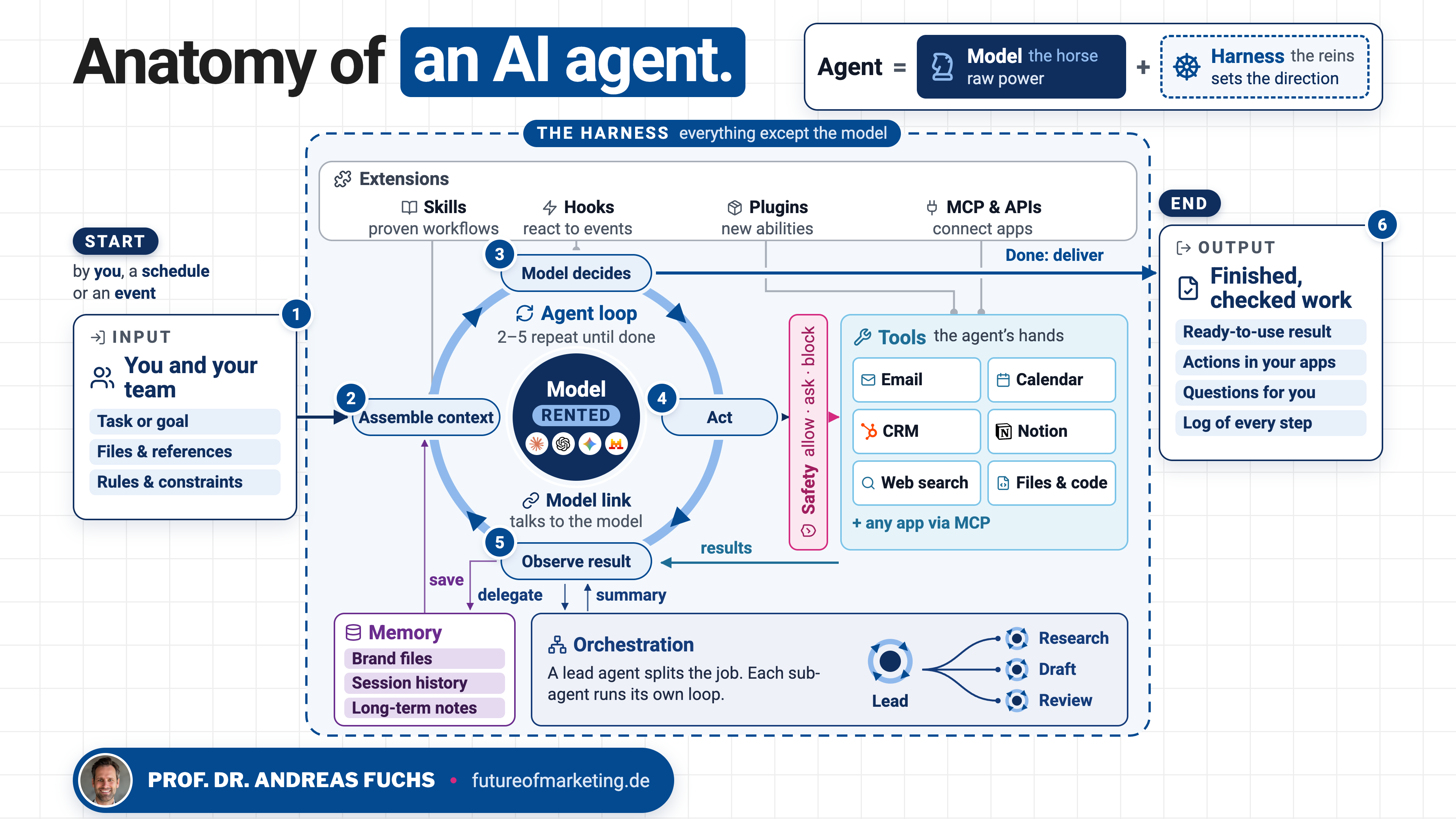
An AI agent is a language model plus a harness. The model supplies the intelligence. The harness is everything else: the software that gives the model a working loop, tools, memory, safety rules, coordination with other agents and ways to extend it (Barbaste et al., 2026, preprint). That one line, backed by a source-code audit of roughly four million lines, changes how marketing leaders should think about buying, building and governing agents.
The Horse and the Harness
For most of history, a horse was a powerful animal and not much more. Raw strength, but no direction. What turned that strength into farming, trade and transport wasn’t a better horse. It was the harness: the collar, the reins, the traces, the cart behind it. Historians often credit the padded horse collar of the Middle Ages with transforming European agriculture, because it let the animal pull with its shoulders instead of choking against a strap.
We’re in a similar moment with AI. Since ChatGPT, almost all attention has gone to the horse. Which model is smarter, faster, cheaper? Which one tops the leaderboard this month?
Meanwhile, the word “agent” has turned into a sticker that gets put on almost anything: a chatbot with a longer prompt, a workflow with an AI step in the middle, a system that runs for hours on its own. If you can’t define something, you can’t buy it well, govern it or build an organization around it.
That’s why this paper matters to marketers, even though it studies coding agents. Software development is where agents are most mature today. Developers adopted them first and pushed them hardest. The architecture you find in their source code today is a good preview of what will sit inside the marketing agents you’ll evaluate tomorrow.
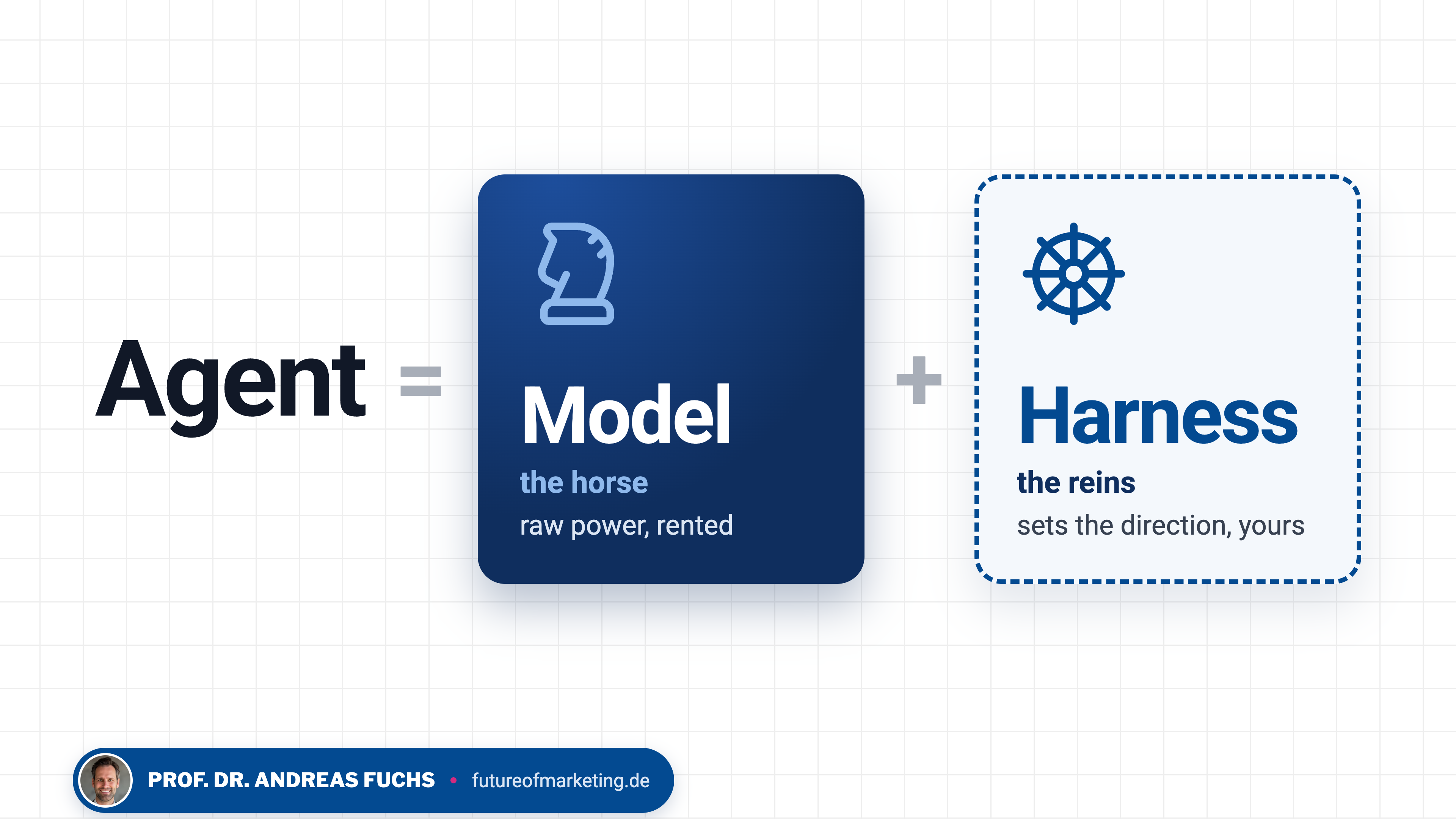
Agent = Model + Harness
The formula itself is young. The term harness engineering entered circulation in February 2026, first used in passing by developer Mitchell Hashimoto and then defined by Vivek Trivedy in LangChain’s engineering blog. Within a few months it had practitioner guides, academic papers and its own small family tree on arXiv (Barbaste et al., 2026, preprint).
What the young discipline lacked was a reference: an account, grounded in real production code, of what a harness actually contains. That’s the gap this study fills. Paul Barbaste, Tristan Darrigol, Germain Vu and Tom Wiltberger (Inclusive Brains and Wavestone AI Lab) read the source code of eleven coding-agent systems:
Four flagship products of the big model providers: Claude Code (Anthropic), Codex CLI (OpenAI), Gemini CLI (Google) and Mistral Vibe (Mistral AI).
Seven open-source systems: OpenHands, Aider, Mini-SWE-Agent, Hermes, Pi, OpenCode and OpenClaw.
They didn’t benchmark or rank anything. They described how these systems are built. And because they audited eight of them in April 2026 and again in July 2026, they could also observe how the same products changed within a single quarter.
One distinction from the paper is worth keeping in mind. A harness isn’t a framework. A framework is a library a developer imports to build an agent. A harness is a runtime you work inside of. You don’t program it in the classic sense. You configure it with plain-language instructions and a few text files.
The model is the horse: raw power you rent. The harness is the reins, and they’re yours: they set the direction and decide what the agent can touch, what it remembers and when it has to stop.
The Anatomy of an AI Agent
The study’s most useful contribution is a map. Every one of the eleven systems has to take a position on the same seven building blocks, from a research prototype with about 100 lines of code to a product with more than a million (Barbaste et al., 2026, preprint). It’s the map behind the graphic at the top of this article.
Here’s how to read it, following the numbers.
Input: Every run starts somewhere: with you, on a schedule or because an event happens. You and your team hand over a task or goal, the files and references it needs, and the rules and constraints it has to respect.
Assemble context: The harness puts together everything the model should see for this step: the task, the relevant files, your brand rules, the matching skills and whatever is stored in memory.
Model decides: The model at the center reads that context and decides what to do next. It’s the only part you rent, whether it comes from Anthropic, OpenAI, Google or Mistral. The model link handles how the harness talks to it: the prompt, caching and cost.
Act: The agent reaches for its tools, the agent’s hands: email, calendar, CRM, Notion, web search, files and code, plus any other app connected via MCP. Every action first passes the safety layer, which decides whether to allow it, ask a human or block it.
Observe result: The results flow back into the loop. What’s worth keeping gets saved to memory: brand files, session history, long-term notes. Then the loop starts again at step 2.
Output: Steps 2 to 5 repeat until the model decides the task is done. Then the agent delivers a ready-to-use result, actions completed in your apps, questions it needs you to answer, and a log of every step.
Two more building blocks sit around this loop. With orchestration, a lead agent splits a larger job and hands parts of it to sub-agents, for example for research, drafting and review. Each one runs its own loop and reports back a summary. Extensions plug into the harness from above: skills bring proven workflows, hooks react to events, plugins add new abilities, and MCP and APIs connect your apps.
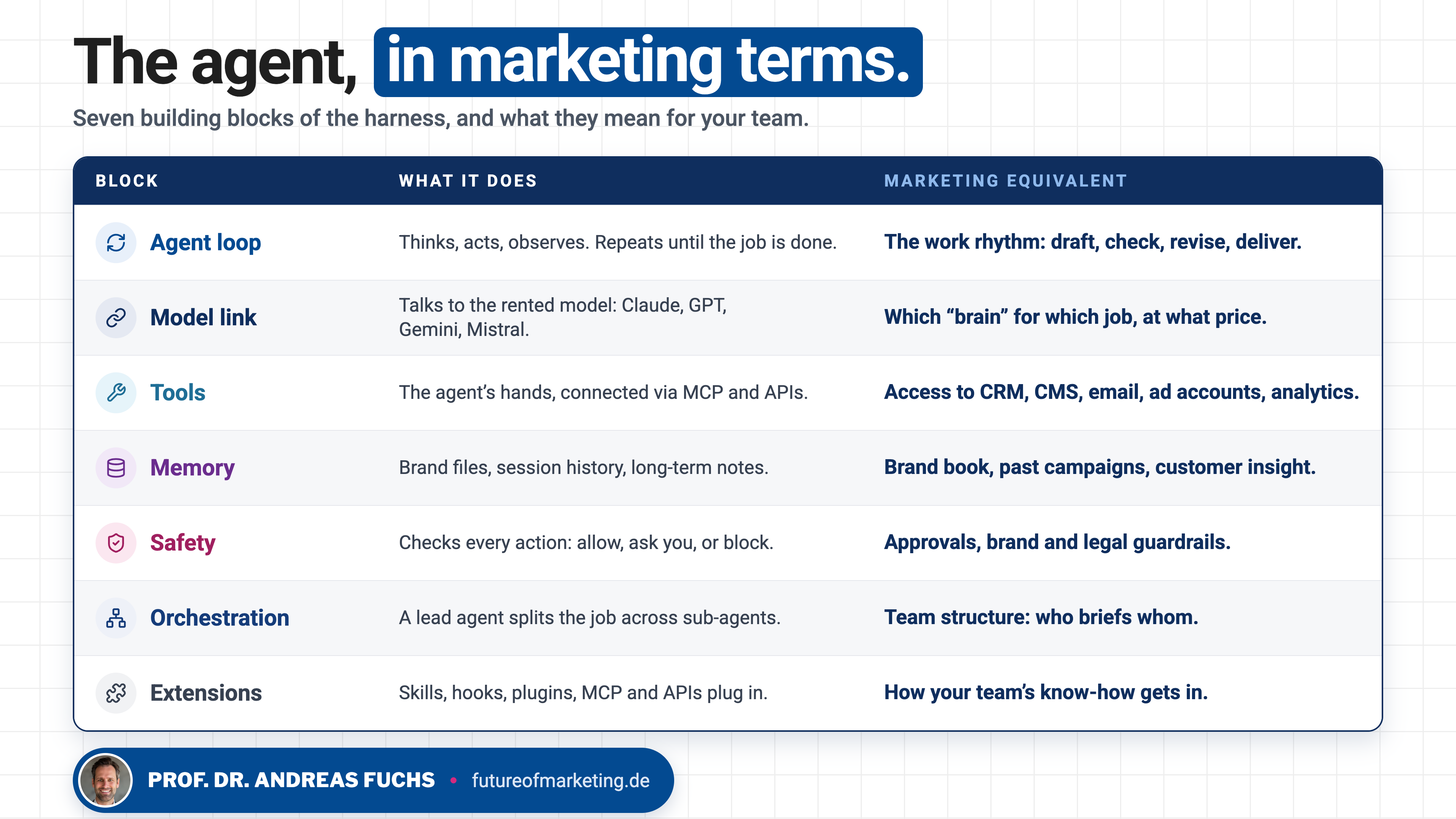
Translated into marketing terms, the seven building blocks look like this:
The range within each part is enormous. The simplest system, Mini-SWE-Agent, runs a plain loop with a single tool (a command line) and keeps its entire history in one growing list. At the other end, OpenAI’s Codex has grown to about 1.1 million lines of Rust, with its own memory pipeline, an AI reviewer that approves risky actions and an operating-system sandbox for Linux, macOS and Windows.
Same anatomy, three orders of magnitude apart. Which raises the obvious question: what is all that extra code for?
Finding 1: Most of an Agent’s Code Goes Into Trust
👉 Premium subscribers unlock: the four findings that matter most for marketing strategy (why most of an agent’s code goes into trust rather than capability, why none of the eleven systems uses an agent framework or a vector database, why skills have caught up with MCP, and how the agent market turned into a platform contest within 90 days), five implications for your marketing organization, the Marketing Agent Harness Check with 7 questions and 21 checkpoints to put to any vendor or internal team, and an honest note on where the study’s limits are.