A (Marketing) Data Strategy That Actually Works
A Five-Step Framework to align Goals, Use Cases, Data & Technology
Why Data Strategy Is the First Move
Marketing has always been a game of understanding people. But in today’s world, where customer behaviour stretches across dozens of touchpoints and privacy regulations reshape data access, intuition alone collapses. What once relied on human experience now demands systemic clarity.
Modern organisations are drowning in data. Dashboards multiply. Tools expand. Storage grows. And yet the one thing that should become clearer — the customer — becomes harder to see.
This is the paradox at the centre of today’s marketing:
We have more data than ever, but less understanding than ever.
The reason is simple.
The problem is not the absence of data.
It is the absence of strategy.
And this matters, because data-driven marketing is no longer optional. The collapse of information asymmetry means customers now move through markets with near-perfect knowledge. They compare instantly. They evaluate independently. They expect relevance by default.
Data-driven marketing answers exactly this shift. It enables deeper …
audience understanding
personalised experiences
better decisions
more accurate journey optimisation
improved customer relationships
smarter product development
and even new data-driven revenue streams.
But none of this happens automatically. None of it comes from collecting more fields or buying more tools. And none of it emerges from dashboards alone.
In every high-performing marketing organisation I work with, one pattern is unmistakable:
Data becomes valuable only when tied to a purpose … a business outcome, a decision, a process, a customer moment.
Everything else is noise.
A data strategy is not a document. It is not a dashboard. It is not a shopping list.
A data strategy is a design decision: Which customer realities must the business understand in order to grow?
Everything follows from this.
Start with the Business: Why Goals Come Before Data
Before a single data point is collected, one truth must be understood:
A data strategy is only as good as the business strategy it serves.
The key to a successful data strategy lies in prioritizing business goals before data collection. Instead of starting with dashboards and tools, high-performing organizations begin with the desired outcomes.
This “Business-First” approach offers three decisive advantages:
Higher Data Quality: Only the targeted information that supports concrete results is collected, which reduces data waste.
Smarter Tech Investments: Technology is selected strategically to meet specific requirements.
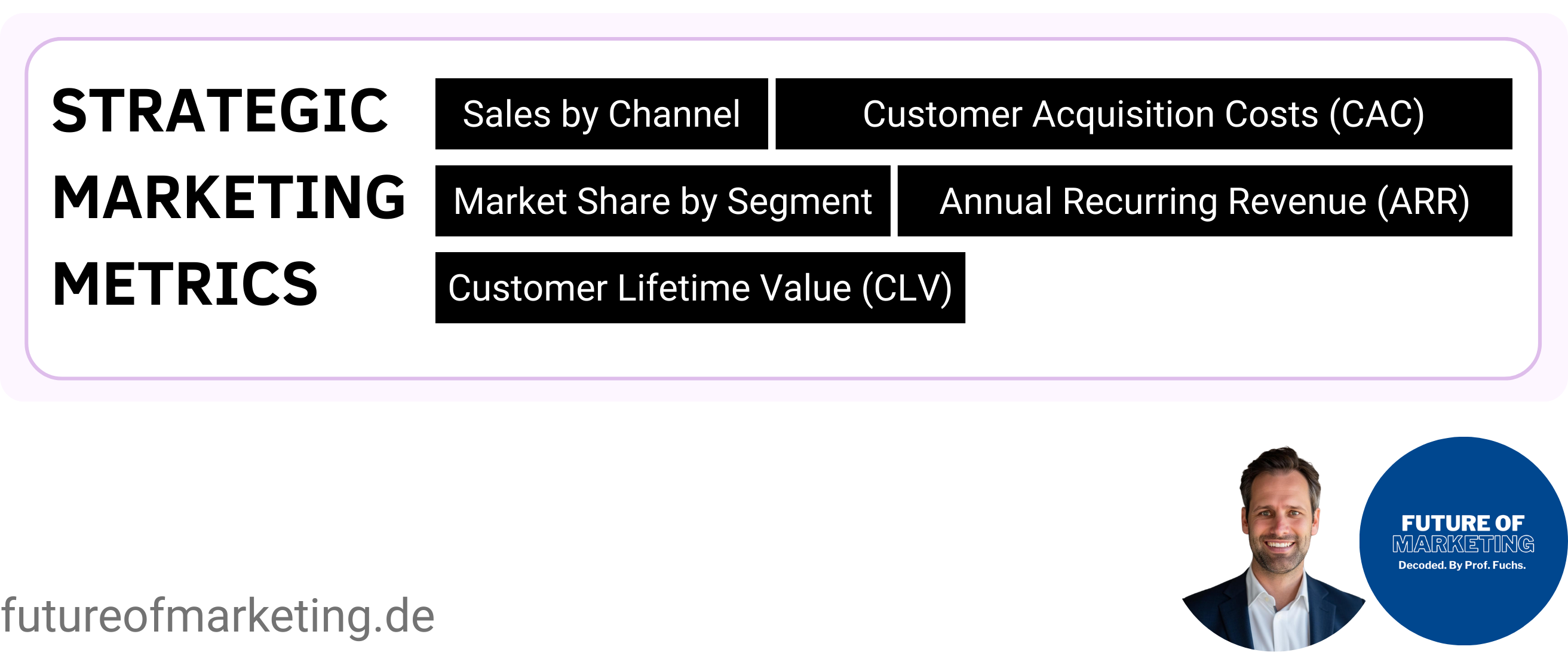
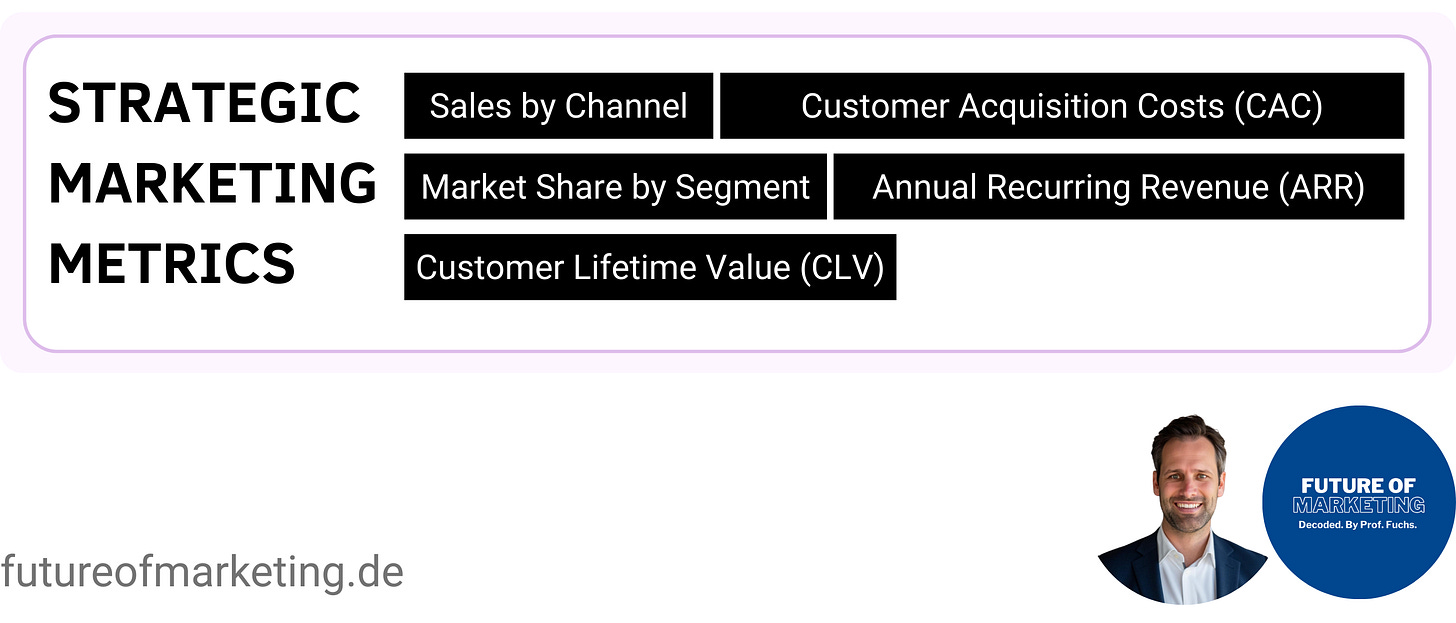
Clearer KPIs: Important metrics (like CLV or ARR) are derived directly from business goals, rather than being incidental.
Source: Fuchs (2025)
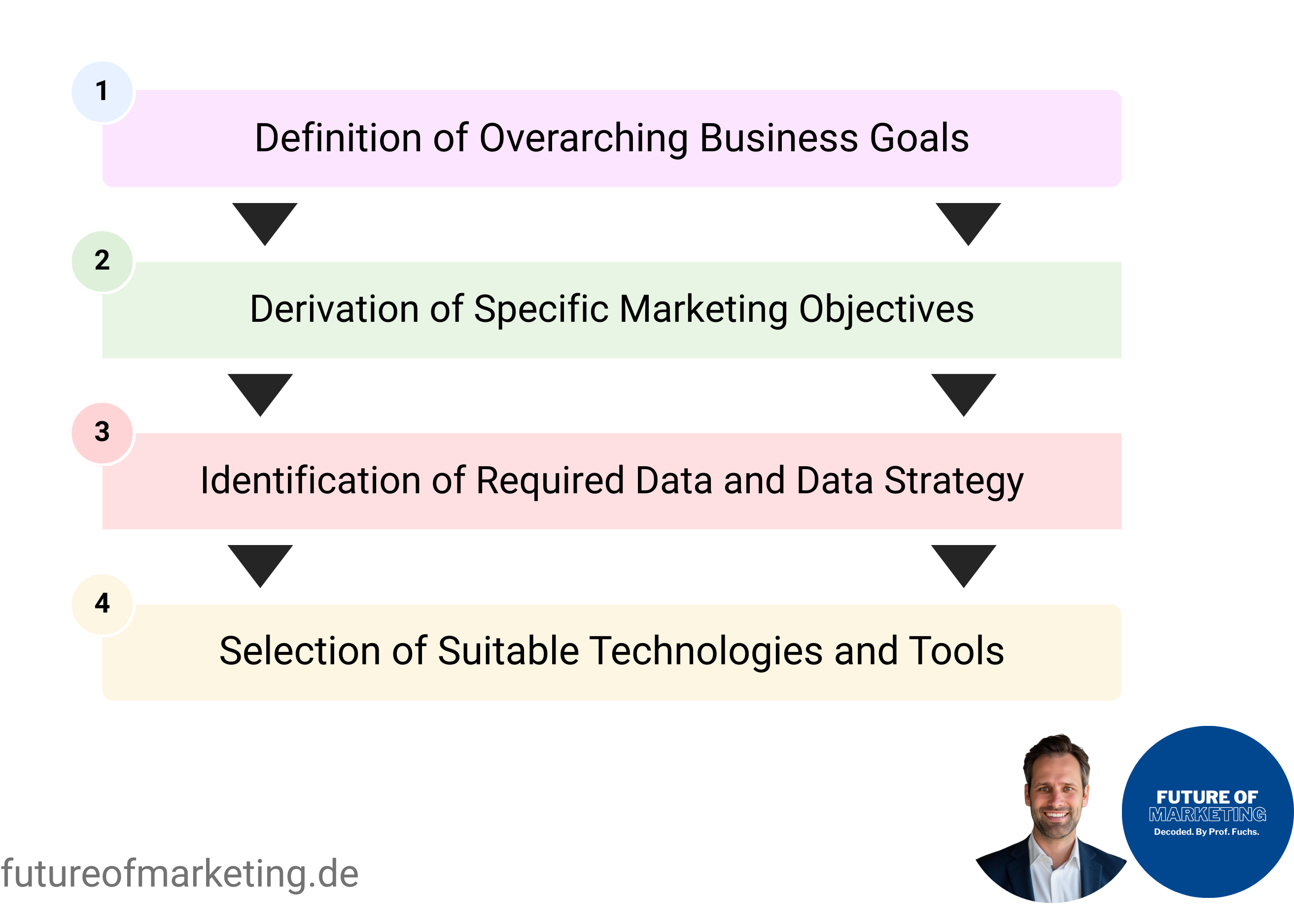
The process is a clear cascade:
Source: Fuchs (2025)
Build a Use-Case-Driven Data Strategy
Once the business goals are clear, the real work begins.
And here most organisations take a wrong turn:
They start listing data fields.
They collect data without purpose.
They overthink data and collect nothing at all.
But a data strategy built on lists will always collapse into abstraction. It becomes theoretical, slow, and disconnected from real impact. Data-driven marketing organisations follow a different logic:
They build their entire data strategy around use cases.
A use case is a concrete, value-creating application of data in the real world.
It is the bridge between strategy and execution.
It tells you exactly which data you need, why you need it, and how it creates value.
A use-case-driven data strategy follows a clear sequence.
Here’s a practical playbook how to to it:
A Practical Playbook: How To Turn Ideas Into a Data Strategy
Once you accept that use cases are the unit of value, the next question is simple.
How do you actually build a data strategy from them?
Marr (2022)1 describes it as a structured journey from ideas to a coherent strategy. In practice, it is a five step loop that any marketing team can run, regardless of size.
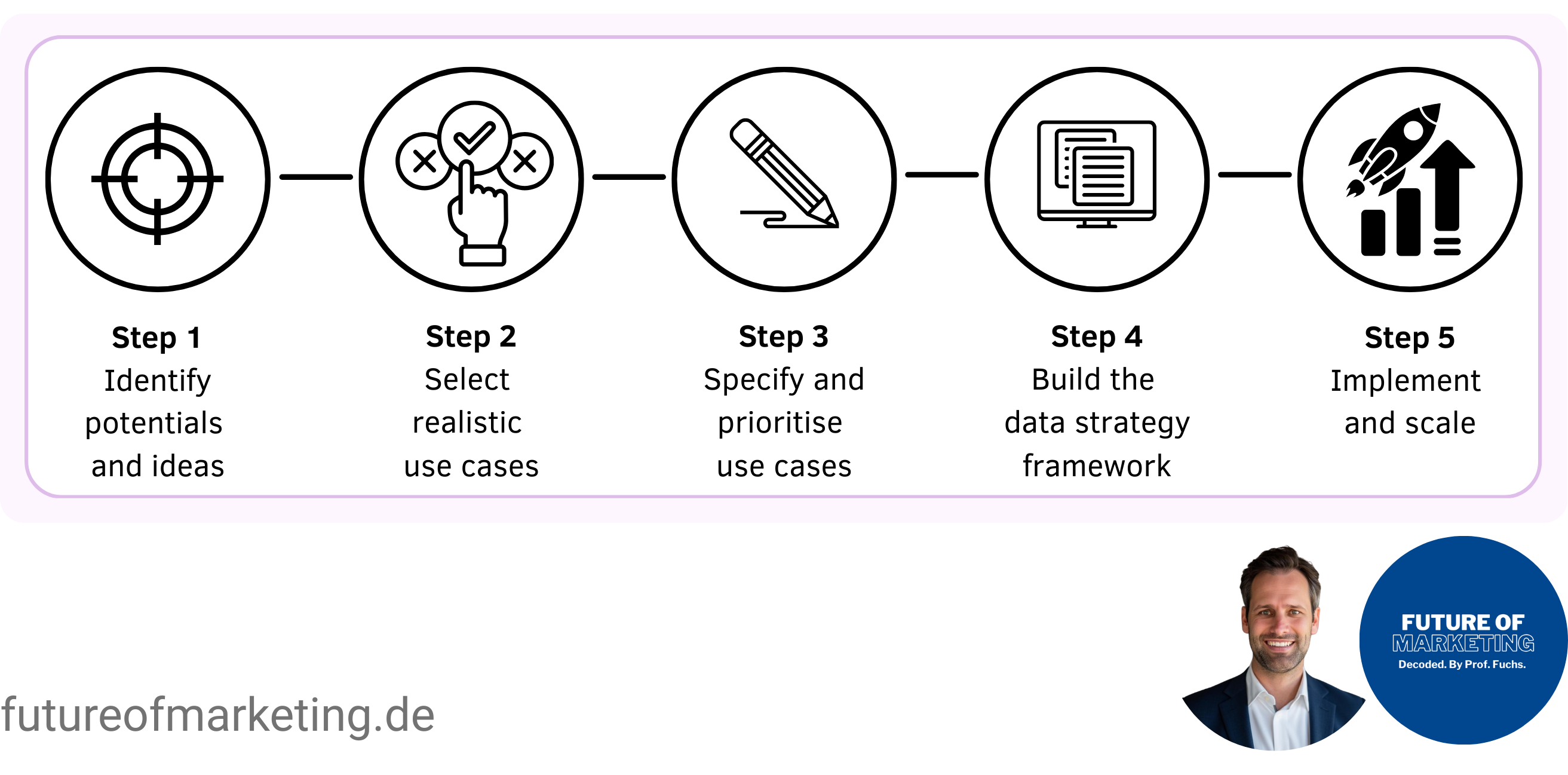
Step 1: Identify potentials and ideas
Start wide.
Map where data could create value along the entire value chain: marketing, sales, service, logistics, even product.
Use simple tools like use case canvases, customer journey workshops or design thinking sessions. Treat every idea as an end to end process, not as an isolated report. Each idea should strengthen at least one of these areas:
better decisions
deeper customer understanding
smarter products or services
more efficient processes
revenue from data itself
At this stage you optimise for breadth, not for perfection. Even complex or expensive ideas stay on the table.
Step 2: Select realistic use cases
From this long list you now create a shortlist that balances ambition and feasibility.
Strategic use cases: 1 to 5 high impact initiatives with real transformational potential
Quick wins: 1 to 3 small, fast projects that prove the concept and build trust
Too many parallel projects dilute focus and make impact hard to measure. The rule is simple: start small, learn, then expand.
Step 3: Specify and prioritise use cases
Now every shortlisted use case needs a clear description and specification.
Here I provide a template with guiding questions:
Source: Fuchs (2025, further developed based on Marr (2022).
This template turns vague ideas into concrete, assessable projects and makes prioritisation much easier. You can score use cases across criteria like strategic relevance, feasibility, effort, and cultural fit, then order them accordingly.
Step 4: Build the data strategy framework
Once your use cases are identified, selected, and specified, the next step is to bring them together into a unified data strategy.
This is where many organisations fail — not because their use cases are bad, but because they never consolidate them into one coherent system.
A strong data strategy requires an integrated, cross-functional blueprint that makes three things visible at once:
the top strategic use cases
the quick wins
the cross-cutting challenges that affect all of them
Here’s the practical principle:
Use cases create value … but the framework creates scalability:
Source: Fuchs (2025 based on Marr (2022).
This template does something no spreadsheet can do:
It reveals the shared foundations beneath all use cases.
For each category — data requirements, governance, technology, capabilities, implementation — the framework shows:
Which problems appear across multiple use cases?
Where do we have redundancies?
Where do we have synergies?
Which gaps must be solved once — and then benefit everyone?
This transforms a list of isolated projects into a connected system.
In other words:
A data strategy created use case by use case is tactical.
A data strategy created as an integrated framework is transformational.
This step is the bridge between ideas and architecture, between experimentation and scale — and the moment a company stops “doing data projects” and starts thinking like a data organisation.
Step 5: Implement and scale
Finally, the strategy moves into execution.
Quick wins are implemented first to generate proof and momentum. Strategic use cases follow with clearer requirements, shared platforms and a growing internal skill base. As new ideas emerge, they are fed back into the same six step playbook and evaluated against the existing framework.
Over time, this creates a living data strategy that evolves with markets, technology and customer behaviour instead of a static slide deck that is outdated the moment it is finished.
Conclusion: A Data Strategy Is a System
In the end, the companies that win in marketing are not the ones with the most data, the most dashboards, or the most tools.
They are the ones with clarity:
Clarity about which business outcomes matter.
Clarity about which customer moments move the needle.
Clarity about which data signals unlock those moments.
Clarity about how technology should serve the organisation, not overwhelm it.
A modern data strategy is not a spreadsheet. It is a way of thinking. It is the shift from collecting data to creating meaning. From buying tools to designing systems. From reacting to signals to shaping customer experience in real time.
When organisations build their data foundation on use cases, something important happens:
Marketing stops guessing.
Sales stops searching.
Service stops firefighting.
And the entire customer journey begins to operate on shared insight rather than fragmented intuition.
A unified data strategy does more than make your tech stack cleaner: It makes your organisation smarter — every workflow, every interaction, every decision.
The companies that master this will not just run better marketing.
Design that system now. Your future organisation will thank you for it.
Yours,
Prof. Dr. Andreas Fuchs 🦊
Marr, B. (2022). Data Strategy: How to Profit from a World of Big Data, Analytics and Artificial Intelligence (2, Aufl.). Kogan Page.