Task-Driven, Agentic Marketing Organizations
From Managing People to Orchestrating Work Between Humans and AI Agents at Scale
The integration of AI-driven workflow orchestration marks the largest organizational paradigm shift since the industrial and digital revolutions.1
What is unfolding is not another efficiency wave. It is a structural transformation of how organizations create value. Companies are evolving toward what I would call the Agentic Organization.
A system in which humans and virtual (or physical) AI agents collaborate at scale, with marginal costs approaching zero.
For marketing organizations, this shift is existential: It forces a move away from rigid hierarchies and role-based structures toward fluid, task-centered systems built around workflows, agents, automation, and orchestration.
The decisive transition is this:
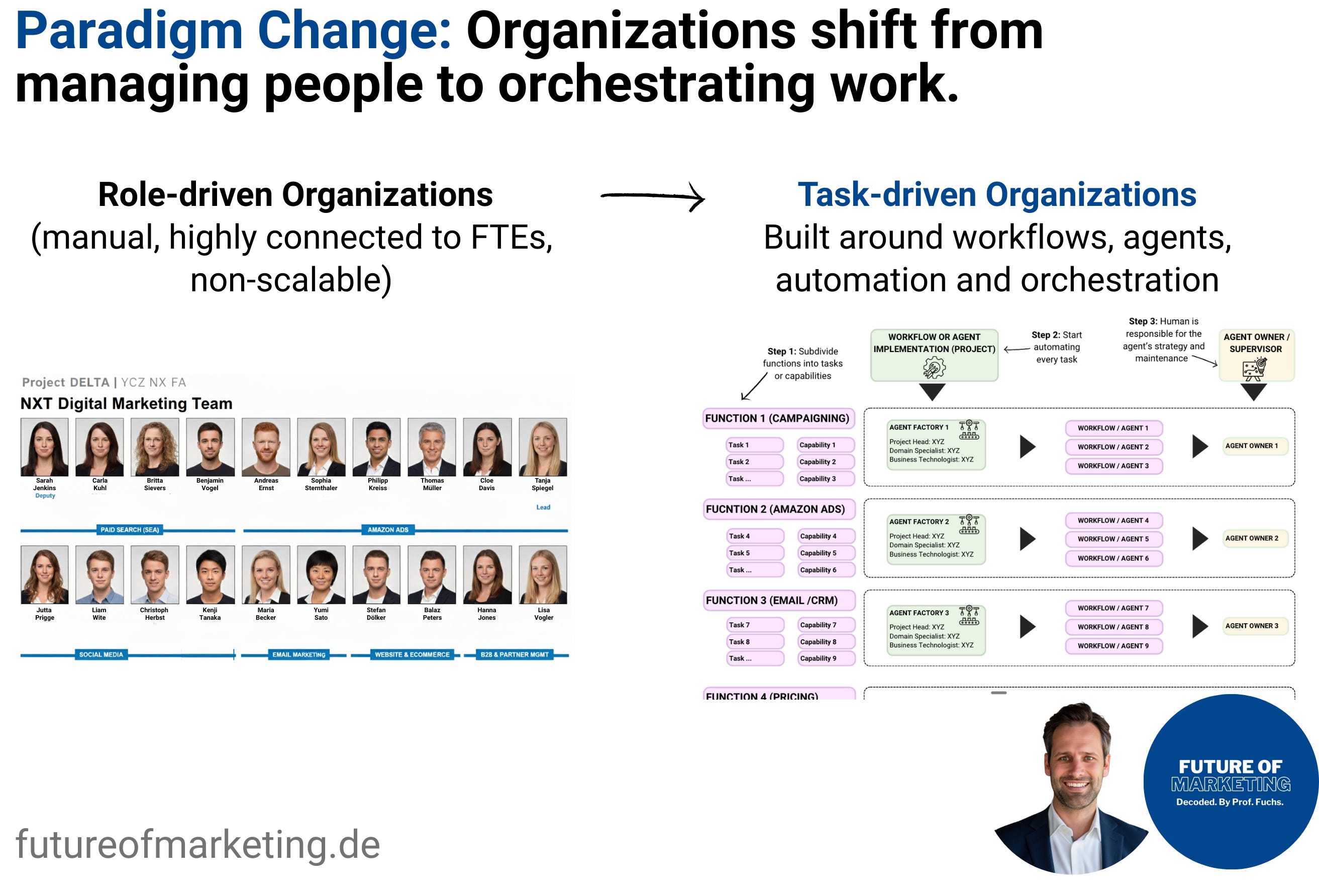
From a Role-driven Organization,
manual, headcount-bound, and difficult to scale,
to a Task-driven Organization,
where value is created by orchestrated work, not by static roles.
The promise is compelling:
Faster execution.
Higher scalability.
Lower marginal cost.
Greater adaptability.
But the implications go much deeper …
The Core Transformation: From Managing People to Orchestrating Work
The most fundamental impact of AI on organizational design is managerial.
Marketing is no longer about managing people. It is about orchestrating work. This reflects a broader paradigm shift across industries. Organizations move from supervising individuals to designing systems that coordinate humans and agents toward outcomes [1].
In this model, growth no longer depends primarily on adding headcount. It depends on redesigning workflows so automation accelerates value creation.
As a result, the definition of a future-proof marketing organization changes fundamentally:
It is no longer defined by roles, titles, and reporting lines.
It is defined by tasks and capabilities.
The central organizational question therefore shifts:
Not: “Who is responsible for what?”
But: “Which marketing tasks and capabilities exist, and how are they executed?”
This shift dismantles traditional functional silos and replaces them with flat, dynamic networks optimized for end-to-end outcomes.
The Agentic Operating Model: Workflows as the New Blueprint
In a task-driven organization, workflows become the primary unit of organizational design. Not roles. Not departments. Not headcount.
The core mistake many organizations make is to apply AI to isolated tasks inside legacy structures. This rarely delivers meaningful productivity gains. The real leverage comes from redesigning entire workflows end to end.2
The operating logic illustrated in the framework above follows three deliberate steps:
Step 1: From Functions to Tasks and Capabilities
The starting point is not technology, but decomposition.
Traditional marketing functions (e.g., Campaigning, Amazon Ads, CRM, Pricing) are broken down into discrete tasks and capabilities. These tasks define what needs to be done, independent of who performs it.
This shift reframes organizational design. Functions no longer dictate structure. Tasks do.
Step 2: From Tasks to Workflows and Agent Factories
Once tasks are defined, the organization moves into implementation.
Instead of automating tasks in isolation, entire workflows are redesigned as AI-first processes. [1] [2] Each workflow can be executed by one or multiple specialized agents.
To scale this execution, organizations introduce Agent Factories.
An Agent Factory is a small multidisciplinary human team (typically two to five people) that designs and implements a large number of specialized agents, often 50 to 100, running an end-to-end workflow such as lead generation, onboarding, or campaign execution.
This structure radically expands organizational capacity beyond the physical limits of human team size. [1]
👉 A deep dive on how to automate you marketing & sales can be found here.
Step 3: Agent Owners and Human Positioning
Once agents are implemented and the execution becomes increasingly agent-driven, human roles shift from doing work to owning work.
Each workflow or agent cluster is assigned to an Agent Owner or Supervisor, who remains accountable for strategy, performance, quality, and maintenance.
Humans are positioned deliberately:
Above the loop, where strategic judgment, governance, and accountability are required
In the loop, where socioemotional skills, trust, and human interaction are essential
This ensures that automation scales execution without removing responsibility.
👉 Further down, I outline the human skills required to thrive in agentic organizations.
Application in Marketing: Lead Generation as an Agentic Workflow
Marketing and sales are particularly exposed to automation, as many core activities rely on reasoning, information processing, and coordination rather than physical execution. [1] [2]
Lead generation and qualification illustrate especially well how an agentic operating model restructures work.
In traditional organizations, human sales teams execute the entire workflow manually. Prioritization is inconsistent, personalization limited, and follow-up constrained by time and capacity. As a result, large parts of the addressable market remain untouched. [2]
In an agentic model, this logic is reversed. The workflow is redesigned end-to-end, and execution shifts to specialized agents, while humans focus on selling activities that require judgment, persuasion, and relationship-building.
As shown in the exhibit above, agents take over analytical preparation, personalized outreach at scale, response handling, qualification, scheduling, and administrative follow-up. Humans remain responsible for interpreting agent outputs, engaging with high-potential leads, managing relationships, and closing deals. [2]
The key change is not automation of individual tasks, but reallocation of human time upward along the value chain.
Business development specialists can spend 30 to 50 percent more time on high-value activities such as negotiation, strategic engagement, and account development, while routine and information-intensive work is handled by agents. [2]
Rather than replacing sales professionals, the agentic workflow amplifies their impact by removing structural capacity constraints.
The Evolving Talent Profile: Who Thrives in Task-Driven Organizations
As agents take over execution, humans shift toward ownership and orchestration of outcomes.
Source: Own visualization based on Sukharevsky et al. (2025).
Three new talent profiles emerge:
M-shaped General Manager: Builds, supervises, and optimizes hybrid workflows; takes end-to-end responsibility for products or processes. These leaders are multiskilled and able to apply knowledge across multiple domains. They combine higher cognitive abilities (e.g., critical thinking, decision-making, creativity) with socioemotional skills and AI fluency.
Skill gap: Compared to today’s manager roles, this profile requires a novel mix of integrative thinking and the ability to manage AI-first workflows.
Example: A Head of Growth who no longer manages channel teams, but orchestrates end-to-end revenue workflows across marketing, sales, and AI agents, and is accountable for outcomes, not headcount.
T-shaped Deep Specialist: Provides expert oversight in agentic systems and handles exception cases. They possess deep domain knowledge alongside AI skills and higher cognitive abilities.
Skill gap: Builds on today’s specialist roles but adds the ability to fine-tune and teach agentic systems, requiring greater technological adaptability.
Example: A CRM manager who not only configures systems, but designs, trains, and continuously improves AI-driven lead routing, lifecycle, and personalization agents.
AI-Empowered Frontline Worker: Focuses on interpersonal tasks where human interaction is critical. These workers combine socioemotional strengths with basic AI fluency and general domain knowledge.
Skill gap: Evolves existing frontline roles by integrating AI capabilities into jobs previously selected primarily for emotional intelligence.
Example: A key account manager who uses AI agents for account research, opportunity insights, and next-best-action recommendations, while focusing human effort on trust, negotiation, and relationship building.
AI fluency has increased nearly sevenfold in US job postings within two years, the fastest-growing skill category observed. [2]
But AI fluency alone is insufficient.
Critical skills for Task-driven Marketing Organizations include:
No-code and automation skills
Designing systems rather than teams
Human–machine orchestration.
While tasks change, 72 percent of human skills persist across automatable and non-automatable work.
What changes is how they are applied.
McKinsey’s Skill Change Index shows that digital and information-processing skills are most exposed to automation, while socioemotional skills such as coaching and negotiation change least. [2]
Governance and Leadership in the Agentic Era
In organizations where agents operate continuously, governance must become real-time, embedded, and data-driven:
Embedded Control Agents: Critic Agents, Guardrail Agents, and Compliance Agents monitor risk inside workflows.
Human Oversight: Accountability remains human. Leaders must balance control with speed and innovation. Crucially, this transformation cannot be delegated to IT.
It is a core business transformation.
Leadership requires:
Future-back design
Continuous upskilling beyond basic AI literacy
A culture of trust and ethical clarity
Organizations that move early will gain a durable competitive advantage.
Final Thought
Task-driven, agentic marketing organizations are not a distant future. They are an architectural inevitability. This shift will unfold gradually, as workflows are redesigned and execution is increasingly delegated to agents.
The question is not whether marketing will change. It is whether organizations will redesign themselves in time.
Those who continue to optimize roles and hierarchies will look efficient, yet organize work for conditions that no longer apply. The advantage will belong to organizations that move from managing people to designing systems & orchestrate work.
Systems where human judgment and accountability remain central, while scale and speed are delegated to machines. Marketing leadership therefore becomes less about supervision and more about architecture (read more here).
Those who make this shift early will not just adapt. They will set the standard others follow.
👉 If you would like to discuss how these ideas can be applied to your marketing organization, feel free to reach out.
Yours sincerely,
Prof. Dr. Andreas Fuchs 🦊🎓
Sukharevsky, A., Krivkovich, A., Gast, A., Storozhev, A., Maor, D., Mahadevan, D., Hämäläinen, L., & Durth, S. (2025). The agentic organization: Contours of the next paradigm for the AI era. McKinsey & Company.
Yee, L., Madgavkar, A., Smit, S., Krivkovich, A., Chui, M., Ramirez, M. J., & Castresana, D. (2025). Agents, robots, and us: Skill partnerships in the age of AI. McKinsey Global Institute.


Thanks Andreas, another excellent post. It really highlights the need for organisations to employ AI translators so that they can teach others how to use these tools in a way that is very very different to the ones that most individuals are already used to...
Outstanding piece on how AI is reshaping org design. The shift from managing people to orchestrating workflows is somethin I've seen firsthand at a few companies, but what's interesting is how agent factories solve the scalability problem without proportional headcount increases. In my experience, the hardest part isn't building the agents, it's restructering how teams think about ownership when their role shifts from execution to supervision. Makes me wonder if most orgs will stumble not on the tech but on the cultural adaptation required.