

Marketing technology was born with a promise.
A promise that tools would make marketing smarter. That automation would make teams faster. That data would make decisions clearer. And that AI would soon fill the gaps humans could not.
But as the tools multiplied, something unexpected happened. The intelligence did not scale. The efficiency did not appear. And the clarity never arrived. Instead, ecosystems became bloated, budgets became strained, and organisations discovered a painful truth:
The more technology we add, the more fragile everything becomes.
Today, the average company uses only around one-third of the capabilities it pays for:
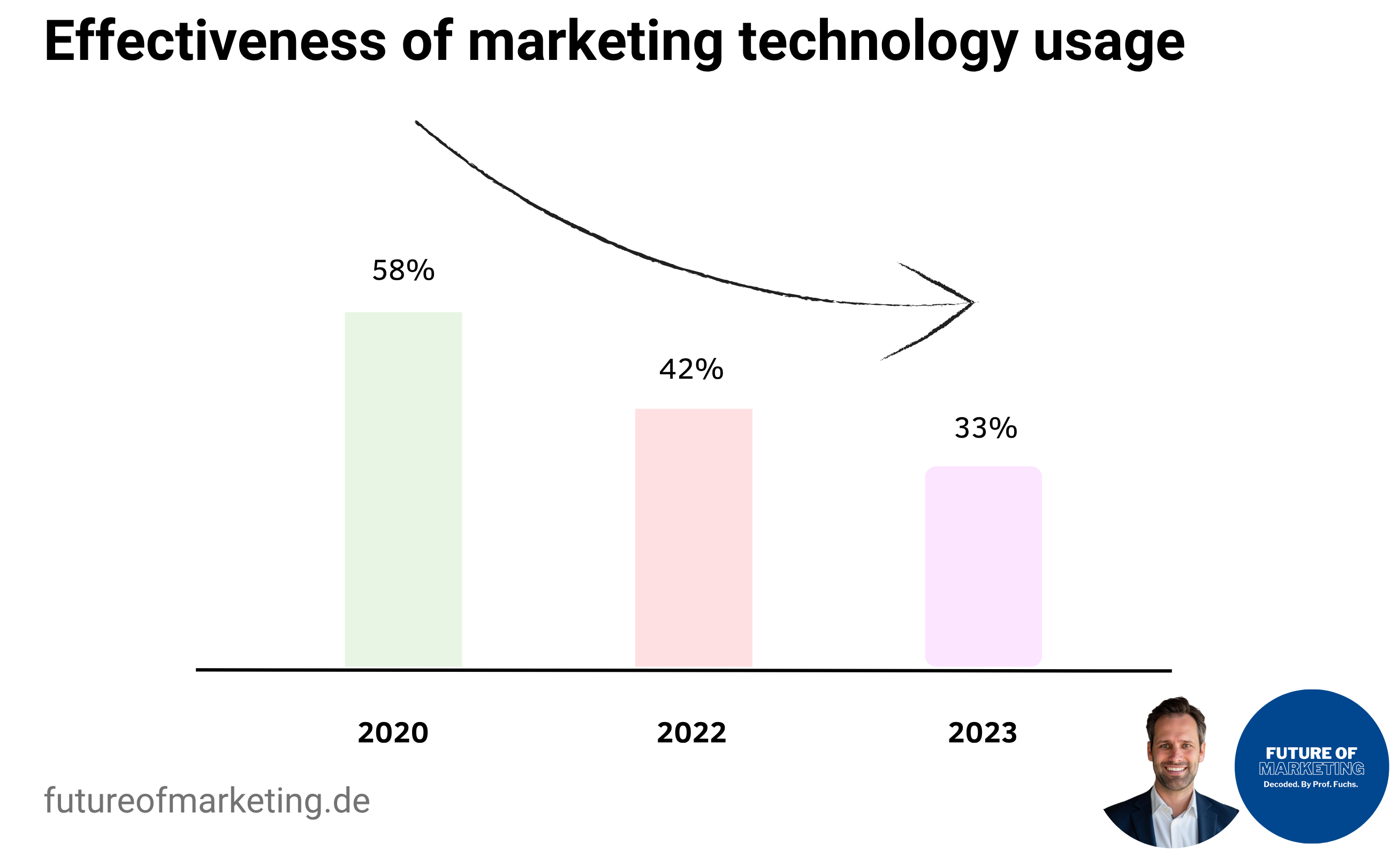
Source: Fuchs (2025) based on Gartner (2023)
The conclusion is unavoidable: Technology is not the problem. Architecture is.
Today, the real divide is not between companies with many tools and companies with few tools. It is between companies that buy technology and companies that design systems. A modern Marketing & Sales Tech Stack is not a shopping cart. It is a living, learning ecosystem that connects data, processes, and AI into a unified revenue engine.
This essay is a blueprint for how to build one.
The Real Problem: Tool Chaos Without Architecture
Modern companies live inside a labyrinth of systems.
A CRM here. A marketing automation suite there. Analytics in one place, customer service in another. E-commerce, AdTech, data warehouses, event tools, CDPs, BI dashboards … each one built to solve a small, local need.
The intention was efficiency. The outcome is fragmentation.
Every tool sees a different sliver of the customer. None see the whole.
And that creates the real crisis:
Data scattered across channels and teams
Customer identities split into dozens of inconsistent versions
Marketing automating noise, not strategy
Sales operating on half-truths
Personalisation failing because the system cannot “see” the human behind the data
“Real-time” existing only in product demos, not in reality
The problem is not technology overload. The problem is architectural blindness. Companies are not drowning because they have too many tools. They are drowning because the tools do not speak the same language, do not share the same memory, and do not follow the same logic.
The real question, then, is not: “Which tools should we buy?”
The real question is: “What system are we trying to build?”
Only when that becomes clear does technology finally begin to make sense.
👉 If you want the full deep dive, read my essay “The New Marketing Operating System”
How a Modern Revenue Stack Actually Works
(and why most companies fail to build it)
A modern Marketing & Sales Stack is not a catalogue of tools. It is a circulatory system. Data enters, flows, connects, transforms, activates, and returns as intelligence.
Most organizations never experience this flow:
Their data sits in silos.
Their channels operate independently.
Their automation triggers noise rather than intention.
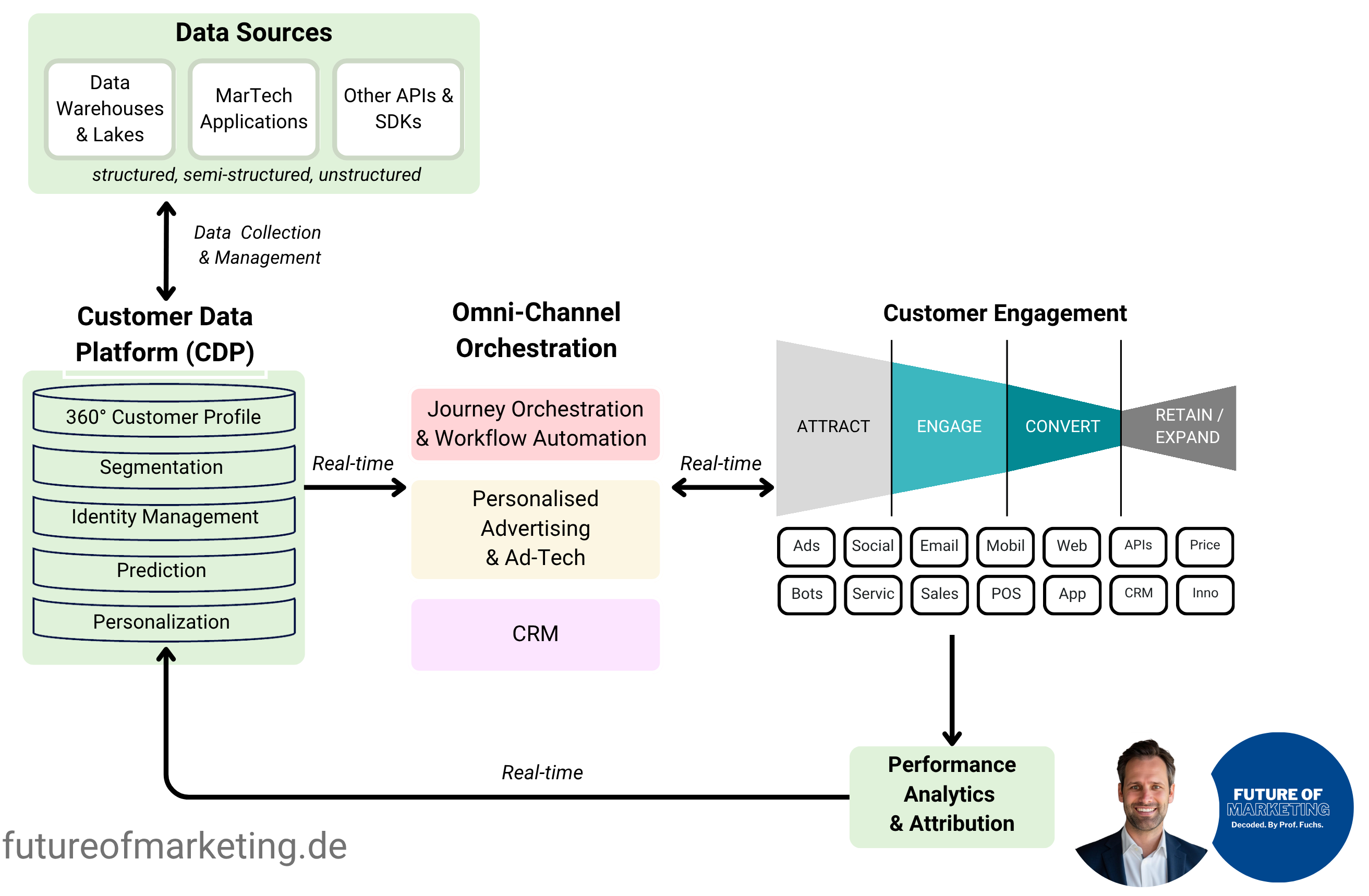
To understand what a working system looks like, imagine the architecture below. It shows how data moves through a unified Revenue Engine: from raw signals to identity, from identity to action, from action to learning.
Source: Fuchs (2025)
At the top, fragmented data from warehouses, applications, and APIs is collected and harmonized.
The Cloud Data Warehouse (CDW) becomes the universal memory … the place where the entire company finally sees the same truth.
The Customer Data Platform (CDP) sits on top of this foundation. It resolves identities, builds real-time customer profiles, predicts behaviour, and prepares segments for activation. This is where “someone who clicked yesterday” becomes “someone who is ready today.”
The Orchestration Layer transforms these insights into action: Journeys fire, workflows adapt, ads synchronize with CRM updates, sales receives signals, and every digital touchpoint responds in context rather than chaos.
Finally, Engagement Channels deliver the message: ads, email, web, mobile, service, sales, apps, POS … all drawing from the same profile, all aligned around the same customer.
Every interaction flows back into Performance Analytics & Attribution, where impact is measured and the system learns what to do next.
This is not automation. This is orchestration. A self-reinforcing loop where every signal strengthens the next decision.
Composability: The Practical Secret Behind a Tech Stack
Most companies don’t fail because they chose the “wrong tools.” They fail because their tools can’t work together.
Composability solves exactly this problem.
Source: Brinker & Riemersma (2024)
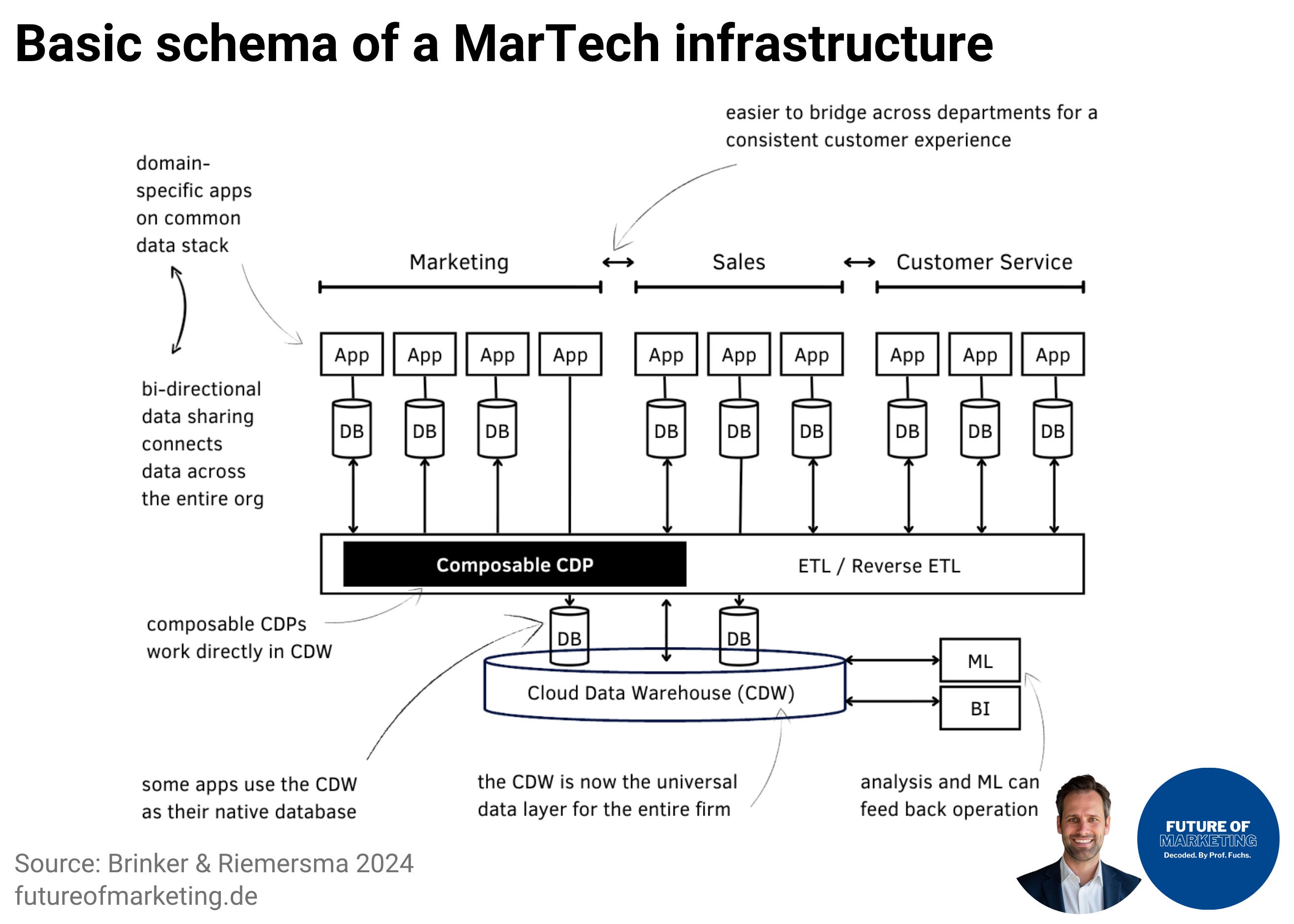
Think of it like LEGO for your tech stack: You don’t buy one giant, heavy block. You build with small, modular pieces that fit together — and can be replaced, upgraded, or rearranged at any time.
Here’s what that means in practice:
Your Cloud Data Warehouse (CDW) becomes the shared data layer for the whole company. Instead of every tool storing its own version of the truth, everything draws from one clean source.
A Composable CDP sits on top and creates a single customer identity who they are, what they did, what they might do next. This is the engine that personalises, predicts, and activates.
An integration layer (iPaaS) acts like plumbing. It moves data between tools, triggers actions, and keeps everything in sync.
All your apps (marketing, sales, customer service) plug into that shared backbone. No more silos. No more guessing. No more “our numbers don’t match.”
How to Build Your Tech Stack: A Six-Step Playbook
A modern Marketing & Sales Tech Stack is not something you buy. It is something you design … deliberately, step by step.
If you ask most companies how their tech stack came into existence, the answer is always the same: not through design, but through accumulation.
A tool bought to solve a local problem.
A vendor pushed by IT.
A CRM upgrade.
A BI tool that the CFO insisted on.
A marketing platform bought during a panic about automation.
Over years, this creates a landscape that resembles archeology more than architecture.
Source: Fuchs (2025)
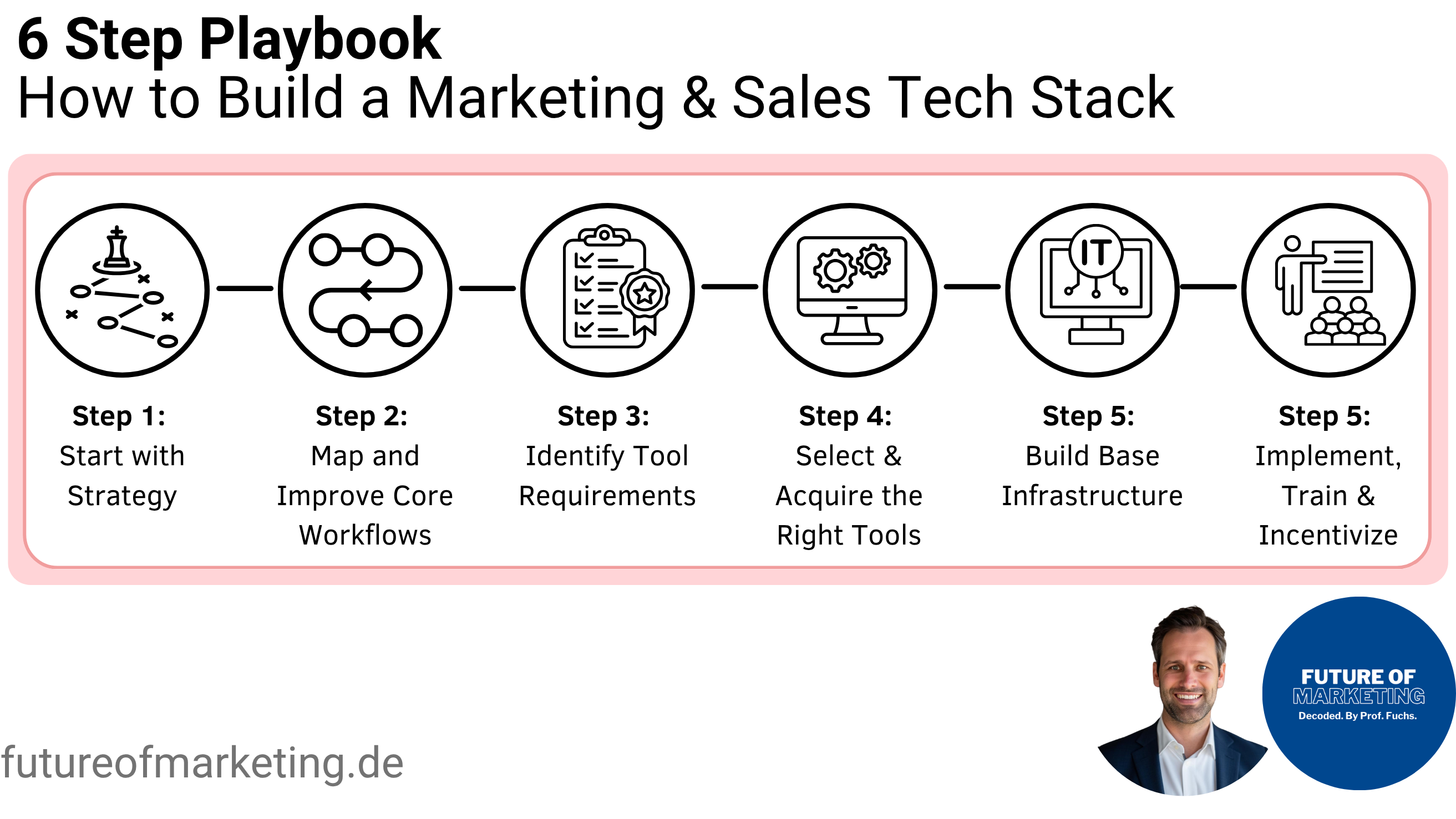
The antidote is a structured, use-case-driven method for building a system that is coherent, scalable, and economically rational.
Below is the six-step blueprint: