

Why read this?
In What Is an AI Agent, Really? we looked inside an agent. This article shows how it gets better every week. In 15 minutes you’ll know:
How the learning loop works: No model retraining, no data science team.
What it looks like in marketing: A brand content agent that learns from your team’s edits.
How to start: A 30-day plan in four steps.
In short: A self-improving AI agent improves its instructions, not its model. A second agent turns your team’s feedback into small edits to the agent’s skill files, and a human approves each one (Segner, 2026, vendor publication).
The Agent That Makes the Same Mistake Twice
Every marketing team knows this moment. A junior copywriter submits a draft, the brand manager marks it up: too many superlatives, the claim about “market-leading” needs a source, and we never call our customers “users.” A week later the next draft arrives. Fewer superlatives, a source for the claim, and “clients” instead of “users.” People learn from feedback. That’s what makes them better every month they spend on a team.
Now replace the copywriter with an AI agent. The brand manager leaves the same comments. The agent fixes the draft. And next week, it writes “users” again.
Most AI agents in marketing today don’t learn from the feedback they receive. The correction lives in a comment thread, a Microsoft Teams message or someone’s head. When the session ends, the lesson ends with it. So the team corrects the same things over and over, and slowly concludes that the agent “just isn’t good enough for our brand.”
The software company Warp ran into exactly this problem with its internal code review agent. Rewriting prompts by hand helped, but it didn’t scale, and the feedback kept disappearing at the end of each session (Segner, 2026, vendor publication). Their answer was a loop in which the agent’s instructions improve themselves, under human supervision. It’s a pattern marketing teams can borrow almost one to one.
What “Self-Improving” Means, and What It Doesn’t
The term sounds like science fiction: software that rewrites itself. The reality is far more practical, and far easier to control. To see where the learning happens, it helps to go back to the anatomy of an agent from my last article:
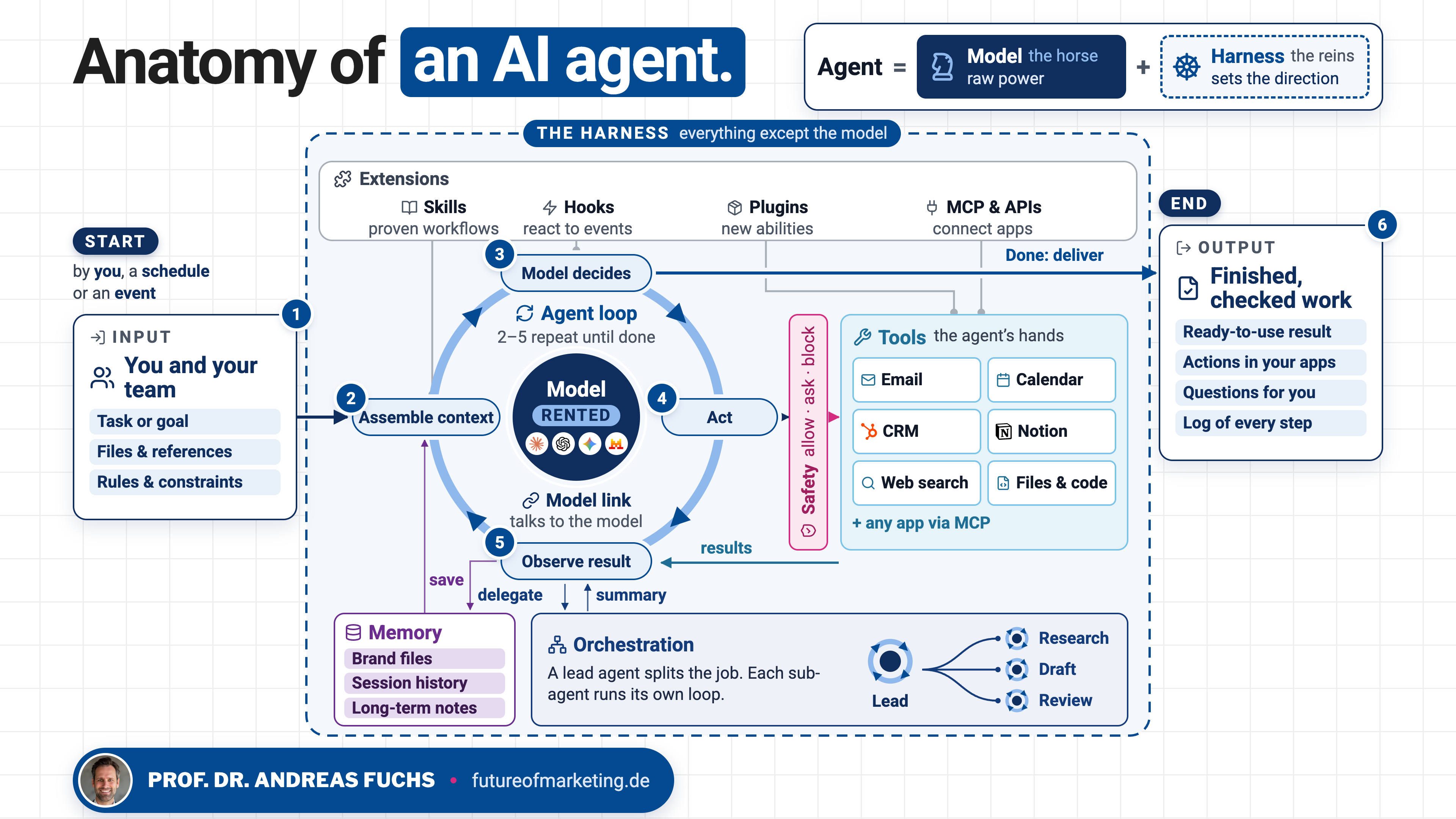
An agent is a model plus a harness. The model in the middle is rented. You can’t change it, and in a self-improving agent nobody does. What improves is the harness around it, and specifically two of its building blocks:
Extensions, above all skills: Skills are plain text files that describe how the agent should do a specific job, such as writing a product post in your brand voice. They’re the agent’s playbook.
Memory: The brand files and long-term notes the agent draws on when it assembles its context.
A self-improving agent adds a second loop around the first one. The inner loop does the work: draft, check, revise, deliver. The outer loop learns from the result. It collects what humans said about the work, looks for patterns, and proposes a small change to the skill file. A person reviews that change, and only then does the next run use it.
That makes it important to be clear about what self-improving does not mean:
It’s not retraining the model: No fine-tuning, no training data pipeline, no data science team. The “learning” is an edit to a text file your team can read.
It’s not an agent that rewrites its own rules unsupervised: In the setup Warp describes, every change to a skill goes through the same review process as any other change to their code (Segner, 2026, vendor publication). Humans stay in charge of what the agent learns.
It’s not the same as memory: Memory stores facts from past sessions. A skill encodes how to do a job. Warp keeps the two apart, and so should you.
👉 The model is rented. The playbook is yours, and a self-improving agent is simply a playbook that gets better every week.
How Warp Does It
Warp builds an AI-powered terminal for software developers and runs several internal agents on Claude: one reviews code, one triages incoming issues, others write and review specifications. Anthropic published how Warp makes these agents improve over time (Segner, 2026). A note on the source: it’s a vendor publication on Anthropic’s own website, the claims come from Warp, and the article reports no measured quality gain. Still, the mechanism is described clearly enough to learn from.
The loop has four parts:
The base skill does the work: It holds the domain knowledge and instructions and runs every time a task comes in, for example when a new issue is filed.
Humans give feedback where they already work: In comments on the agent’s output, inside the tools the team uses every day. A thumbs-up counts, but a reason counts more.
An improver skill learns from it: A second agent runs on a schedule, not on every task. It collects the feedback, compares what the agent suggested with how humans responded, and proposes one small, focused edit to the base skill.
A human approves the edit: Because the skill is a plain file, the change goes through Warp’s normal review process. Once it’s merged, the next run uses the improved skill.
The article gives a simple example. Warp’s triage agent kept forgetting to apply a specific label to issues that described a real problem. A maintainer pointed this out in a comment. The scheduled improver agent picked up the comment and proposed a change to the triage skill, which the team reviewed and merged.
Two statements from Warp’s CEO Zach Lloyd stand out. On collecting feedback: “Low friction is what keeps signal flowing.” And on reuse: “the improver skill for a code review agent is not that different from the improver skill for any other agent” (quoted in Segner, 2026). That second point matters for marketing. Once you’ve built the improver for one agent, you can put it behind every other agent you run.
What This Looks Like in Marketing: A Brand Content Agent That Learns
Let’s move the pattern from code to content. The following scenario is illustrative, not a case study, but every step in it can be built with today’s tools.
Picture a B2B software company with a small content team. They run a brand content agent that turns briefs into LinkedIn posts, newsletter intros and product page copy. Its playbook is a single skill file, brand-voice-content, that describes the audience, the tone, the claims the company may make and the words it avoids.
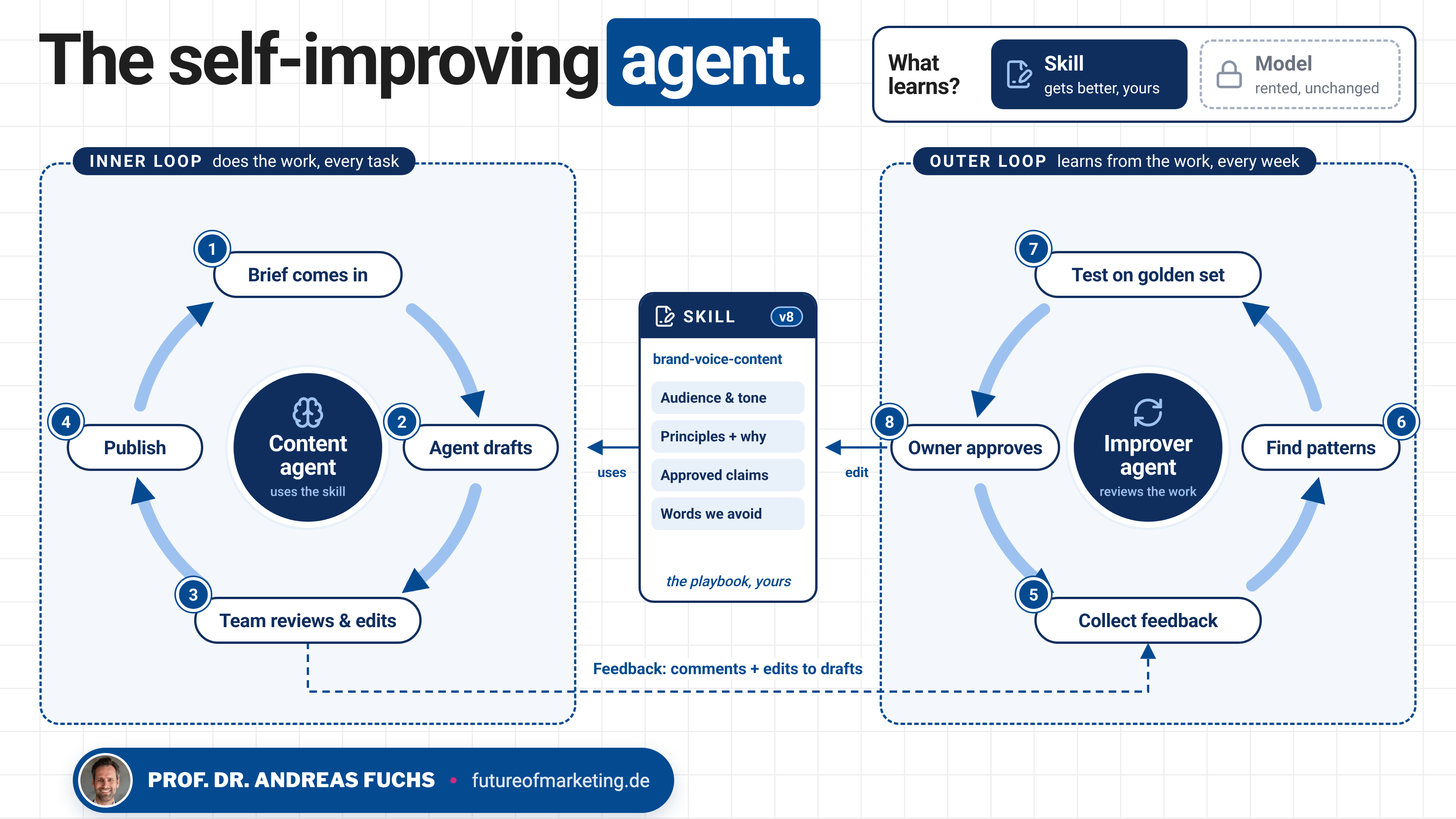
Monday to Thursday, the inner loop does the work: The agent drafts content from the week’s briefs. The brand manager, a product marketer and occasionally legal review the drafts in the tools they already use, leave comments and edit the text until it’s ready to publish. A few typical comments:
“We don’t say users. We sell to firms, so we say clients.”
“Market-leading needs a source from our approved claims list, otherwise cut it.”
“Too salesy for a CFO. Lead with the risk, not the feature.”
Friday, the outer loop learns: An improver agent runs once a week. It reads every comment, and it also compares each draft with the version that was finally published. That second source is the hidden treasure of marketing feedback: every edit your team makes to a draft is a lesson the agent could learn, even when nobody writes a comment. The improver notices that users was replaced in six of ten drafts and that unsupported superiority claims were cut three times. It proposes two small additions to the skill:
We address our customers as businesses we work with, so we call them clients, not users.
Every superiority claim needs an entry in the approved claims file. Without one, describe the benefit instead.
Before anything changes, the edit is tested: The improver reruns the updated skill on a set of 20 past briefs whose approved versions the team already knows. If the new drafts match the approved versions better, and nothing else got worse, the edit goes forward.
Then a human decides: The brand lead reviews the proposed change in a short weekly slot, reads the reasoning and accepts, adjusts or rejects it. From next Monday on, the agent writes clients. Nobody has to say it again.
The same pattern fits almost any recurring marketing task with a clear owner and regular human review: campaign briefs, SEO and GEO briefs, sales enablement material, social media replies, monthly performance reports. In Skills are the New Skills in Marketing I described how to write such skills. A self-improving loop is what keeps them current.