

This is Part 3 of the Claude for Marketing & Sales mini series. Each part is a practical guide to a different Claude capability for marketers.
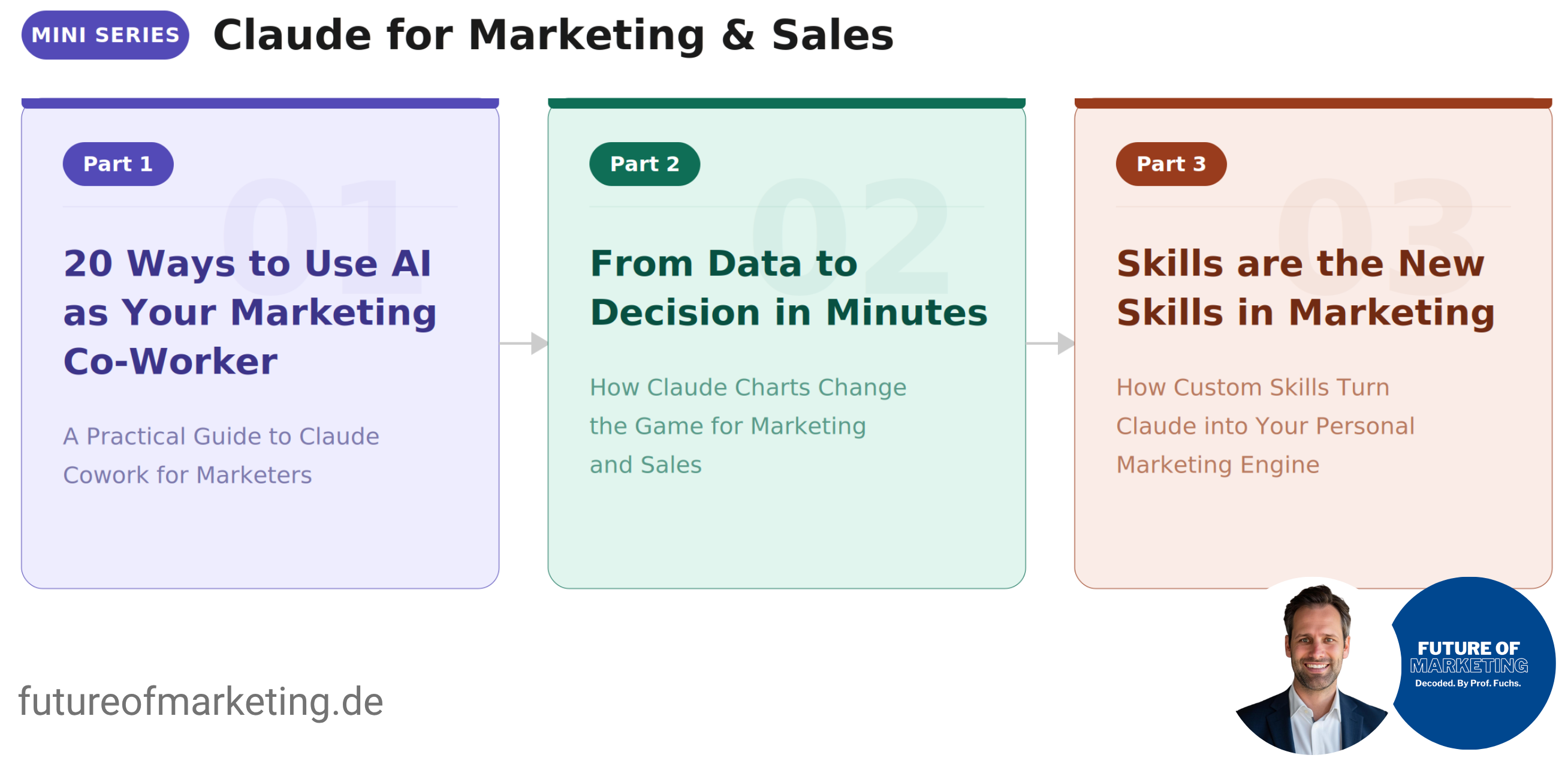
Part 1: 20 Ways to Use AI as Your Marketing Co-Worker: How to set up Claude Cowork, how to work with it, and 20 use cases to start today.
Part 2: From Data to Decision in Minutes: How Claude Charts turns marketing data into interactive visualizations and dashboards.
Part 3 (this guide) Skills are the New Skills in Marketing: How to create custom Skills that make Claude permanently better at your specific marketing work … with 10 ready-to-use Skill templates.
Our whole life has been shaped by one thing: building skills.
We went to school. We went to university. We did internships, trainee programs, first jobs where we had no idea what we were doing. We watched people who were better than us and tried to figure out what they knew that we didn’t. We read books. We took courses. We failed, got feedback, and tried again. And slowly, over years, we got good at things.
Skills are what made us who we are professionally.
Maybe you were the one on the team who built the best presentations. The person everyone came to when a pitch had to land. Maybe you were the analyst who could pull insights out of messy data that nobody else even looked at. Maybe you were the brand strategist who could articulate a positioning in one sentence while the rest of the room was still debating slide three.
Some of us became the go-to person for market research. The one who knew how to design a survey that surfaces real customer insights instead of confirming what everyone already believed. Others became the best copywriter in the department, the one who could write a headline that stops the scroll and a CTA that converts. Others got really good at briefing agencies, reading a P&L, running focus groups without leading the answers, or segmenting audiences in ways that made campaigns perform twice as well.
These skills were our edge. The thing that separated us from the next candidate, the next freelancer, the next agency pitch. They made us valuable. They made us hard to replace.
And they didn’t come for free. Every one of them took years.
The good news: learning never stops. The marketer who’s still curious, still willing to sit with something unfamiliar until it clicks, has always had an advantage. That hasn’t changed.
What has changed is what we need to learn next.
Technology is reshaping what marketing teams look like, how they’re staffed, what gets outsourced, and what gets automated. Organizations are restructuring. Budgets are tighter. Teams are smaller. “Do more with less” stopped being a management cliché and became the operating reality for most marketing departments.
And right in the middle of this: AI.
We’ve created something that can execute many of the tasks we spent years mastering. Not because it’s smarter than us. But because it doesn’t forget, doesn’t get tired, doesn’t have an off day. It applies the same quality standard to the 500th campaign brief the way it did to the first.
The marketer who spent years mastering Excel? Claude builds the spreadsheet from a description. The one who could write a positioning statement in her sleep? Claude drafts five variants before she finishes her coffee. The one who was fastest at turning a report into a slide deck? Claude does it in two minutes.
This can feel unsettling. But here’s how I see it:
The competition hasn’t stopped. It has shifted. The people who will stand out in marketing won’t be the ones who resist the tools. They’ll be the ones who master them faster than everyone else. Who figure out how to take what they know (all those skills, all that experience, all that judgment built over years) and encode it into systems that scale.
And this isn’t just about individuals.
Think about marketing organizations. Every team has built its own way of doing things over the years. How campaigns get briefed. How reports get structured. How brand guidelines get applied. How content gets repurposed across channels. Most of this knowledge lives in people’s heads, in scattered documents nobody maintains, or in the muscle memory of whoever has been around the longest.
When that person leaves, the knowledge walks out with them. When a new team member joins, it takes months before they produce work at the level the team expects. Every organization knows this problem. Very few have solved it.
The same shift that applies to individuals applies to teams: the marketing organizations that will pull ahead aren’t the ones with the biggest budgets or the most people. They’re the ones that figure out how to capture what makes them good and turn it into infrastructure that works independently of who’s in the room on any given Monday.
The race to be the best hasn’t ended. The track has changed. For you personally, and for your team.
And the most valuable skill in the next chapter of marketing might be: building Skills.
Not metaphorically. Literally.
That’s what this guide is about.
What Are Skills? (And Why Should Marketers Care?)
A Skill is a set of instructions you write once that Claude follows from that point forward.
Unlike a prompt that disappears when the chat ends, a Skill lives permanently in your Claude setup. It gets loaded automatically whenever Claude recognizes that your request matches what the Skill was built for.
Think of it this way: a prompt is a conversation. A Skill is a playbook.
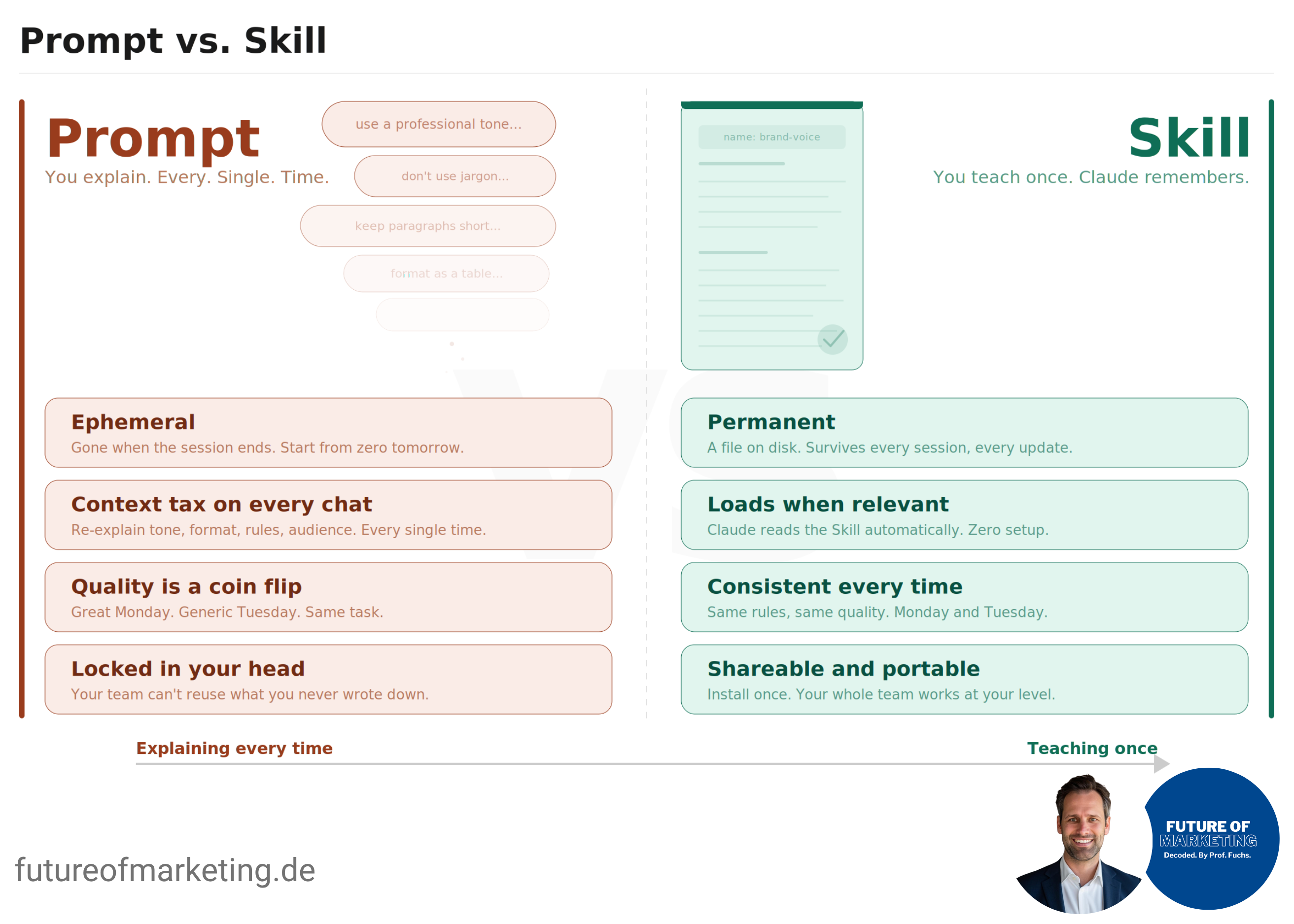
If you’ve spent the last two years getting better at prompting, here’s the uncomfortable truth: that effort was necessary, but it doesn’t compound. Every prompt you’ve ever written is gone the moment you close the chat. Skills change that equation. You invest the thinking once. You define what good looks like once. And from that point forward, Claude delivers at that level without you having to explain it again. The game isn’t writing better prompts anymore. It’s writing better Skills.
You don’t tell your senior content strategist how to write a LinkedIn post every time you ask for one. They know your voice, your format, your audience, your no-go phrases. They just deliver. That’s what a Skill does for Claude.
Anthropic provides pre-built Skills for common tasks (creating PowerPoint files, Excel spreadsheets, Word documents, PDFs). Those are useful. But the real power is in custom Skills: the ones you build yourself, tailored to your exact marketing workflows.
Here’s why this matters for marketing specifically:
Marketing work is highly repetitive in structure but highly variable in content. Every campaign brief follows the same logic but covers different products. Every content calendar uses the same framework but different topics. Every competitive analysis follows the same structure but different markets.
Skills capture the structure. You provide the content. Claude handles the rest.
👉 Skills are the difference between using AI as a chatbot and using AI as a trained team member.
How Skills Work (The Technical Part, Made Simple)
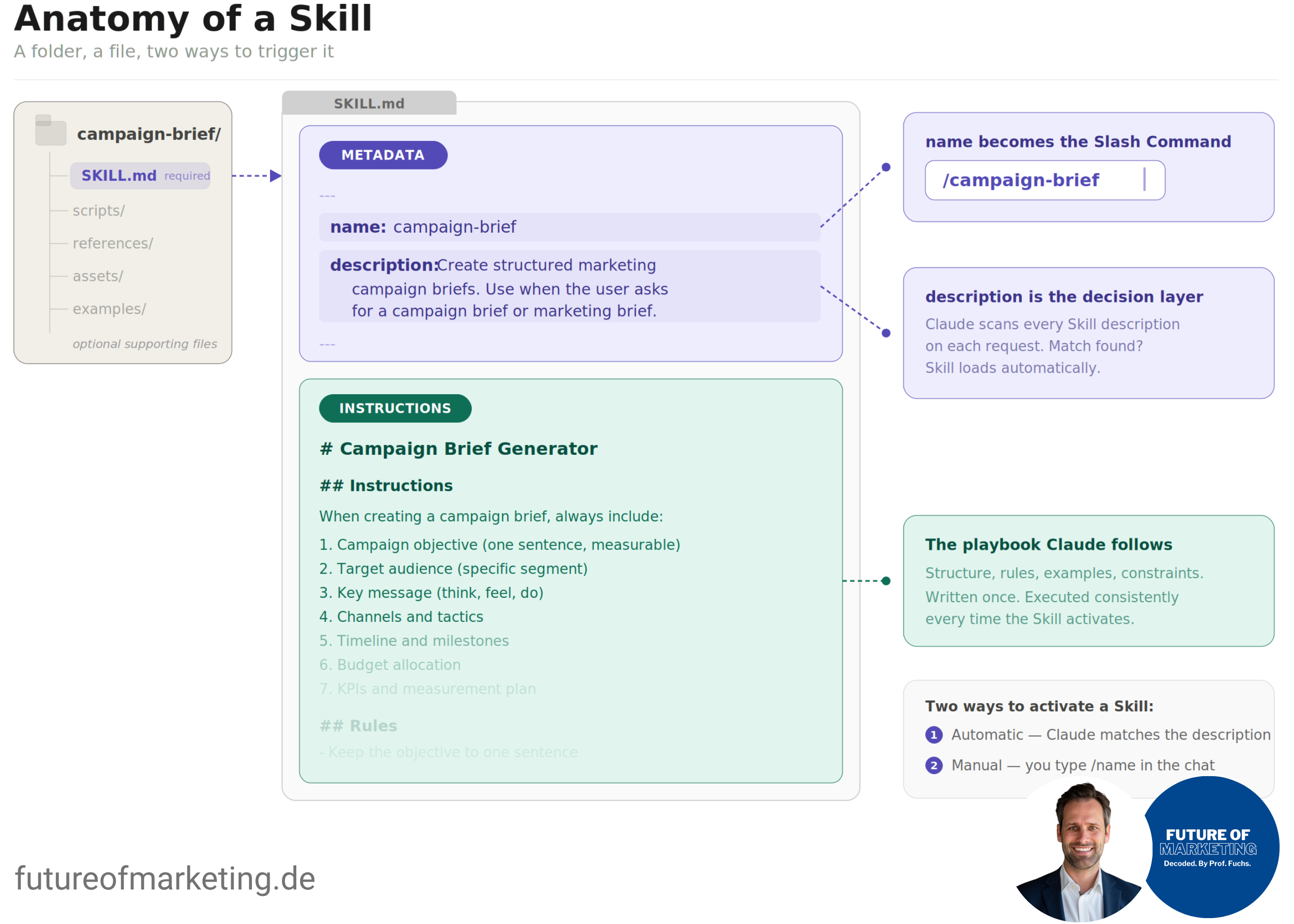
A Skill is just a folder with a text file inside.
That file is called SKILL.md. It contains two things:
Metadata (a name and a description that tells Claude when to use this Skill)
Instructions (the detailed playbook Claude follows when the Skill is activated)
Here’s the simplest possible example:
---
name: campaign-brief
description: Create structured marketing campaign briefs. Use when the user asks for a campaign brief, campaign plan, or marketing brief.
---

# Campaign Brief Generator

## Instructions
When creating a campaign brief, always include these sections:
1. Campaign objective (one sentence, measurable)
2. Target audience (specific segment, not "everyone")
3. Key message (what we want them to think, feel, do)
4. Channels and tactics
5. Timeline and milestones
6. Budget allocation
7. KPIs and measurement plan

## Rules
- Keep the objective to one sentence
- Always ask for the product/service if not provided
- Use plain language, no marketing jargon
- Include a "What success looks like" section at the end
That’s it. This file teaches Claude how to create a campaign brief every single time, without you having to explain the format again.
The description field is critical. Claude reads every Skill description to decide which ones are relevant to your current request. If you ask for a campaign brief, Claude sees the description, loads the Skill, and follows the instructions. Automatically.
You can also invoke a Skill directly by typing /campaign-brief in Claude Cowork.
How to Set Up Your First Marketing Skill
Every article takes days to research and write. Most of them are free. If they help you stay ahead in marketing, consider becoming a paid subscriber to support this work.
👉 Premium subscribers unlock: Three ways to set up your first Skill (including a prompt that lets Claude build it from your own best work). Plus 10 complete marketing Skill templates with full SKILL.md code to copy and install: Brand Voice, Content Repurposing, Competitive Intel, Email Sequences, Campaign Post-Mortems, SEO/GEO, Customer Personas, Budget Allocation, Leadership Reporting, and Sales Enablement. Plus a framework for turning Skills into organizational infrastructure and a concrete action plan for your first week.