

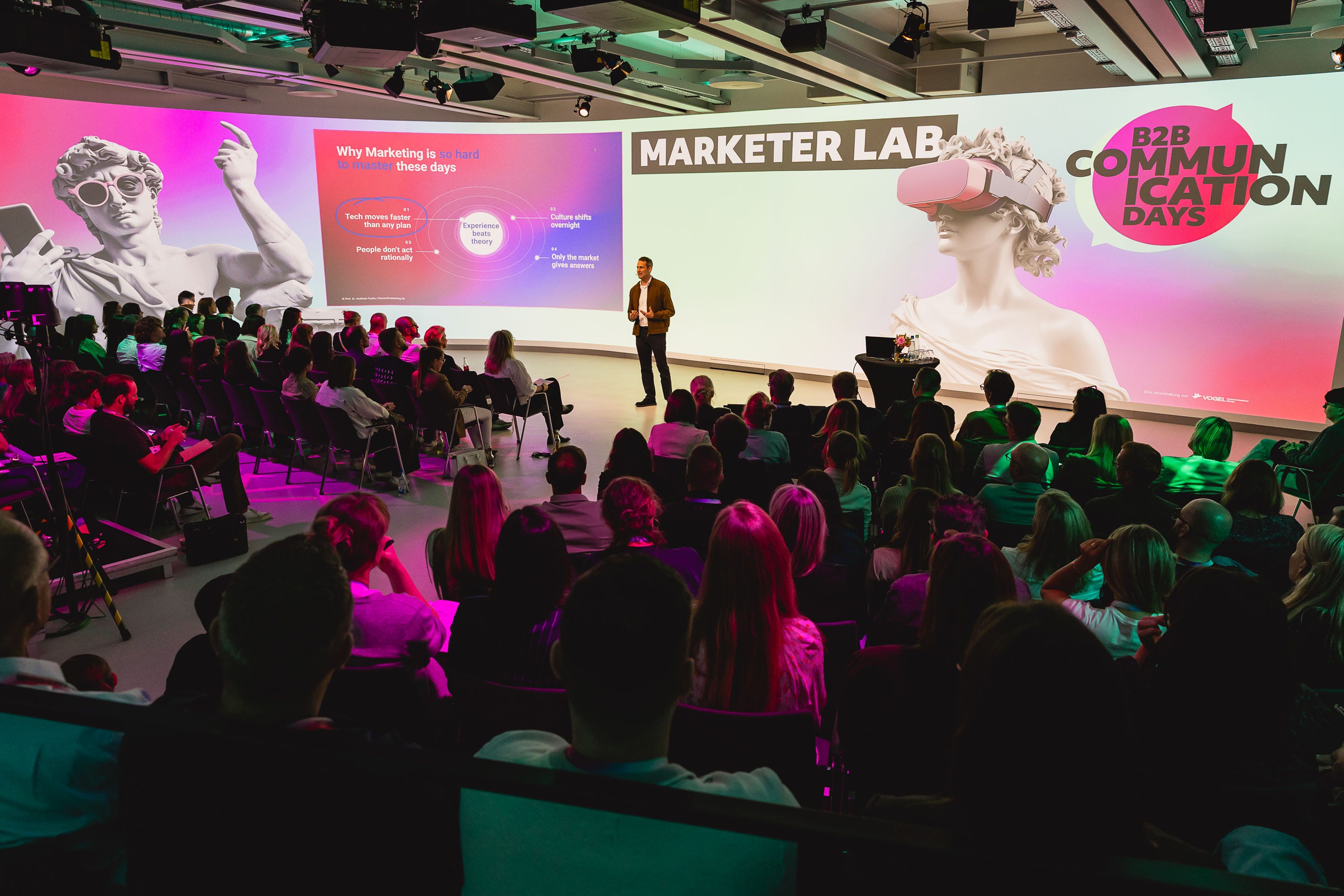
Why read this? This essay grew out of my keynote “Rewriting the Game” at the B2B Communication Days 2026 in Germany. If you lead marketing, you’re probably surrounded by AI pilots, new tools and shrinking budgets, and you’re wondering what’s really changing underneath and what stays the same. This post gives you the three structural shifts behind it, with one model per shift that you can take straight into your next leadership meeting. Reading time: about 12 minutes.
Marketing leaders don’t lack information about AI. New tools, models and use cases arrive every week, each one promising to change everything. What’s much harder to see is the pattern underneath: the structural shifts that will still matter in five years, long after today’s tools have been replaced.
This essay looks at three of those shifts. They touch how marketing work is organized, who does it, and what still sets a company apart once every competitor has access to the same AI. To understand them, it helps to start with an old question: why is marketing so hard to master?
Why marketing is so hard to master right now
Philip Kotler is one of the best-known marketing professors of all time, and he has shaped the discipline like no one else. In 2003, he summed it up in one line:
“Marketing takes a day to learn. Unfortunately, it takes a lifetime to master.” It has rarely been more accurate than today.
Four forces make mastery harder. Technology moves faster than any plan. Culture shifts overnight. People don’t act rationally. And in the end, only the market gives answers. What connects all four is that experience beats theory, and experience needs time that most marketing teams feel they no longer have.
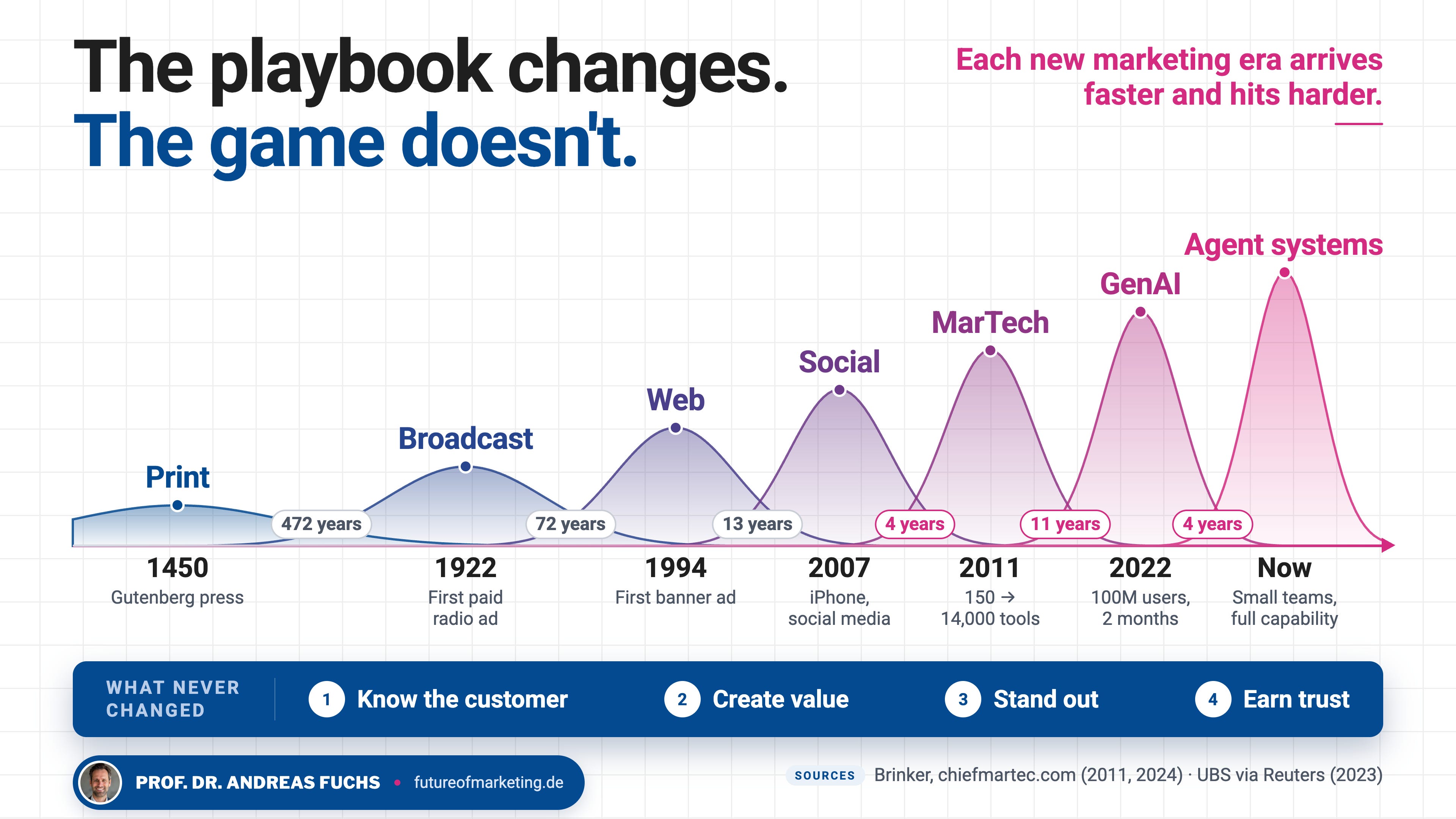
Yet amid all this change, one principle holds: the playbook changes, the game doesn’t. Know the customer, create value, stand out, earn trust. None of these four fundamentals has moved an inch. What’s changing is how we play.
Which leads to the question this essay answers: what’s reshaping the game in marketing right now?
Shift 1: Orchestration is the new strategic discipline
Imagine an orchestra without a conductor. Every musician is excellent. The horns, the cellos, the flutes and the timpani all play beautifully. And still what reaches the audience is noise, because nobody decides who plays when, how loud, and toward which piece.
That’s where many marketing departments stand with AI today.
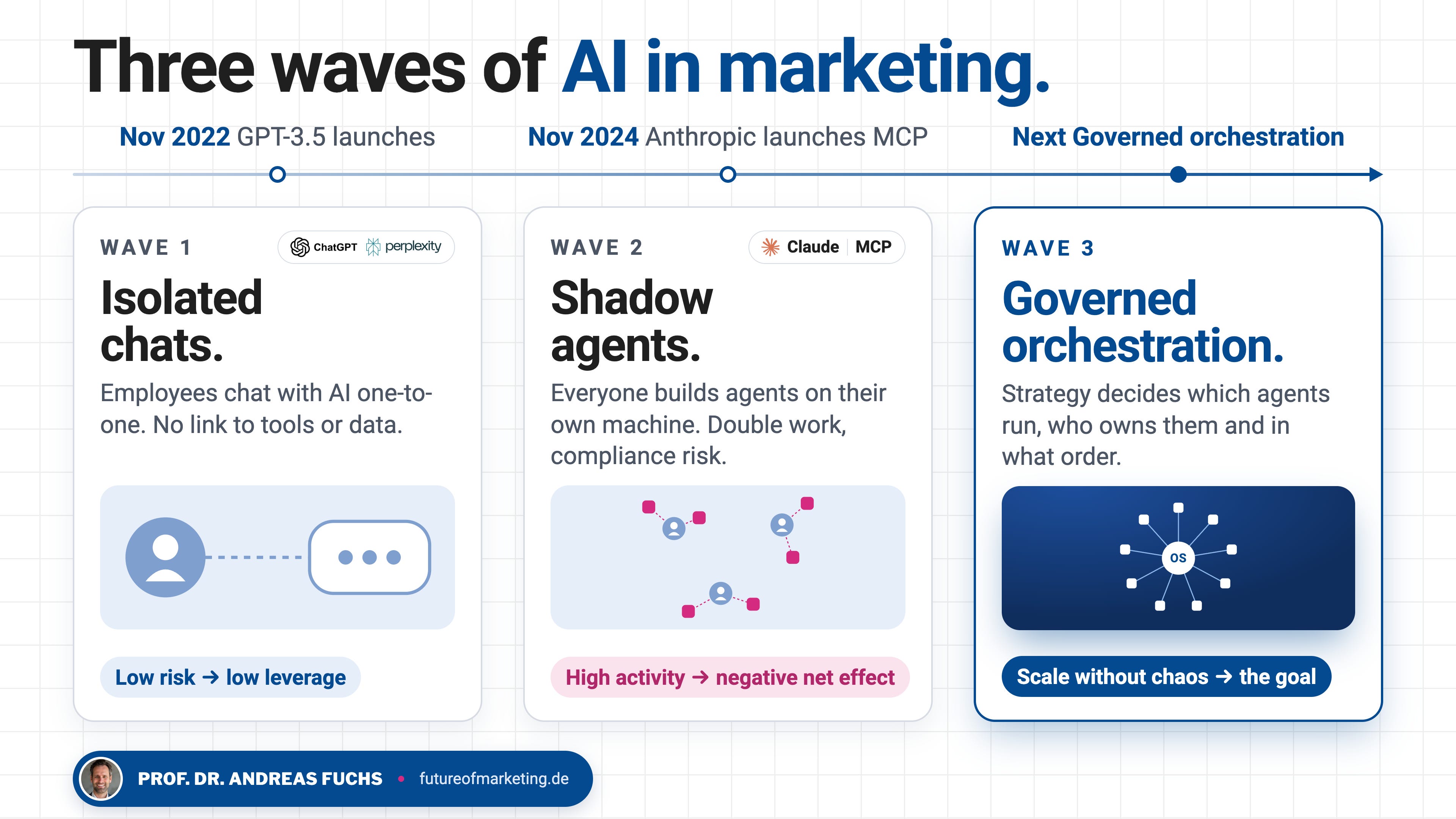
Three waves of AI in marketing. The first wave started in November 2022, when OpenAI launched ChatGPT on GPT-3.5. Employees chatted with AI one-to-one, with no connection to company tools or data. Low risk, but also low impact.
The second wave began in November 2024, when Anthropic launched the Model Context Protocol (MCP), an open standard that connects AI models to tools and data sources. From then on, AI could act, not just answer. And people started building agents on their own machines: one for LinkedIn posts, one for reporting, one for competitor monitoring.
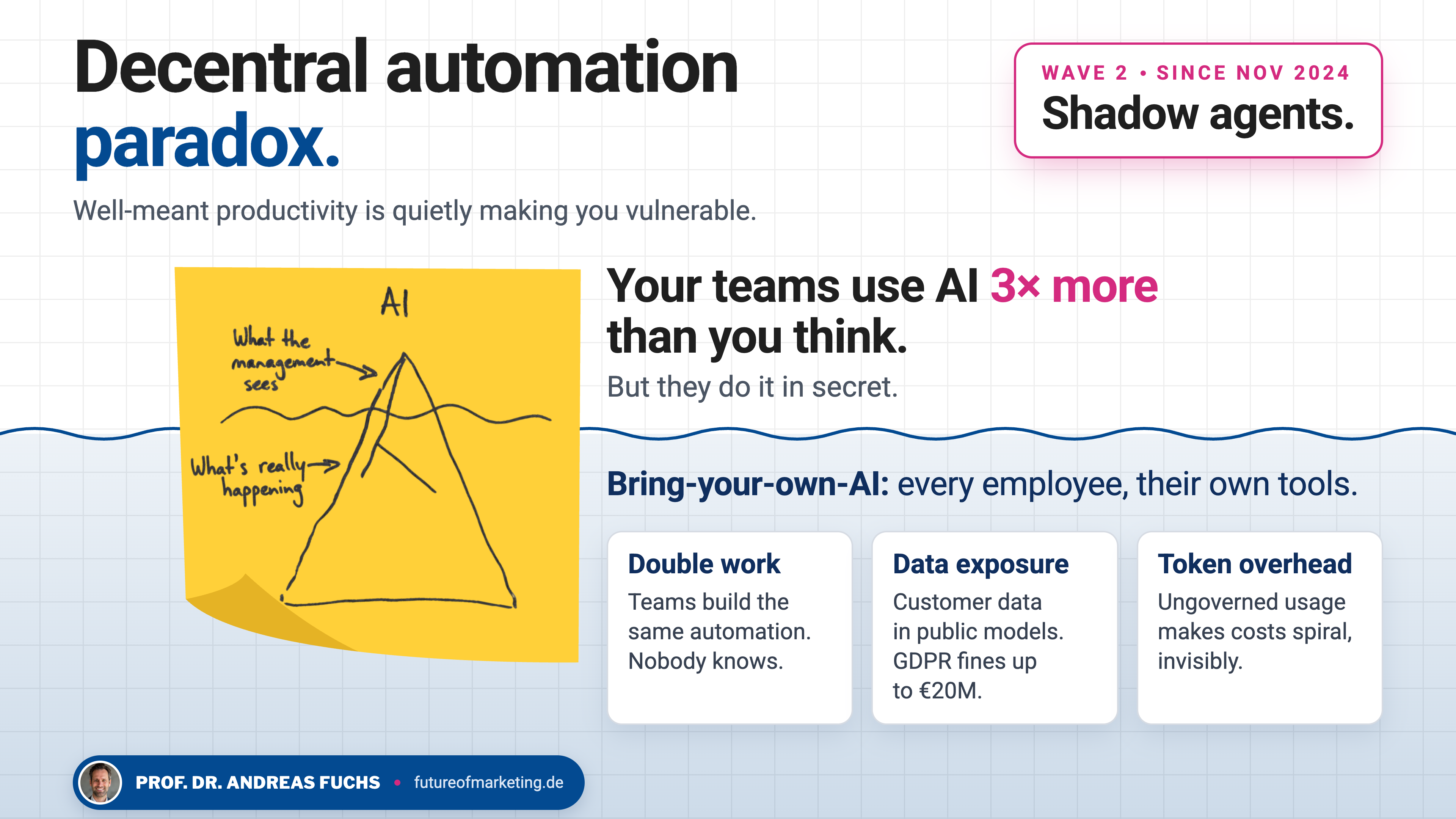
I call this the decentral automation paradox. Each of these agents is well-meant, and each one makes a single person more productive. Taken together, they quietly make the organization more vulnerable: duplicated work, inconsistent brand voice, company data flowing through tools nobody approved, and compliance risks nobody can see. Management sees the tip of the iceberg, while most of what’s happening sits below the waterline. The result is high activity with a negative net effect.
These are shadow agents, the direct successors of shadow IT.
The pattern is well documented. In a survey of 31,000 people across 31 countries, 75% of knowledge workers said they use AI at work, and 78% of those AI users bring their own AI tools instead of waiting for company-provided ones (Microsoft & LinkedIn, 2024; vendor data). Every one of these private tools is a potential agent that nobody in the organization oversees.
Where to start. The first step is unspectacular: an inventory. Ask your team which agents, custom GPTs and automations they’ve built, which company data those tools touch, and who maintains them. You can’t conduct an orchestra if you don’t know who’s on stage.
The third wave, the one we’re entering now, uses the same technology for the opposite purpose. Instead of every employee wiring up private agents, the organization connects agents, data and tools into one system that follows one strategy.
The Marketing Operating System. The agents and tools themselves are becoming commodities. Every competitor can buy the same models for content, SEO and GEO, CRM, ads, analytics and email. What can’t be bought is the layer between strategy and tools: the orchestration that translates goals, brand and positioning into instructions every agent follows.
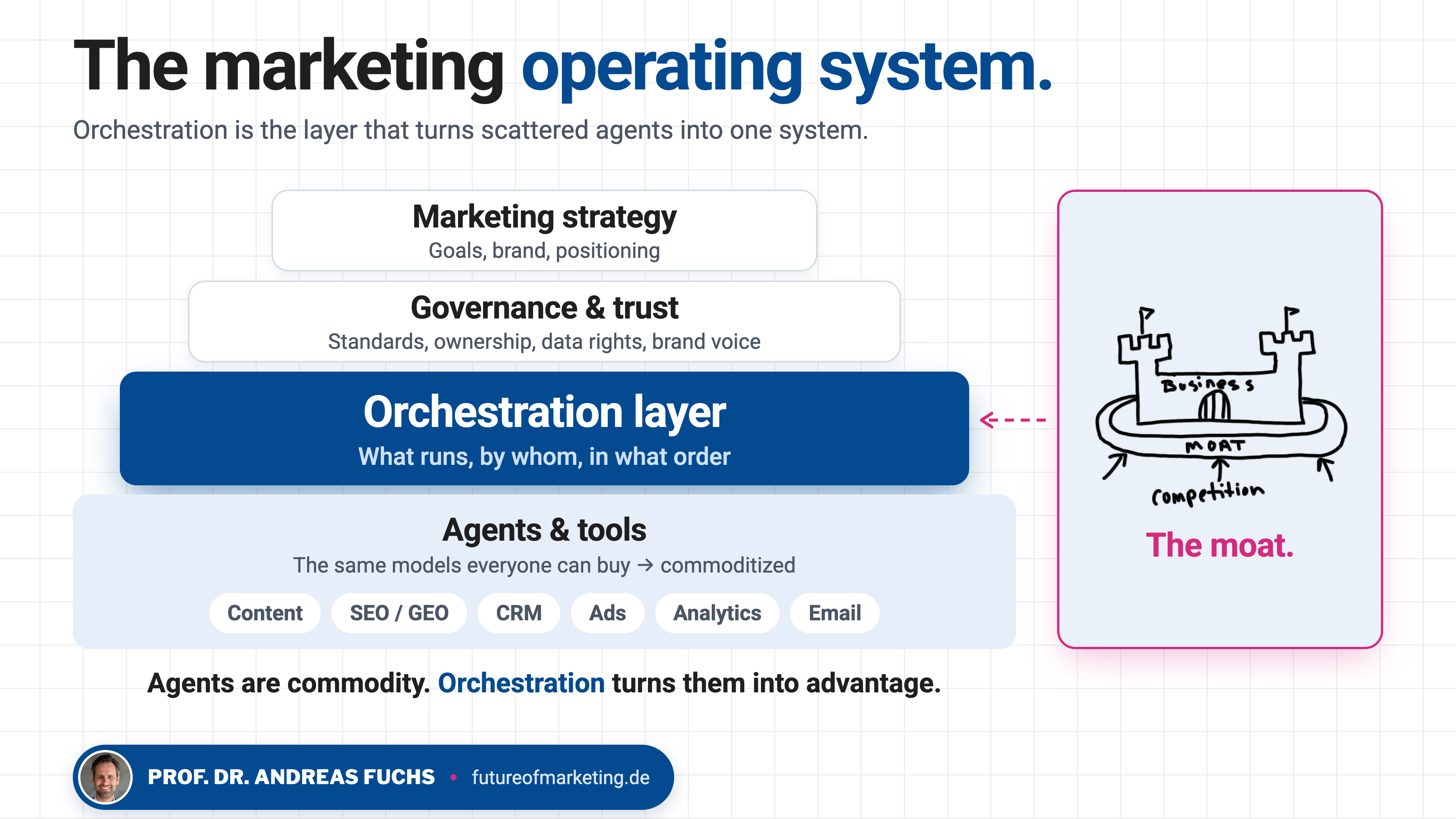
That’s why the bottleneck has moved. For years, the limiting factor was AI and automation capacity. Today, it’s strategic steering.
What does orchestration look like in practice? Four elements turn a collection of agents into an operating system:
A shared memory. Briefs, brand rules, personas, past campaigns and results live in one place, so every agent works from the same context instead of a private copy.
Central brand and quality rules. Marketing writes them down once and maintains them, and every agent follows them, rather than each prompt reinventing the brand.
Reusable skills. Proven workflows, such as how your team writes a launch post or evaluates a campaign, are packaged so that anyone on the team can run them the same way.
Clear ownership. Someone knows which agents exist, which data they touch and whether they still earn their place.
All four are management decisions rather than technology purchases. They’re exactly what a conductor brings to an orchestra: a score everyone plays from, and someone responsible for how it sounds.
👉 The competitive edge comes from conducting your agents well, not from owning more of them.
If you want to go further, I’ve described the architecture in detail in The Future of Marketing: Building Your Own Marketing Operating System.
Shift 2: Every marketer is now a builder
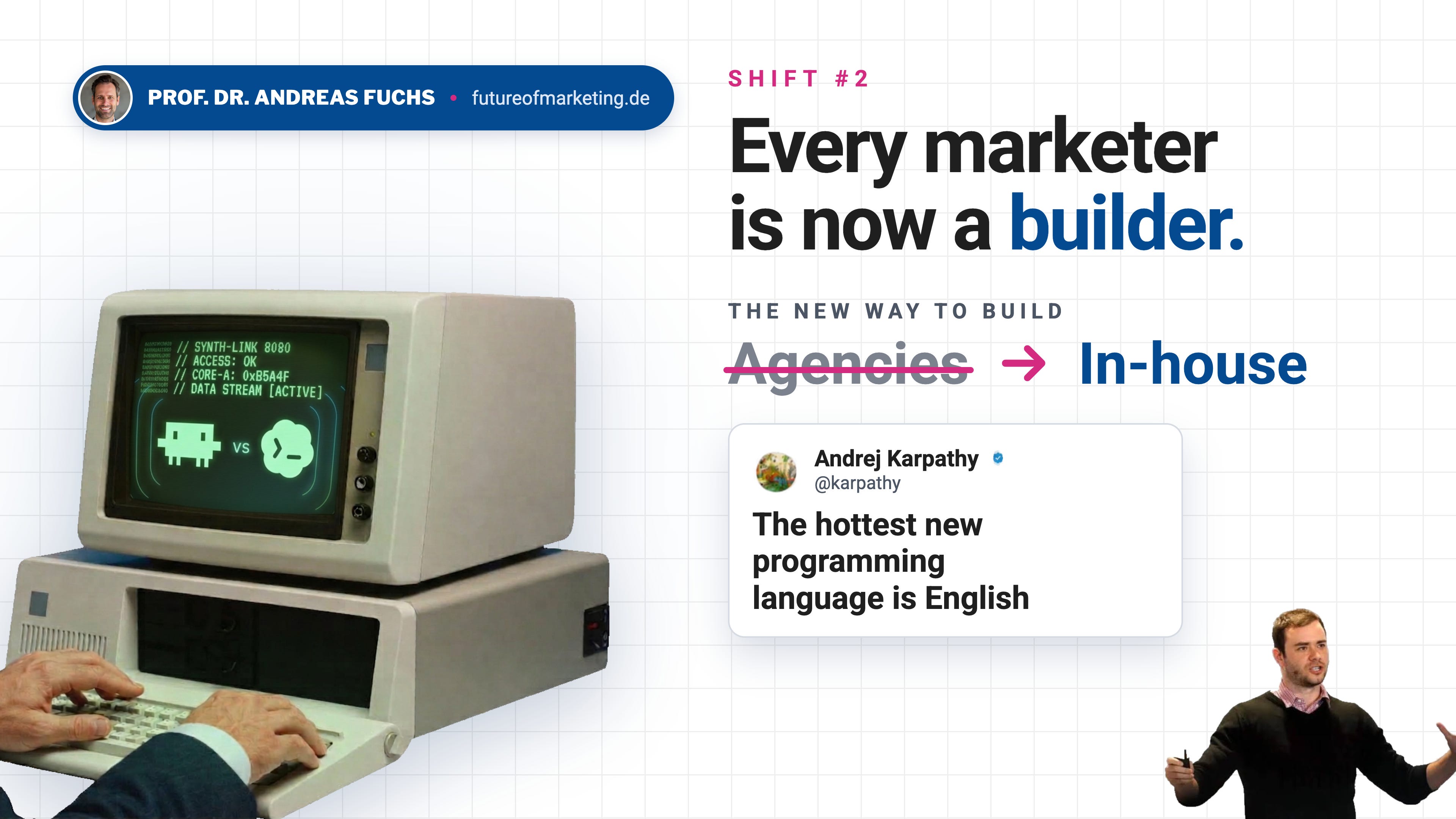
Can marketers code? Most would say no, and until recently that was true. Today, anyone who can describe a task clearly in plain language can build complex agent operating systems. Andrej Karpathy summed it up in a single sentence back in 2023: “The hottest new programming language is English.” Tools like Claude Code let marketers describe what they need and get working workflows, applications and agents in return.
👉 Premium subscribers unlock: What the 2026 budget data means for your team, with three consequences for agencies, hiring and tool purchases. A real-world Content OS, showing how one system runs four channels from idea to publication. Shift 3 in full, with the two-by-two matrix for deciding which marketing tasks belong to people and three arguments for why brand is the one asset AI can’t copy. Three questions for your next leadership meeting.