

In my last post, I outlined the CMO Agenda 2026 that will shape this Substack over the coming weeks and months.
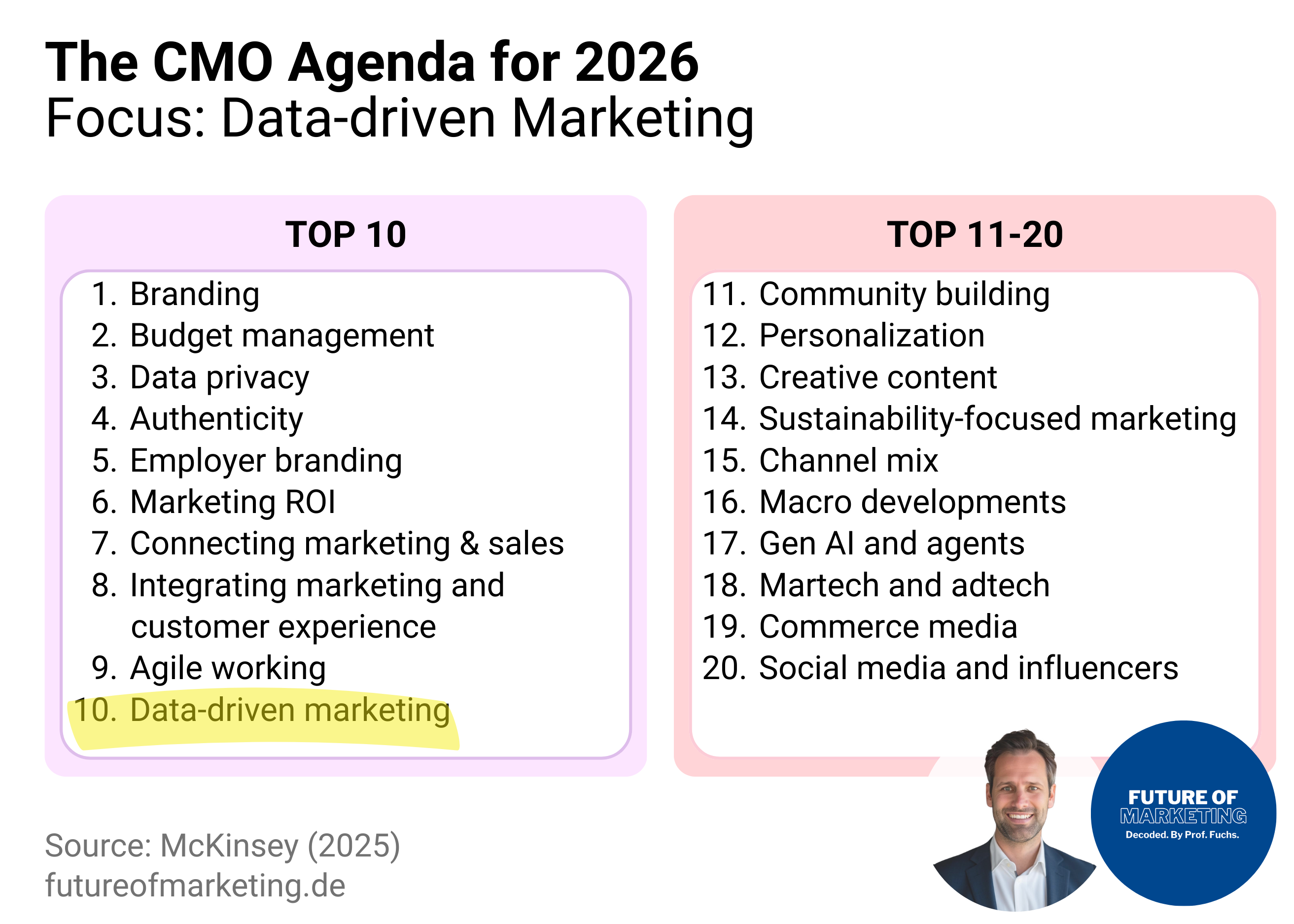
Based on the State of Marketing Europe 2026 report, we identified the ten themes (the CMO Agenda 2026) that currently matter most to CMOs across Europe (see illustration below).
Today, we begin with an unusual starting point.
Not with the topic ranked #1. But with the one ranked last.
#10: Data-Driven Marketing.
And I want to argue that this ranking tells us something far more important than it seems.
Why Last Place Is Not What You Think
At first glance, you might read “#10” as a demotion. A signal that data has lost its relevance. That CMOs have moved on.
That would be the wrong conclusion.
When 500 senior marketing leaders across Europe rank data-driven marketing at the bottom of the top ten, they are not saying it does not matter. They are saying something more nuanced:
Data has become assumed infrastructure.
It is no longer a strategic initiative. It is a precondition.
Think about it this way: Nobody puts “electricity” on a list of strategic priorities either. Not because it is irrelevant — but because without it, nothing else on the list works.
Branding (#1)? Requires data to measure distinctiveness, track perception, and allocate budgets. Marketing ROI (#6)? Impossible without clean, shared data. Connecting marketing and sales (#7)? A coordination problem that collapses without a common data foundation. Personalization (#12)? Entirely data-dependent.
Data does not compete with these themes. It runs beneath all of them.
And that is exactly why its position at #10 is not a weakness — it is a sign of maturation.
The Paradox: DDM Is Everywhere Present, But Nowhere Mastered
But here is the tension.
If data-driven marketing has become foundational, you might expect organisations to have figured it out by now. They have not.
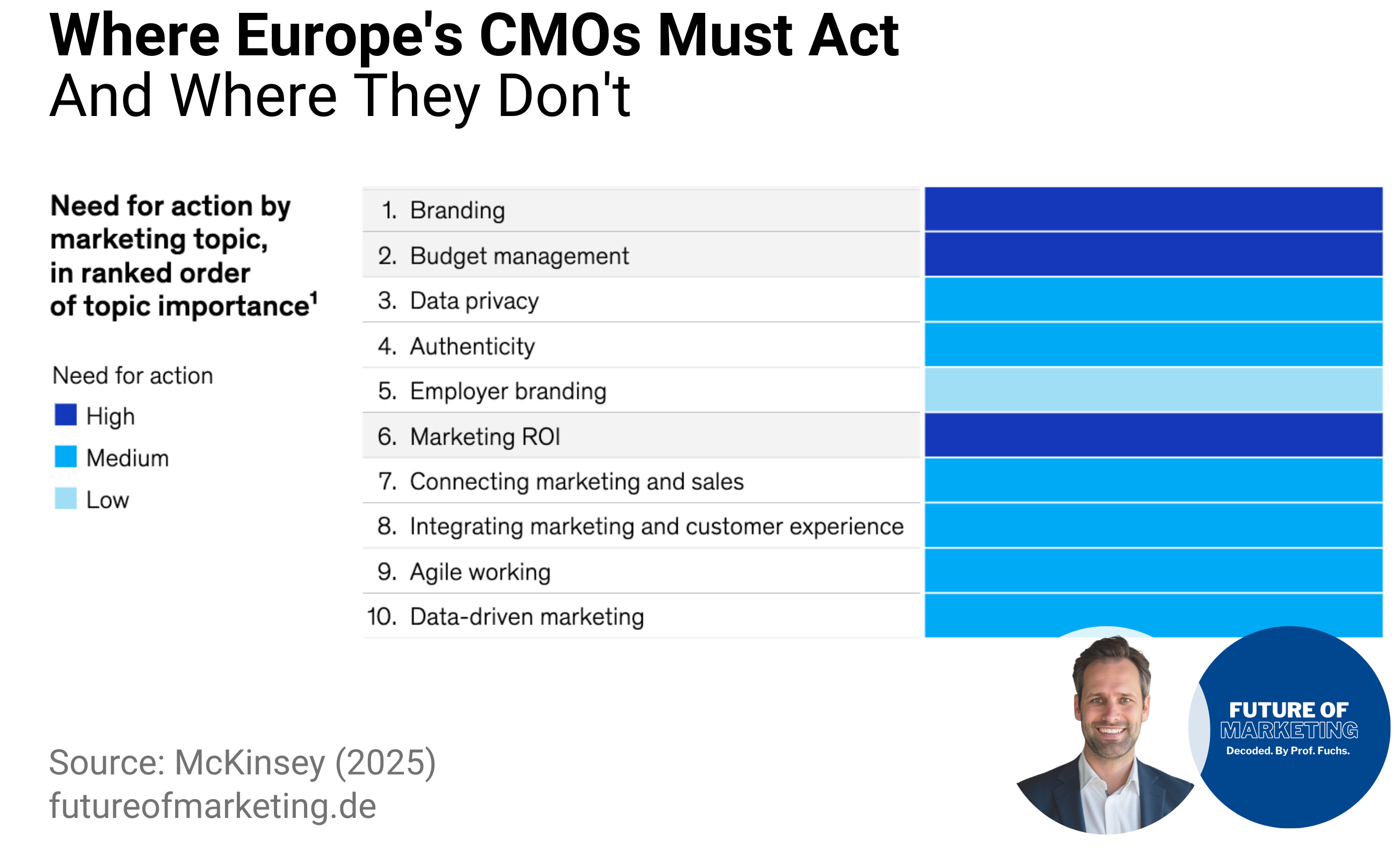
McKinsey’s report classifies data-driven marketing as a medium need-for-action topic — not the highest urgency, but far from resolved. The gap between perceived importance and actual maturity remains real.
And in every organisation I work with — whether mid-market or enterprise, B2B or B2C — I see the same pattern:
More data than ever. Less shared understanding than ever.
Dashboards multiply. Reports circulate. Analytics teams grow. And yet, in leadership meetings, people still argue about which numbers to trust.
This is the paradox at the centre of modern marketing:
We have solved the access problem. We have not solved the alignment problem.
Most organisations today do not struggle to collect data. They struggle to agree on what the data means — and what to do with it.
From Reporting Layer to Coordination Mechanism
This is where the conversation needs to shift.
For the past decade, data-driven marketing has been framed as a reporting function. Build the dashboard. Track the KPIs. Report to leadership. The implicit assumption: once people see the numbers, they will make better decisions.
That assumption is wrong.
Data does not create alignment by being visible. It creates alignment by being trusted, shared, and decision-relevant.
The real question is not: “Do we have the data?”
The real question is: “Do we agree on what the data tells us — and does it change what we do?”
This reframing matters enormously. Because it shifts data-driven marketing from a technical capability to an organisational coordination mechanism.
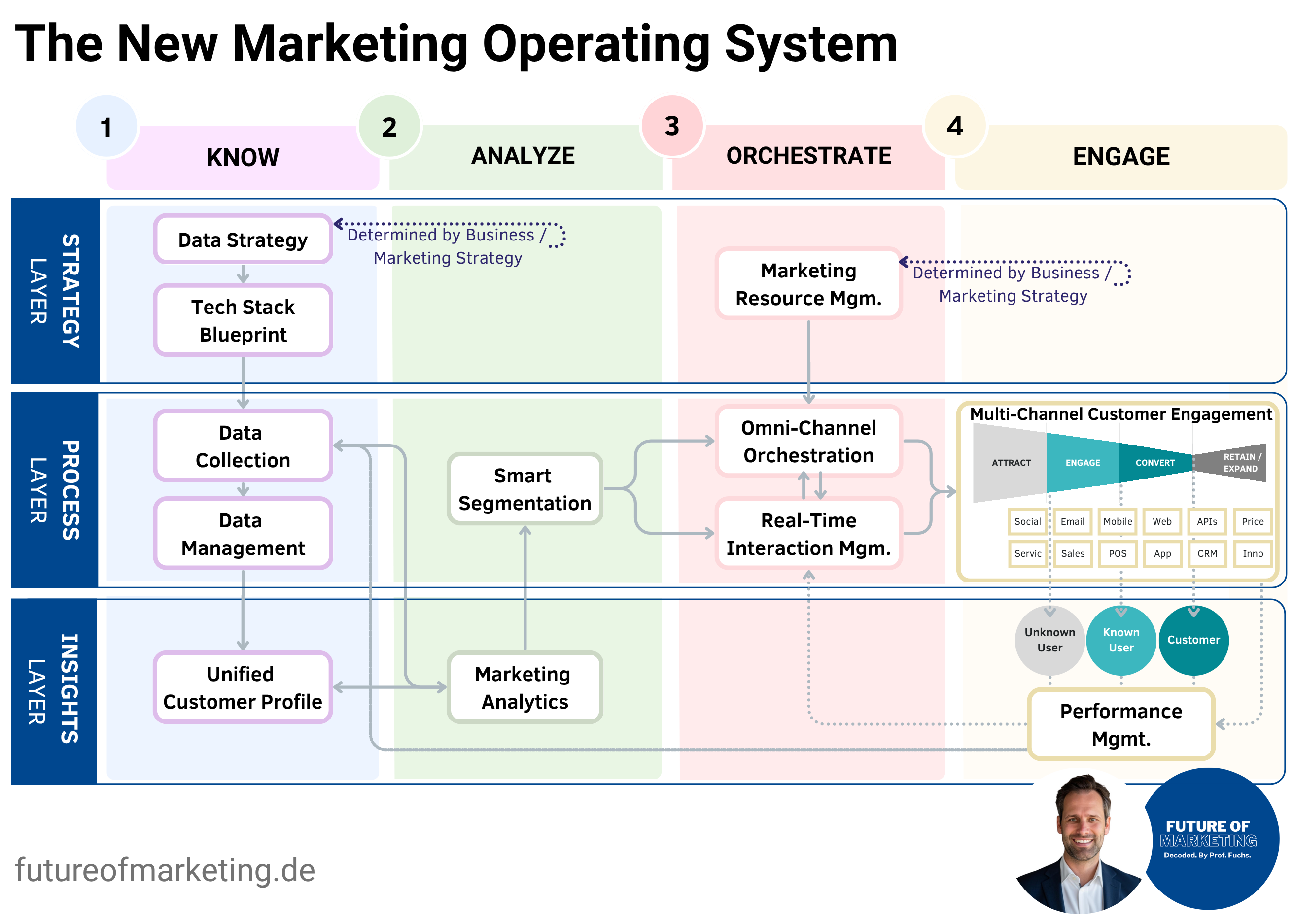
And if you have been reading this Substack, you know that this is not a new thought. It connects directly to the Marketing Operating System (MOS) I introduced earlier. The MOS is built on three layers — Strategy, Process, and Insights — and runs through four dynamic phases: Know, Analyze, Orchestrate, and Engage.
Data-driven marketing is not one of those phases. It is the thread that connects all of them.
Source: Fuchs (2025).
Without a functioning data foundation, the KNOW phase has no memory. The ANALYZE phase has no inputs. The ORCHESTRATE phase has no signals. And the ENGAGE phase has no feedback loop.
Data is the nervous system of the entire Marketing OS. When it works, the system learns. When it breaks, the system guesses.
Let me unpack what this means in practice.