

In my previous essay, Task-Driven, Agentic Marketing Organizations, I argued that marketing organizations are undergoing a structural shift:
Task-Driven, Agentic Marketing Organizations

Why read this article:
This article shows how marketing organizations can scale execution without scaling headcount. It explains how task-driven, agentic workflows replace role-based structures and why human work shifts from execution to ownership and orchestration. The article provides a clear operating logic for redesigning marketing and sales in the age of AI agents.
Marketing organizations are moving away from role-based hierarchies toward task-driven, agentic systems, where humans and AI agents collaborate at scale.
This shift changes how work is executed.
But it raises a more fundamental question:
If tasks, not roles, become the organizing principle,
how should human work itself be designed?
This essay is not an attempt to name new roles for an AI age.
It is an attempt to rethink where human contribution belongs once execution itself becomes scalable.
Why Roles Lose Their Explanatory Power
Roles are an organizational invention optimized for scarcity.
They bundle tasks because human time is limited.
They stabilize accountability when coordination is costly.
They make organizations manageable when execution depends primarily on people.
Agentic systems quietly dissolve these assumptions.
Tasks can now be decomposed, recombined, and executed by specialized agents at near-zero marginal cost. Execution no longer scales with headcount. Work becomes continuous, parallel, and fluid.
Under these conditions, roles do not suddenly disappear.
They simply stop explaining how value is created.
They turn into a legacy interface between humans and work.
The instinctive response is familiar. New titles appear. AI managers. Automation leads. Prompt engineers.
But changing labels preserves the logic that is already failing.
The real transition is not from old roles to new ones.
It is from roles to the deliberate design of human work.
From Managing People to Designing Work
Once execution is delegated to agents, leadership changes its nature.
The central question is no longer:
Who is responsible for what?
It becomes:
Where should humans be positioned relative to workflows, agents, and outcomes?
As machines take over execution, human value moves upward.
Humans stop being the primary executors of tasks. They become owners, designers, and stewards of systems. Human work can no longer be inherited from org charts designed for a different era. It has to be designed intentionally.
The Three Human Positions in Agentic Marketing
What emerges is not a new org chart, but a set of recurring human positions. Structural positions that agentic systems require in order to function without drifting into chaos.
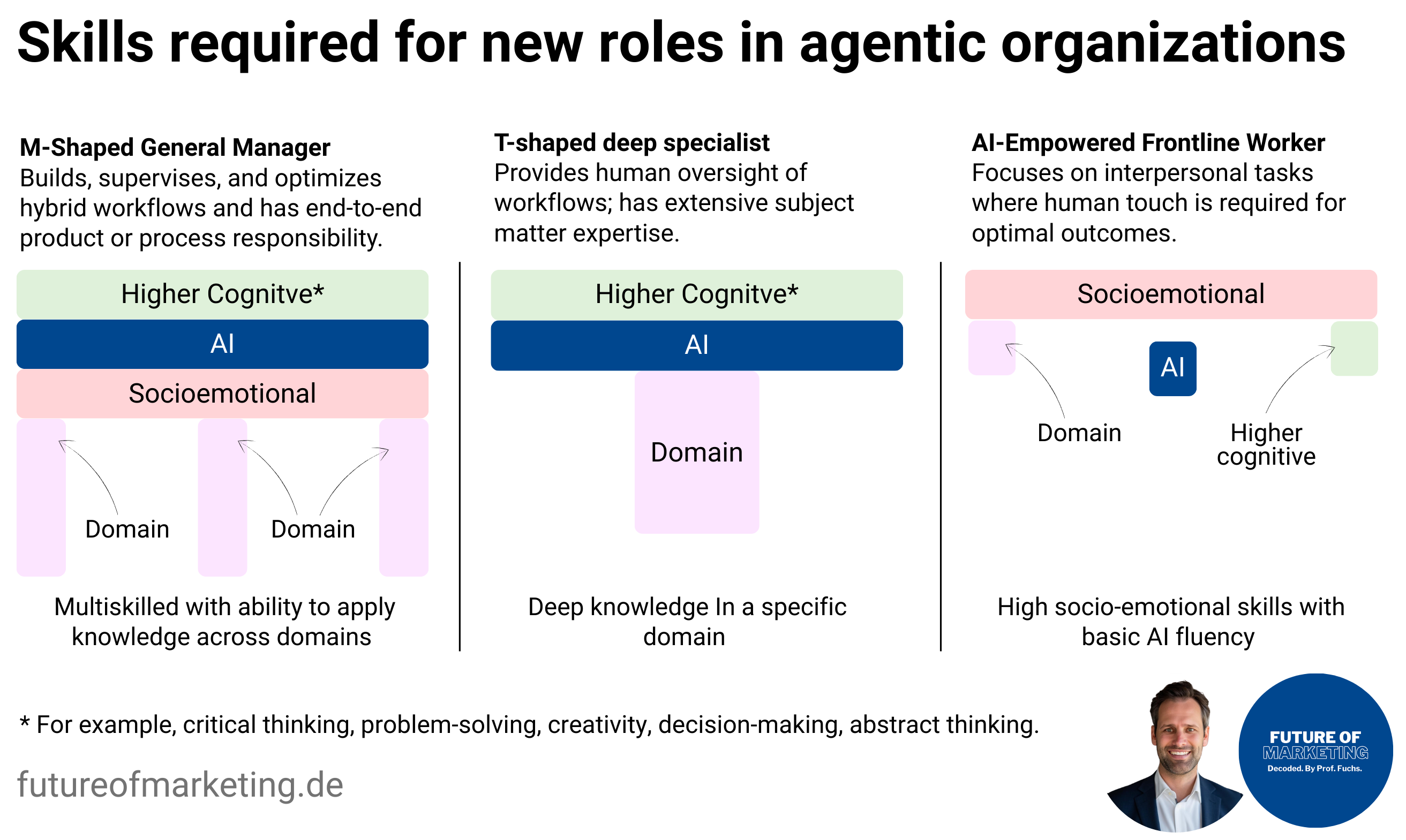
Source: Own visualization based on Sukharevsky et al. (2025).
1. Orchestrators of End-to-End Work
(M-Shaped General Manager)
Orchestrators represent the evolution of management when managing people is no longer the bottleneck.
Their responsibility is not supervision. It is system design.
They define outcomes, decompose work into workflows, and decide where automation operates autonomously and where human involvement remains essential. They manage trade-offs between speed, quality, risk, and cost.
Crucially, they retain accountability.
Execution can be automated. Accountability cannot. It must remain human.
Orchestrators do not manage teams or channels.
They orchestrate interaction between capabilities.
Example: A Head of Growth who no longer runs channel teams, but owns end-to-end revenue workflows across marketing, sales, and AI agents and is accountable for outcomes rather than headcount.
Skill gap: Compared to today’s manager roles, this profile requires a novel mix of integrative thinking and the ability to manage AI-first workflows.
2. Stewards of Expertise and Exceptions
(T-Shaped Deep Specialist)
As automation scales, deep expertise becomes more valuable, not less.
Stewards of expertise provide human oversight in agentic systems. They fine-tune and teach agents, handle exception cases, and protect quality where automated execution alone is insufficient.
They combine deep domain knowledge with higher cognitive abilities such as pattern recognition, judgment, and system-level understanding.
Compared to traditional specialist roles, this position expands responsibility. It shifts from configuring tools to shaping and evolving agentic systems over time.
Example: A CRM expert who not only configures systems, but designs, trains, and continuously improves AI-driven lead routing, lifecycle management, and personalization agents.
Skill gap: Builds on today’s specialist roles but adds the ability to fine-tune and teach agentic systems, requiring greater technological adaptability.
3. Human Interfaces in Trust-Critical Domains
(AI-Empowered Frontline Worker)
Some parts of marketing are not defined by efficiency, but by trust:
Sales conversations.
Strategic partnerships.
Negotiations.
Leadership communication.
In these domains, human presence is not a temporary limitation. It is the value proposition.
AI agents increasingly support these interactions by providing research, insights, and recommendations. But the human remains the interface where responsibility, persuasion, and relationship-building converge.
As automation expands, weak human interaction becomes visible and costly. AI does not remove the need for human interfaces. It raises the bar for them.
Example: A key account manager who uses AI agents for account research, opportunity insights, and next-best-action recommendations, while focusing human effort on trust-building, negotiation, and long-term relationships.
Skill gap: Evolves existing frontline roles by integrating AI capabilities into jobs previously selected primarily for emotional intelligence.
Why Reskilling Is the Wrong Primary Frame
Much of the current debate frames this transformation as a reskilling challenge.
This framing is incomplete.
Most human capabilities persist even as tasks are automated. What changes is not the skill itself, but where and how it is applied.
AI fluency has increased rapidly and is now one of the fastest-growing skill categories. But AI fluency alone is insufficient.
The critical capabilities for task-driven marketing organizations are structural:
designing systems rather than teams,
orchestrating human–machine interaction,
managing trade-offs under uncertainty,
applying judgment where automation fails.
👉 The core challenge is not training individuals. It is repositioning human work inside systems.
Careers Without Stable Roles
When work is organized around tasks and workflows, careers can no longer be linear ladders tied to stable roles.
They become portfolios of positions across workflows.
Progress is defined less by title and headcount, and more by the scope of outcomes someone owns, the complexity of systems they orchestrate, and the trust they are granted.
This has far-reaching implications for
performance management
incentives
leadership development
and HR systems.
Static org charts give way to work charts that reflect dynamic ownership and accountability relationships.
Final Thought
The competitive advantage of agentic marketing organizations is not better AI. It is better design of human work. Organizations that cling to roles will optimize execution inside structures that no longer fit. They will appear efficient, yet remain fragile.
Organizations that deliberately design human work as part of their agentic architecture will scale with clarity. They will move faster without losing control. They will automate without eroding responsibility.
In the agentic era, marketing leadership is no longer about managing people.
It is about designing systems in which human judgment remains central, while speed and scale are delegated to machines.
That is the real transformation ahead.
👉 If you would like to discuss how these ideas can be applied to your marketing organization, feel free to reach out.
Yours sincerely,
Prof. Dr. Andreas Fuchs 🦊🎓
1 Sukharevsky, A., Krivkovich, A., Gast, A., Storozhev, A., Maor, D., Mahadevan, D., Hämäläinen, L., & Durth, S. (2025). The agentic organization: Contours of the next paradigm for the AI era. McKinsey & Company.
A piece that needed to be written. Thank you Dr. Fuchs!
Spot-on framework! The three positions (Orchestrators, Stewards, Interfaces) capture how human work elevates from execution to system stewardship in agentic orgs, while preserving accountability where it matters most.