

Why read this article: This article introduces a framework for dividing marketing work between humans and AI agents. It explains why the most consequential line in the modern organization, the line between human and machine, is currently being drawn by accident, and how two questions turn it into a deliberate decision. The article provides the sorting logic every (marketing) organization needs before building agentic structures.
In the spring of 1776, Adam Smith opened the most influential book in the history of economics not with a theory of money, but with a visit to a pin factory.
Ten workers, he observed, could produce forty-eight thousand pins in a single day, provided the work was divided into roughly eighteen distinct operations. One man drew the wire, another straightened it, a third cut it, a fourth sharpened the point. The same ten men, each making entire pins alone, would have struggled to produce twenty between them.
The machines in that workshop were unremarkable. The revolution lay entirely in the division of labor.
Every economic era since has begun the same way. Not with a new technology, but with a new answer to the oldest question in business: who does what?
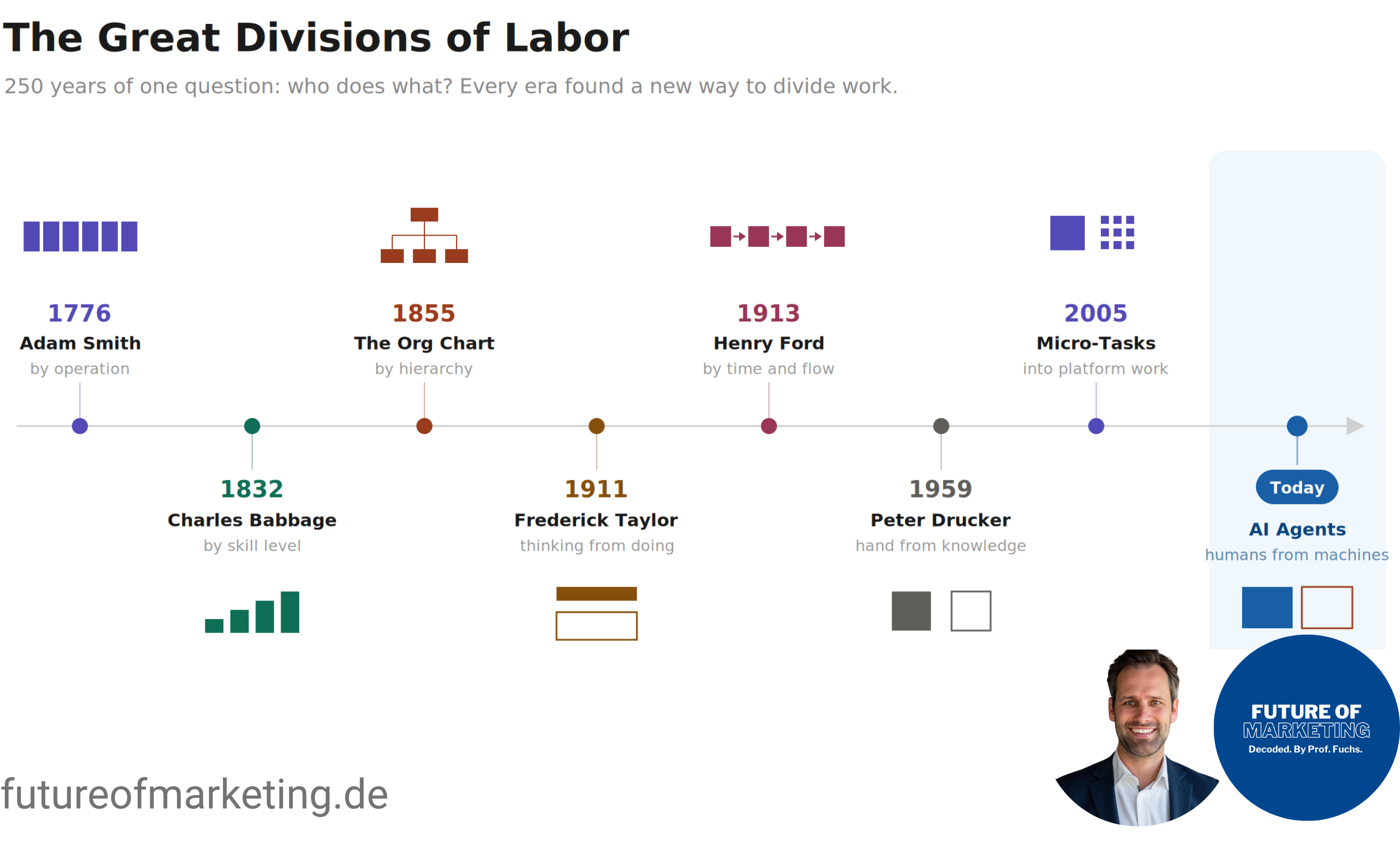
Source: Own visualization (Fuchs, 2026).
The factory sorted work by operation. A century later, Frederick Taylor sorted thinking from doing, and built scientific management on that single cut. The modern corporation then sorted work into roles, stacked the roles into hierarchies, and drew the result as a chart, an invention born on an American railroad in the 1850s and so successful that we now mistake it for the organization itself. And the cutting never stopped: Babbage divided work by skill, Ford by time, Drucker separated hand from knowledge work, and the platforms of the 2000s shredded jobs into micro-tasks.
Each of these divisions felt, at the time, like a technical exercise. Each one, in retrospect, decided who would create value, who would capture it, and what an entire generation of working lives would look like.
We are now living through the next great division of labor. AI agents can decompose, recombine, and execute knowledge work at near-zero marginal cost, which quietly dissolves the assumption underneath every previous arrangement: that execution requires human time.
I have written about what this does to organizational structure and to the design of human work. This essay is about the step that precedes both, the division of the work itself.
Because this time, something is different.
The line no longer runs between people. It runs through the middle of every job.
The Most Consequential Line in Marketing Is Drawn by Accident
Here is the uncomfortable observation: in most marketing organizations, this line is being drawn right now, and almost nobody is drawing it deliberately.
It is drawn by whoever happens to adopt a tool first:
by the enthusiasm of a performance team that automates its reporting,
by the hesitation of a brand team that touches nothing,
by a procurement decision,
by a vendor demo that went well.
Task by task, the most consequential boundary in the modern organization, the boundary between human and machine, is emerging as the accidental by-product of a thousand uncoordinated decisions.
Adam Smith at least had a manufacturer who designed the eighteen operations on purpose. The typical marketing organization of 2026 is a pin factory dividing its labor at random.
And the standard question leaders ask makes it worse. They ask: what can we automate?
It sounds like strategy. It is actually surrender, because it lets technical feasibility decide a question that belongs to strategy. Ask only what can be automated, and you will automate whatever is easiest, including work that quietly carries your judgment and your voice. Meanwhile the true waste, the work too messy to automate and too trivial to matter, survives untouched, because nobody ever asked whether it should exist at all.
Feasibility is a fact about the machine. The division of labor is a decision about the company.
These are not the same thing, and confusing them is how organizations end up automated and undifferentiated at the same time.
The Framework: Two Questions That Sort Every Marketing Task
👉 Premium subscribers unlock: The complete Division-of-Labor Matrix, my two-axis framework for dividing marketing work between humans and AI agents, with the full 2×2 visual. The four verdicts the map produces for every marketing task, from the work your best people must keep to the work that should quietly disappear, each illustrated with concrete examples from brand, performance, and analytics. How the sorted map translates into the task-driven organization, function by function, with the two-step diagram. The two hidden properties that decide whether your division of labor stays current or silently expires. And the one rule that must never be broken when work moves to machines.