

Why read this article: This article explains what actually makes a marketing organization future-proof once AI agents become normal. It connects four shifts into one model: customers delegating decisions to machines, organizations reorganizing around tasks instead of roles, orchestration as the new strategic discipline, and brand as the one advantage AI cannot copy. The core idea is simple: agents are commodity, and the real moat is the system you build around them.
Every conversation about future-proofing marketing starts in the same place:
Which tools.
Which agents.
Which platform.
That’s the wrong starting point.
The technology is the one part of this transformation that everyone will have. Your competitors will buy the same models, plug in the same agents, run the same automation. The evidence that AI itself does not create durable advantage is by now hard to argue with (Why AI Will Not Bring Sustainable Competitive Advantage).
So the real question is not how much you automate. It’s what you build on top of it.
A future-proof marketing organization is not the one that automates the most. It’s the one that turns scattered AI agents into one coherent system, reinvests the freed capacity into work that differentiates, and protects the few things AI cannot copy: brand, trust, and human judgment.
I recently developed a keynote on exactly this question. Four shifts kept surfacing. Together they describe what “future-proof” actually means once the hype is stripped away.
Here they are.
#1 Your Next Customer Is a Machine
The first shift does not happen inside your organization. It happens inside your customer.
Picture the single most important customer your company has to win next year. It isn’t a person. It’s a piece of code. An algorithm that scans billions of data points in milliseconds and decides, coldly, whether your product lands on a shortlist or disappears for good. That’s not a thought experiment from a science fiction novel. It’s the direction the market is already moving, fast.
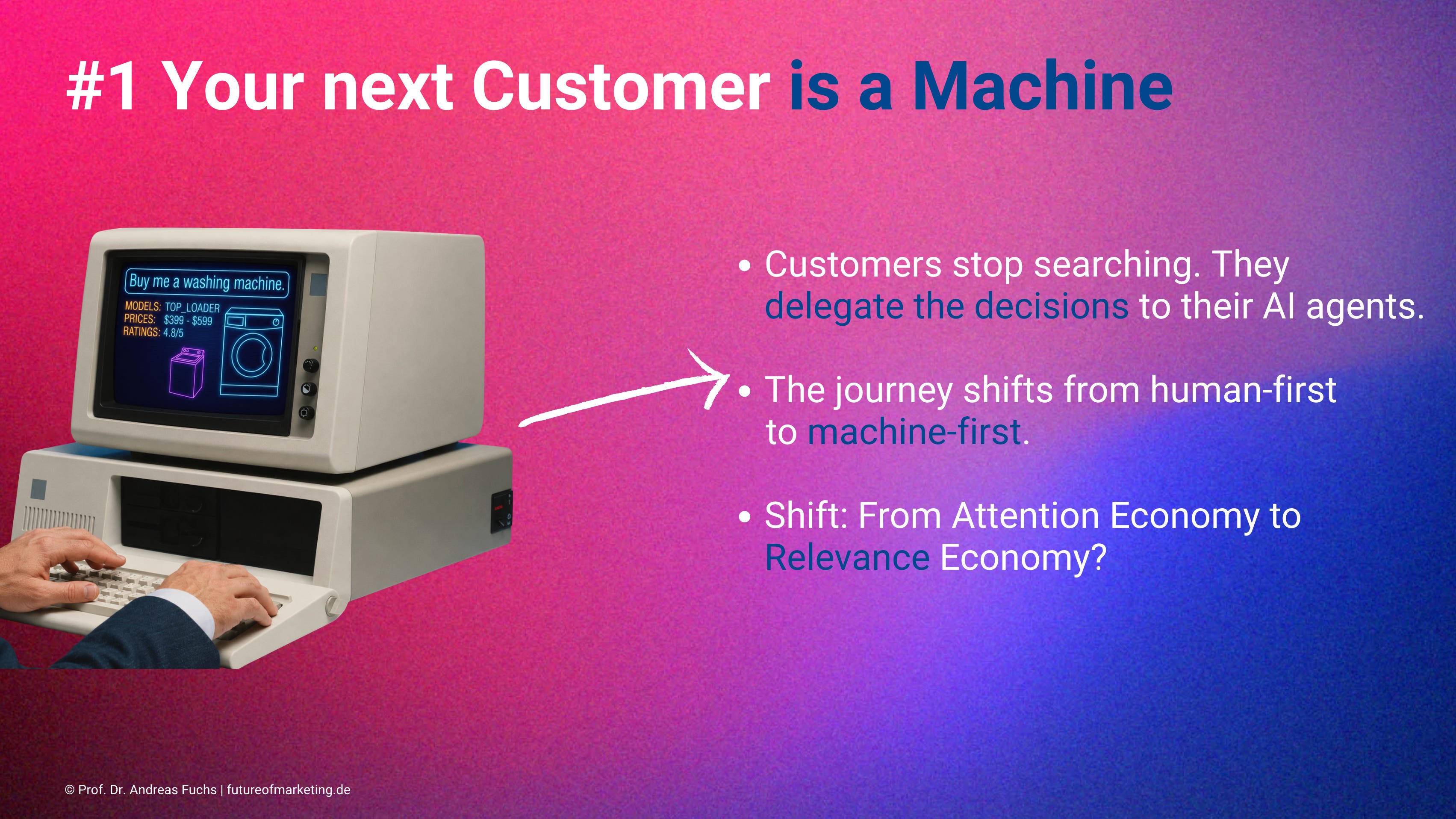
Customers are starting to stop searching. They delegate the decision to their own AI agents. The journey moves from human-first to machine-first, and the funnel collapses into the agent.
Think of it the way a billionaire shops. With thirty million in the bank, you wouldn’t compare washing machines or decode airline pricing yourself. Your butler would. Every customer is becoming Bruce Wayne. Not in money, but in delegation. The real privilege was never wealth. It’s the ability to delegate thought.
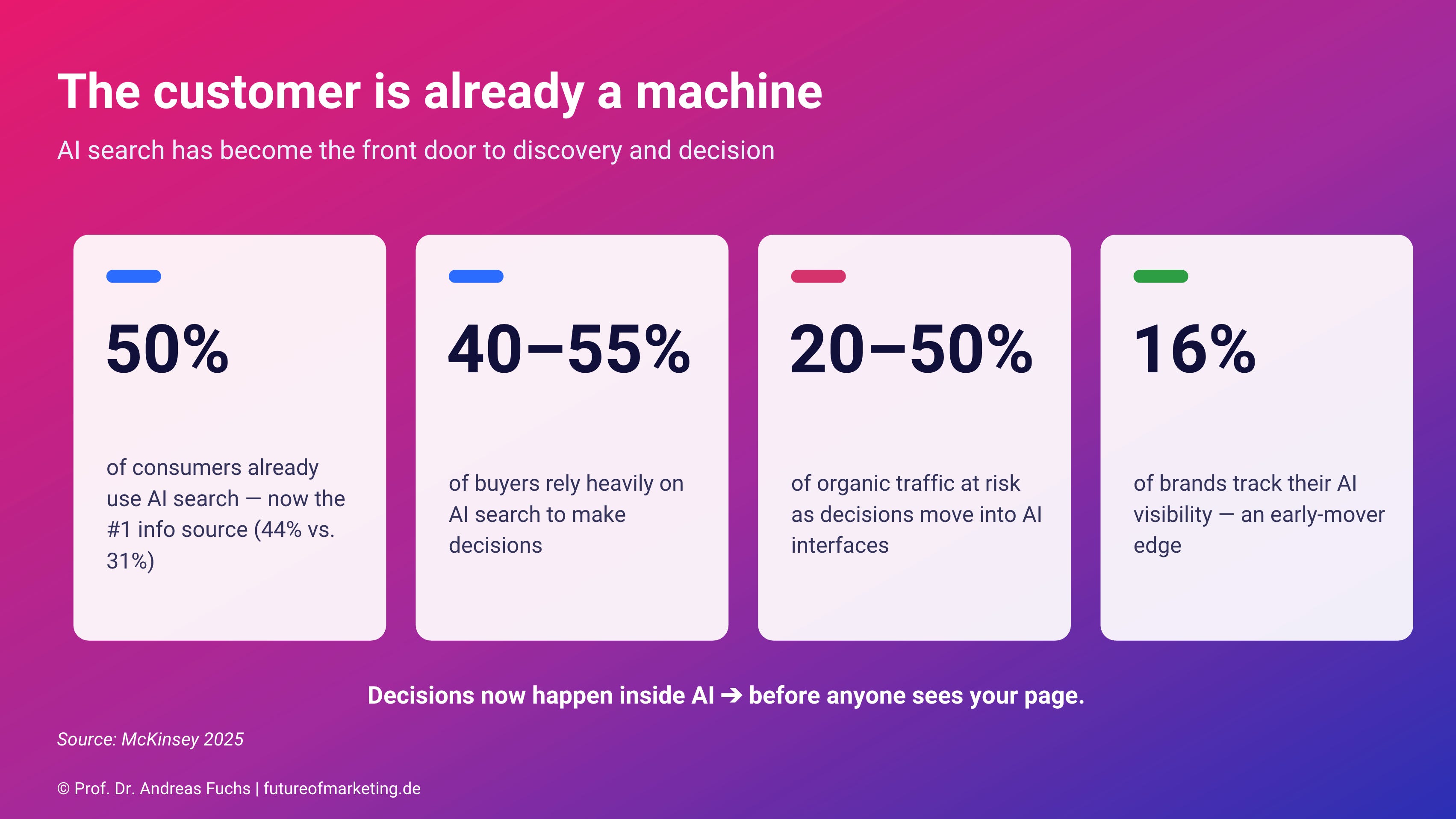
The data already points there. Around half of consumers use AI-powered search, which is now their most preferred digital information source, ahead of traditional search engines at 44 percent versus 31 percent (McKinsey, 2025). Between 40 and 55 percent of buyers rely heavily on AI search to make decisions, and 20 to 50 percent of organic traffic is at risk as decisions move into AI interfaces. Yet only 16 percent of brands track their AI visibility today (McKinsey, 2025).
Read that last number again. The shortlist is built before the customer ever lands on your page, and almost no one is measuring whether they make the list.
Here’s what that does to you as a brand. You’re now trying to court the VIP guests of a club you can’t get into. You printed the best flyers, prepared the sharpest arguments, and you never get past the doorman. The AI is the bouncer. It can’t be charmed, and the decision about which products even qualify happens out of sight, inside the model’s context window. The customer never sees the other ninety options.
And it gets harder. If your brand isn’t anchored deeply enough in the model, or the model doesn’t connect your brand to the problem it solves, you don’t rank low. You don’t exist. The human on the other side will never learn your product was even an option.
This forces a dual strategy. Build desire for humans. Deliver data for agents. You serve two worlds at once: the human funnel you already know, and the agent ecosystem forming around it. That means building trust signals into everything and making your brand machine-readable.
The operational response has a name. Generative Engine Optimization, the discipline of getting cited inside AI answers rather than ranked in a list of links (the GEO Playbook). It’s why visibility alone no longer wins customers, and why Share of Voice is quietly giving way to Share of Model (The Attention Economy Is Dead. Long Live the Relevance Economy). The deeper logic of how customers delegate, and what it does to brand building, I unpacked separately (Customer AI Agents in Marketing).
👉 Premium subscribers unlock the rest:
The four-quadrant model for sorting every marketing task into automate, scale, or protect
The three waves of AI adoption, and how to reach governed orchestration without the chaos in between
The Marketing Operating System blueprint that turns commodity agents into a real moat
Why brand stays the one advantage AI can’t copy, backed by the 2026 CMO data