

Everyone is talking about AI replacing jobs.
The panic version: millions of marketing roles will disappear overnight. The denial version: AI is just a tool, humans will always be in control.
Both are wrong.
And the reason both are wrong is the same: neither is based on data.
Last week, Anthropic published something genuinely rare in this debate. Not another thought piece. Not another prediction. A rigorous empirical study that measures what AI is actually doing in professional settings, right now, in real usage data (Massenkoff & McCrory, 2026).
The study covers the entire labor market. All occupations. From software developers to cashiers, from lawyers to agricultural workers.
I read it twice. And then I did what this newsletter exists to do: I took a broad, economy-wide study and ran it through a single lens.
👉 What does this mean specifically for marketing and sales?
Because buried inside a general labor market paper are findings that every CMO should be aware of. The strategic implications are more urgent than most organizations currently realize.
Why This Study Is Different
Most research on AI and labor markets measures what AI could theoretically do.
The standard approach, introduced by Eloundou et al. (2023), assigns each professional task a score based on whether an LLM could theoretically speed it up by at least 50%. This theoretical capability measure captures potential. But potential and reality are very different things.
Massenkoff & McCrory (2026) introduce something new: observed exposure.
The standard approach measures potential. Massenkoff & McCrory (2026) measure reality. They combine O*NET occupational data with real Claude usage data from the Anthropic Economic Index, weighting automated deployments more heavily than augmentative use, and work-related contexts more heavily than personal use.
The result is a measure that tracks the gap between capability and deployment.
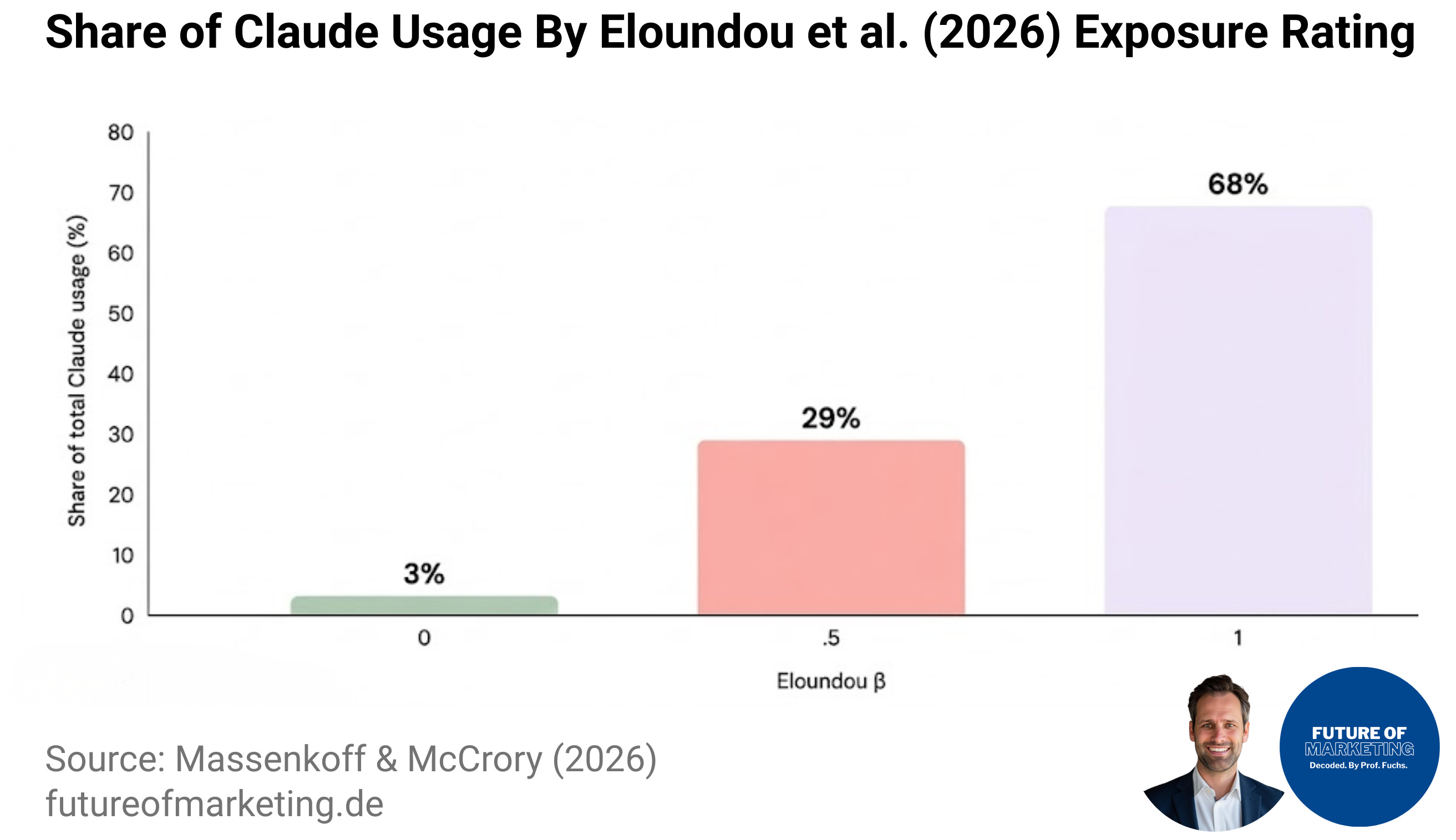
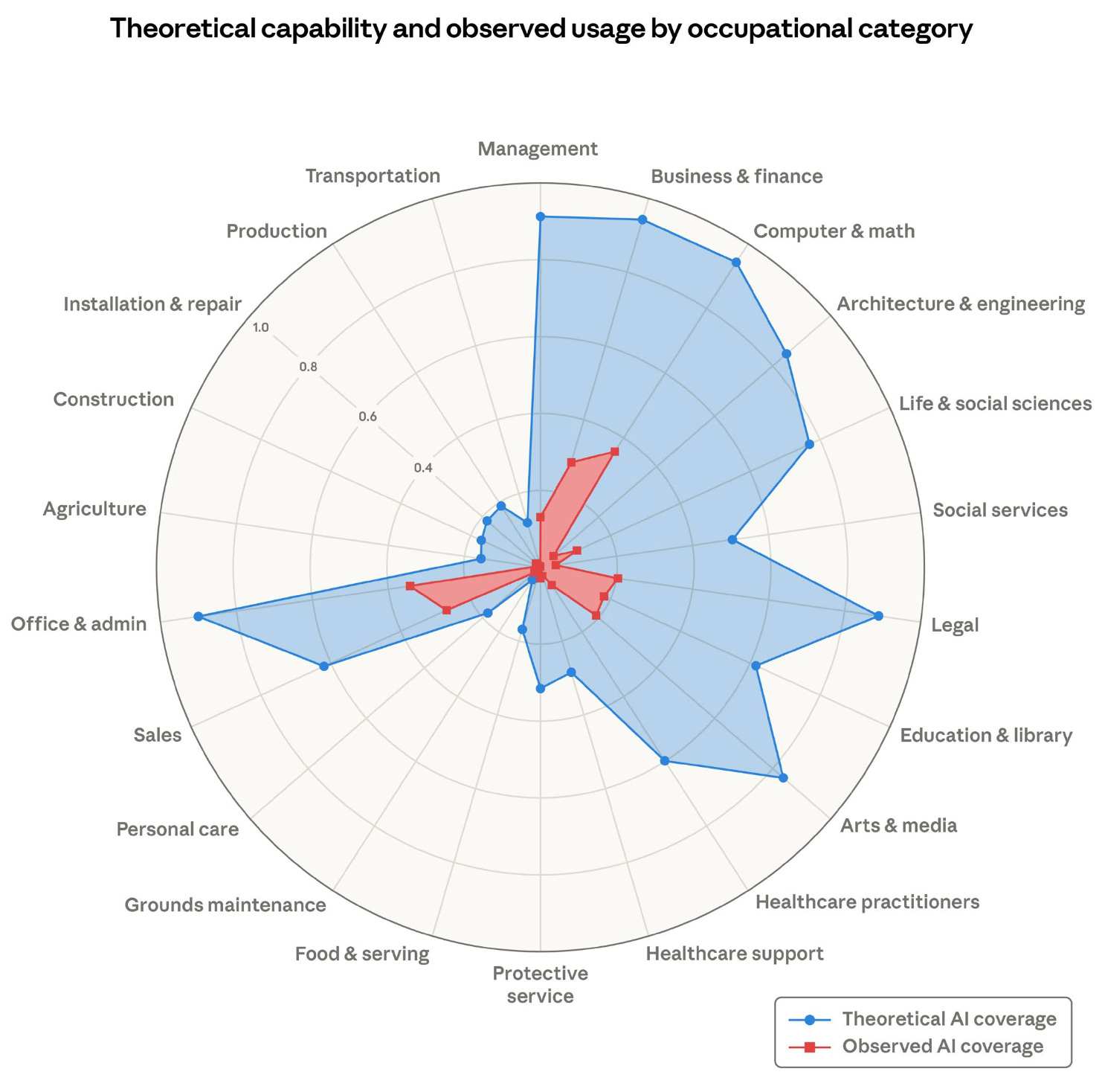
This distinction matters enormously. Because right now, AI is far from reaching its theoretical ceiling. Actual coverage remains a fraction of what is feasible. The gap between blue and red in the Anthropic data is wide.
But that gap is not permanent. It is a trajectory.
Three Marketing & Sales Roles Under Pressure
This is where the data gets concrete for our profession.
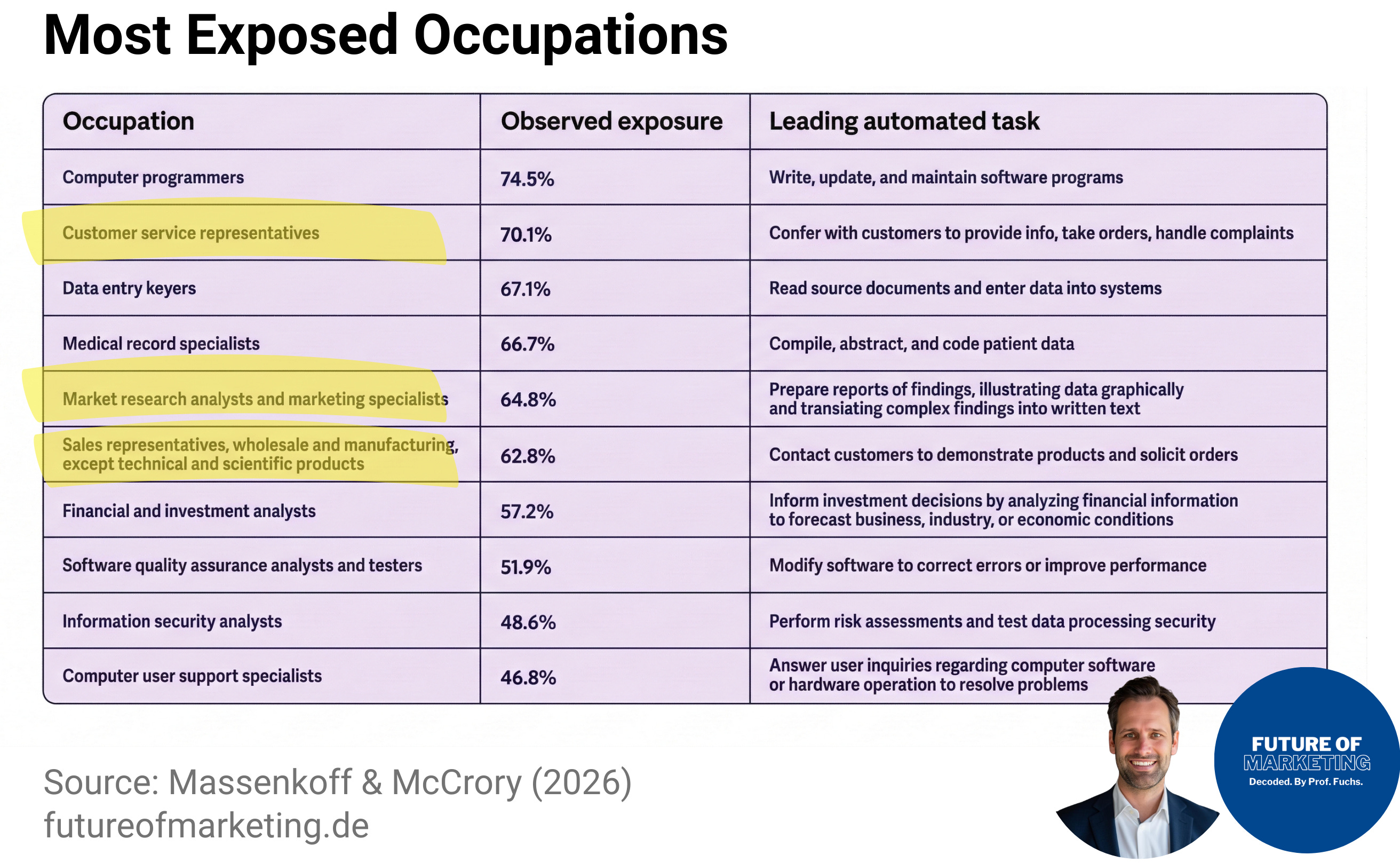
Massenkoff & McCrory (2026) identify the ten most exposed occupations based on observed exposure. Three of them sit directly in marketing and sales.
Let me take each of these seriously.
1. Customer Service Representatives: 70.1% observed exposure
The leading automated task: Confer with customers to provide info, take orders, handle complaints.
This is not a marginal task. This is the core function of the role. And Massenkoff & McCrory (2026) note that Customer Service Representatives rank second among all occupations precisely because their primary tasks are increasingly visible in first-party API traffic. Organizations are already deploying AI here at scale.
For CMOs, the relevant question is no longer whether this is happening. It already is.
What matters is whether customer service automation gets treated as an HR and operations decision, or as a brand decision. Every automated customer interaction is a brand interaction. The design of those systems, the handoff logic, the moments where humans take over, these are brand architecture decisions that fall squarely in the CMO’s domain.
2. Market Research Analysts and Marketing Specialists: 64.8% observed exposure
The leading automated task: Prepare reports of findings, illustrating data graphically and translating complex findings into written text.
Read that sentence carefully.
The most exposed task for this role is the translation of findings into written reports and visualizations. Not data collection, not statistical modeling. The output layer. The thing most marketing analysts spend the largest share of their time actually producing.
When that layer migrates toward automation, the value of the role shifts toward hypothesis generation, strategic framing, and judgment calls that require context no report can summarize cleanly.
Organizations that understand this will redesign these roles proactively. Organizations that do not will find themselves with roles that feel redundant before anyone formally decides to eliminate them.
👉 I wrote about which marketing roles are fading and which are emerging in an earlier essay: The Future of Marketing Roles: Emerging and Fading Jobs.
3. Sales Representatives: 62.8% observed exposure
The leading automated task: Contact customers to demonstrate products and solicit orders.
Outbound contact and product demonstration are high on the automation list. This does not mean that sales as a function disappears. It means that the entry-level and process-heavy components of the sales function are already being absorbed by AI systems in organizations that have chosen to deploy them.
The human value proposition in sales is shifting toward complexity resolution, relationship depth, and strategic account development. The transactional layer is leaving.
CMOs who own the marketing-sales interface need to factor this into how they think about pipeline architecture, lead handoff logic, and what kind of human touchpoints are worth investing in.
The Paradox: No Unemployment Spike, But a Hiring Freeze
Here is where the data gets genuinely surprising, and where intellectual honesty requires slowing down.
Massenkoff & McCrory (2026) find no statistically significant increase in unemployment among workers in the most exposed occupations since the release of ChatGPT in late 2022. None. The unemployment trends for exposed and unexposed workers have moved largely in parallel.
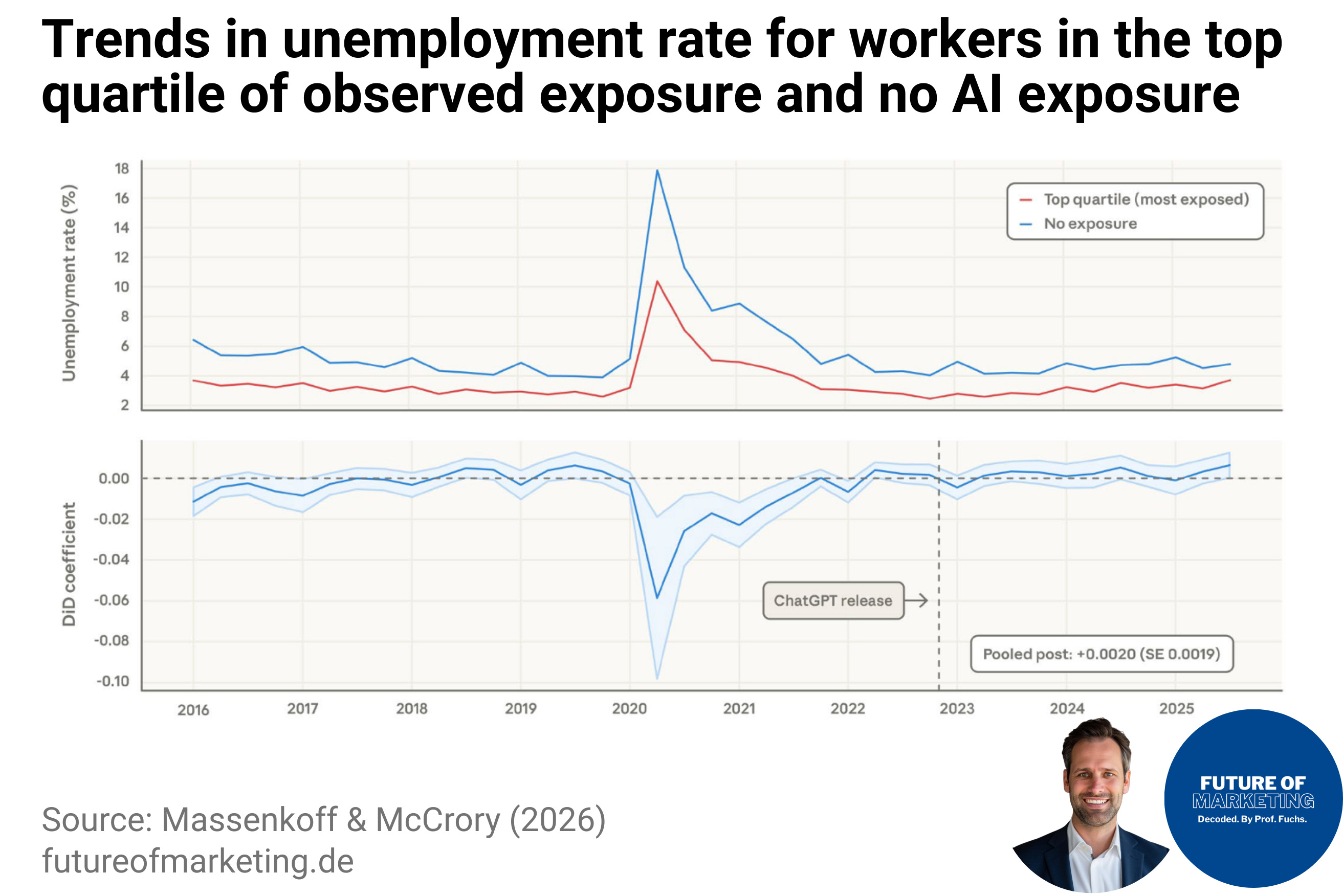
This is important. Anyone using this study to argue that marketing jobs are collapsing right now is misreading it.
But here is what the data also shows, and this is the part that matters most for CMOs thinking about talent architecture.
Among workers aged 22 to 25, there is a different story.
Massenkoff & McCrory (2026) find a roughly 14% decline in the job-finding rate for young workers entering highly exposed occupations, compared to the pre-ChatGPT baseline. The finding is barely statistically significant, but directionally consistent with Brynjolfsson et al. (2025), who report a 6 to 16% fall in employment in exposed occupations for the same age group.
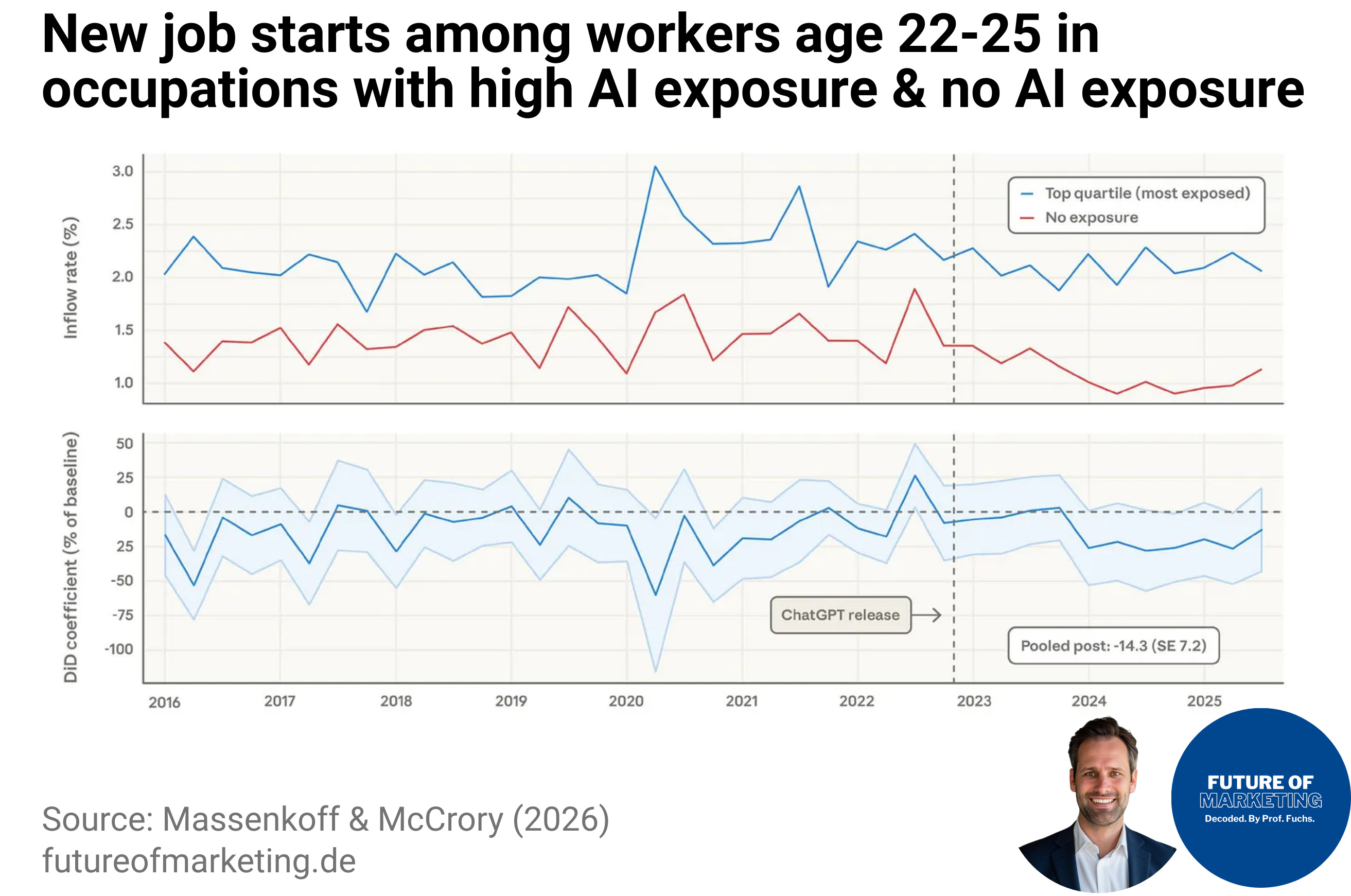
AI has not started firing people. But it has started not-hiring them.
The pipeline is quietly narrowing. Not through layoffs. Through a slowdown in the entry points. Young talent is being hired less frequently into the exposed roles. Whether because organizations need fewer junior positions, because the onboarding value of those roles has declined, or because the expected career trajectory has changed, the data does not say. But the direction is clear.
For CMOs, this is a talent pipeline signal, not a workforce crisis. The alarm is not ringing yet. But the pressure is building at the entry level.
And there is a second-order problem worth naming. If organizations stop hiring juniors into exposed roles, they also stop developing the next generation of senior marketers. The people who will eventually lead campaigns, run analytics teams, and own customer strategy are the juniors of today. Cut the entry point, and you cut the pipeline for the decade ahead. A profession that automates its own apprenticeship is making a bet it may regret.
The Gap That Defines the Next Two Years
Perhaps the most important visual in the entire study is Figure 2.
Source: Massenkoff & McCrory (2026)
Massenkoff & McCrory (2026) state clearly: as capabilities advance, adoption spreads, and deployment deepens, the red area will grow to cover the blue.
This is the most important sentence in the study for marketing and sales leaders.
The current calm in the unemployment data does not reflect the long-run trajectory. It reflects the early state of deployment. The technology is ahead of the organizational adoption curve. That gap closes over time. And the organizations that treat that gap as a permanent cushion will find themselves unprepared when it narrows.
There is a parallel here to the history of digital transformation. In 2005, the companies that understood what the internet would do to retail had a significant planning advantage over those that waited for the disruption to become undeniable. The disruption was already visible in the data. It just had not fully materialized yet.
We are in a similar moment now, at the task level, inside professional roles.
Three Strategic Lenses for CMOs
What should marketing leaders actually do with this data?
Not panic. Not ignore it. Think structurally.
Lens 1: Role Design
Which tasks inside your exposed roles are being automated in practice, not just in theory? The Anthropic data specifies the leading automated task for each occupation. That is the place to start, and the answer should drive role redesign before it drives headcount decisions. What remains when the report-writing and outbound-contact layers are automated? What grows in value? That is where you invest in capability development.
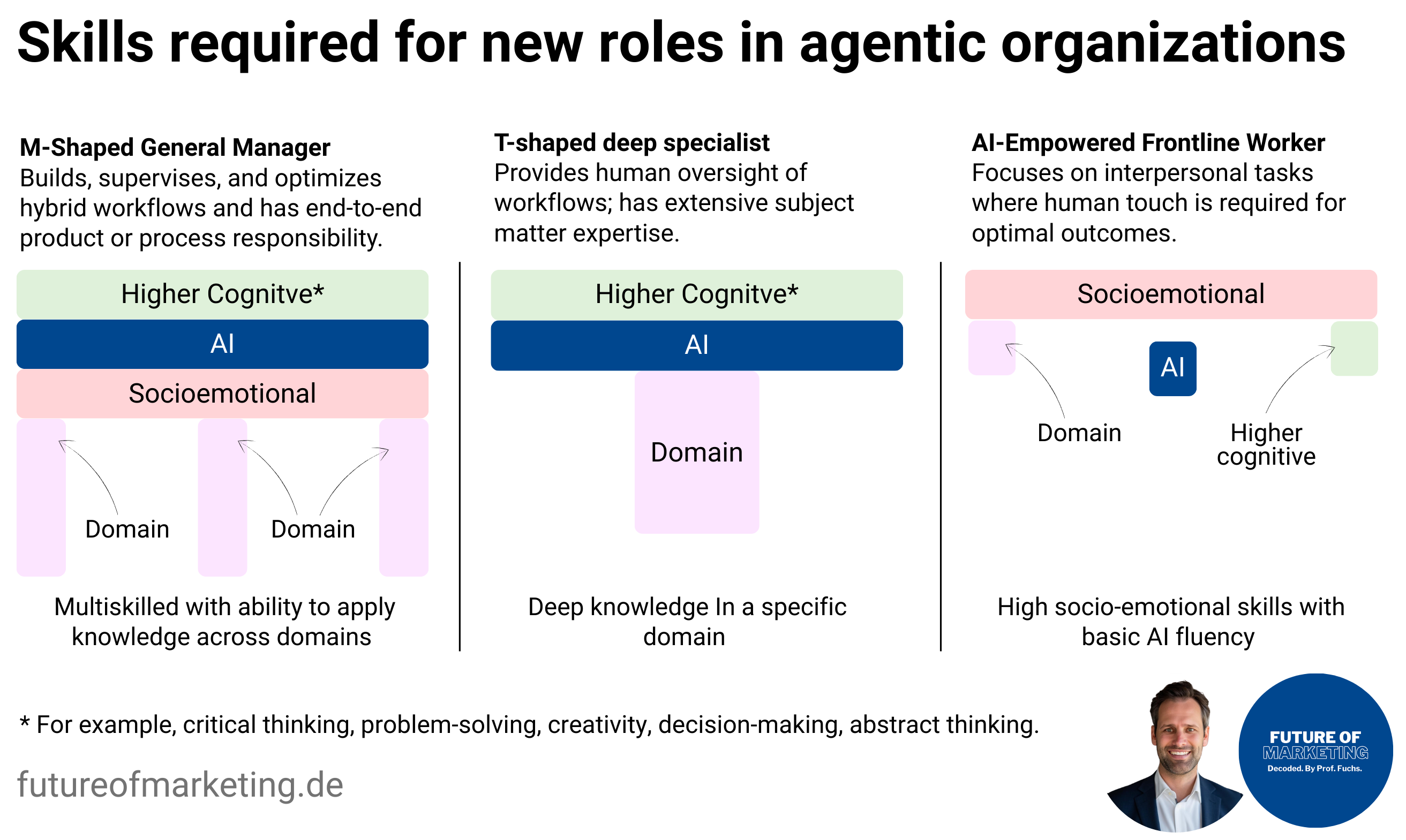
One useful framework for thinking through this comes from earlier research on agentic marketing organizations. As execution migrates toward AI systems, three distinct human positions emerge:
Source: Own visualization based on Sukharevsky et al. (2025).
The pattern across all three positions is the same: AI handles the execution layer, while humans own the higher cognitive and socioemotional layers that machines cannot replicate. For CMOs redesigning exposed roles, this is the directional logic. A Market Research Analyst who no longer produces reports still has a role — but it looks more like the T-Shaped Specialist than the execution-heavy position it was. A customer service function that automates routine interactions still needs AI-Empowered Frontline Workers for the cases that require human judgment, empathy, and relationship depth.
👉 If you want to think through how to redesign marketing work structurally, two earlier essays go deeper: Task-Driven, Agentic Marketing Organizations and Designing Human Work in Agentic Marketing Organizations.
Lens 2: Talent Pipeline Architecture
If junior hiring into exposed roles is already slowing across the market, your organization is making an implicit choice whether you recognize it or not. Better to make it deliberately. What does your entry-level marketing and sales talent pipeline look like in three years if outbound contact, report generation, and data-translation tasks continue migrating toward automation? What capabilities need to enter at a different point in the career arc?
Lens 3: Customer Experience Ownership
Customer Service Representatives are the second most exposed occupation in the entire economy. They are also the primary touchpoints of your brand experience for most customers. If those roles are being automated in your organization or in your competitors’ organizations, the experience design questions that used to live in operations now belong to marketing leadership. Who decides where the AI stops and the human begins? Who owns the brand implications of that boundary? That is a CMO question.
👉 For a practical look at how marketing teams are already working with AI tools in their daily workflows, see: Claude Cowork for Marketing.
What the Data Actually Says
The Anthropic study does not tell us that marketing jobs will disappear.
It tells us something more specific and more useful: the tasks inside those jobs are already changing in the organizations that are deploying AI at scale. The unemployment data has not moved yet. But the hiring data for young workers has. And the theoretical capability that has not yet been deployed is still sitting in the gap between blue and red on that radar chart, waiting for the next capability jump, the next deployment cycle, the next organization that decides to move.
The companies that are designing for that future now, at the role level, at the talent pipeline level, at the brand experience level, will be in a fundamentally different position when the gap narrows.
The companies that wait for the unemployment data to tell them something has changed will be two years behind.
That is not a prediction. That is what the data already shows.
Yours,
Prof. Dr. Andreas Fuchs 🦊🎓
References
Brynjolfsson, E., Chandar, B., & Chen, R. (2025). Canaries in the coal mine? Six facts about the recent employment effects of artificial intelligence. Digital Economy.
Eloundou, T., Manning, S., Mishkin, P., & Rock, D. (2023). GPTs are GPTs: An early look at the labor market impact potential of large language models. arXiv. https://arxiv.org/abs/2303.10130
Massenkoff, M., & McCrory, P. (2026, March 5). Labor market impacts of AI: A new measure and early evidence. Anthropic. https://www.anthropic.com/research/labor-market-impacts